

Today’s construction industry is no longer just about moving dirt. More companies are aligning with emerging Construction Trends, focusing on how to connect data with what’s happening on-site. The old “learn as you go” approach is risky and often leads to losses. Material costs are rising, global supply chains are unstable, and projects are more complex than ever. The old way of doing things just doesn’t work anymore.
By 2026, the industry hits a key turning point. This is when government policy, jobsite technology, and economic pressure all come together:
- Many projects funded by the Infrastructure Investment and Jobs Act (IIJA) are moving into the final stages.
- Workers are now more comfortable using digital tools.
- Costs are rising—high inflation and changing tariffs are squeezing profit margins.
Because of this, digital transformation is no longer just a buzzword. It directly affects whether a company makes money or not. A jobsite is no longer just a piece of land—it’s becoming a connected, data-driven system.
KEY TAKEAWAYS
- Digital Twins Help You See Problems Before They Happen
- Modular Buildings(Temporary Structures) Are Becoming More Valuable
- Data is Changing Insurance Risk and Pricing
- Federal Funding Is Driving a More Tech-Focused Future
- Protecting Both Physical and Digital Safety on the Jobsite
- Smart Maintenance for Aging Infrastructure
Digital Twins Help You See Problems Before They Happen
One of the biggest changes in 2026 is the fast growth of digital twins. According to ITS America, a digital twin is more than just a 3D model.
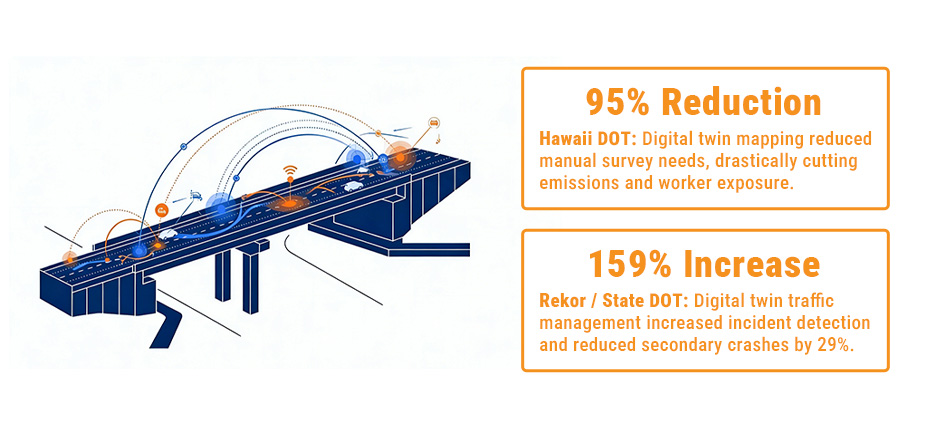
Simply, a digital twin is a virtual copy of real equipment or projects, connected in real time. It doesn’t just show what a bridge looks like — it shows its current condition. You can see if it’s under stress, has small deformations, or is aging.
The biggest value of digital twins is simple: See the outcome before you act. You can test new lane designs or bridge repairs in the digital model before you even move a crane. You build only after confirming everything works, avoiding costly mistakes. For example, TxDOT used this technology and cut expensive project change costs by 40%.
To make this work, construction equipment is getting an upgrade. Today, many machines act as mobile data collectors. Machines with sensors, LiDAR, and 360° cameras gather field data and build a digital model. Data also comes from the infrastructure itself and even traffic systems, creating a complete 2D and 3D model.
Many DOTs now follow a simple 5-step approach:
- Use flexible, data-driven workflows instead of fixed long-term plans
- Focus on key assets like pavement and cables
- Be clear on the goal—safety, incident response, or maintenance planning
- Build a GIS map so data can move both ways
- Use mapping vehicles to collect real-world data
What’s the Difference Between a Digital Twin and BIM?
The main difference is: whether there is real-time, two-way data flow.
- BIM (Building Information Modeling) is like a very detailed digital blueprint. It’s very useful during design and construction, but after the project is finished, it’s rarely updated. It’s mostly used for viewing and reference.
- A Digital Twin is different. It’s a “living” system. It keeps running in a loop: measure → real asset → digital model → back to the real world. Sensors on site keep sending data to the model. The model updates in real time, and then you use it to guide what to do in the real world.
So the difference is:
- BIM: more static, mainly used for design and construction.
- Digital twin: always updating, used for long-term monitoring and improvement.
Modular Buildings (Temporary Structures) Are Becoming More Valuable
RMB is becoming a strong trend in the industry. In the past, people saw relocatable buildings like portable classrooms as something that loses value over time. But by 2026, that view has changed. Relocatable Modular Buildings (RMBs) are now gaining value—this is the “RMB paradox.” They’re widely used, from about 200,000 portable classrooms in North America to pop-up clinics. Today, they’re no longer one-time-use units, but long-term assets.
RMBs are more valuable mainly because of cost pressure and standardization. In 2024, resale values jumped by 143%. The reason is simple: traditional construction is getting more expensive. As new builds cost more, high-quality used modular units become more valuable. At the same time, RMBs are built in factories with standard parts like HVAC and electrical systems. This makes installation faster and repairs easier, with less downtime.
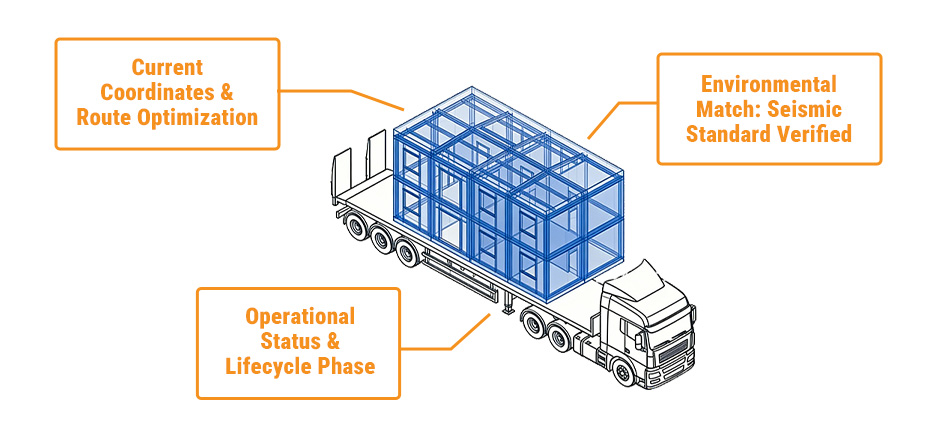
But RMBs also have a clear problem: data gets lost. A study from Hanyang University shows that contractors often work short-term. When buildings move from place to place, important data can be lost—like condition, location, and maintenance history. Without this info, it’s harder to manage and maintain the units.
The next step is to manage RMBs with digital twins. The industry needs to track these buildings through their full lifecycle. Digital twins can record everything—from production to use to relocation. This helps keep full records and turns RMBs into assets that are easier to manage and keep their value over time.
Data Is Changing Insurance Risk and Pricing
By 2026, risk management will no longer be stable. Things change fast. In 2025, nonresidential construction costs went up by 4.4%. Tariffs can add another 9%. This makes project budgets hard to control. For insurers, claims now cost 20%–30% more than a few years ago.
This is pushing the industry to change. More projects are moving from fixed-price contracts to cost-plus models. Also, more owners are buying key materials themselves. For example, they may purchase switchgear or bridge parts early. This helps avoid tariff spikes and reduces risk for contractors.
Insurance companies are also changing how they look at risk. They don’t just check past accident records anymore. They care about data, control, and transparency. If you can show strong cost control and good safety practices, you’re more likely to get better rates.
Think of it like car insurance. Safe drivers usually pay less. It’s the same in construction. A strong safety culture can now be measured. For example, one contractor kept their premiums stable just by adding a daily “stretch and safety” routine. It’s simple, but it reduces injuries and shows insurers they take safety seriously.
Federal Funding Is Driving a More Tech-Focused Future
Federal funding is helping infrastructure projects move into the build and finish stage. Many projects funded by the IIJA (Infrastructure Investment and Jobs Act) are starting to finish in 2026. The law totals $1.2 trillion. Port of Monroe in Michigan is one example. It received $11 million for upgrades and $24 million for an underpass. This shows federal money is being used to solve real local needs.
These projects are starting to include more new technology during construction. The underpass is expected to be completed this year. It will fix a long-time issue where trains cut through parts of the community and slow down freight. Once finished, traffic will flow better and logistics will be more efficient. The project also uses new tech, like renewable-energy containers and bridge parts with sensors that can monitor structural health in real time.
More advanced technology is moving from testing to real-world use. As these projects are completed, tools that were once only used in small tests are now being used more widely. Early trials at ports and underpasses have shown they can improve efficiency and help connect communities better.
Protecting Both Physical and Digital Safety on the Jobsite
More devices mean more risk on digital jobsites. By 2026, jobsites have more sensors, tablets, and connected tools. A jobsite is no longer just a physical place. It’s a connected network. Each mobile mapping unit or sensor can be a possible entry point for cyberattacks.
Insurance companies now include cybersecurity in risk and pricing. Underwriters check how well a company is prepared for cyber risks. A digital attack, like ransomware on a project system, can cause major losses. Because of this, good cybersecurity can directly affect insurance costs.
Data can also help prevent physical problems. Some contractors use existing sensors to monitor conditions. For example, if a power room gets too hot, the system can send an alert. The team can check the cooling system early and fix issues before damage happens.
Smart Maintenance for Aging Infrastructure Can Deliver Huge Returns
Data-driven methods are very useful for infrastructure maintenance. A good example is the I-90 floating bridge in Washington state, a project by WSDOT and the University of Washington. Engineers use a tool called Paradim to view a 3D model of the bridge and monitor the condition of its support cables in real time. These live data help them maintain the bridge more accurately and spot issues earlier.
Proactive monitoring can reduce costs and deliver high returns. By using sensor data to extend the life of the cables, the ROI can reach up to 2000%. The key is to catch problems early and avoid replacing major parts too soon, which saves a lot of money.
Digital twins also improve incident response and daily operations. Data from Rekor shows a 159% increase in incident detection and a 29% drop in secondary crashes. Hawaii DOT also found that field surveys can be reduced by up to 95%. These changes show how infrastructure management is being transformed.
Conclusion
Digital twins, modular construction, and connected sensors are quickly becoming the new normal in the industry. Technology is a part of the project itself. In today’s fast-changing world, embrace data and cutting-edge tech to get ahead, or stick to old ways and risk getting left behind?
At FridayParts, we work with construction equipment every day, and we’re right there feeling these construction trends. Excavators, bulldozers, loaders, and other machines are becoming more connected and data-driven than ever. That means demand for reliable parts is higher than ever, too. We’ve been keeping up with this trend, focused on providing high-quality replacement parts.
