

When one of our off-road machines starts losing pull, smoking more than usual, or struggling to keep hydraulics responsive under load, we don’t have time for forum arguments—we need a clear choice that protects uptime and keeps repairs predictable. This guide compares 12v vs 24v Cummins engines (the 5.9L inline-six family) from an off-road machinery owner’s angle: what changed, what tends to fail, what the power numbers really mean in the dirt, and how we choose the right version for our work cycle.
About the 12V Cummins Diesel Engine
“12V” means two valves per cylinder (12 valves total on a six-cylinder). In the 5.9L Cummins lineup, the 12-valve version is commonly referred to as the 6BT. Based on the provided reference timeline, it powered applications through mid-1998, with a notable update wave around 1994 driven by tighter diesel emissions requirements.
What matters for off-road machinery?
In real off-road use, 12-valve engines tend to be valued for two reasons:
- Mechanical fuel control (minimal electronics compared with later versions)
- Straightforward troubleshooting when you’re working in the field with limited diagnostic tools
That “simple” reputation is most useful when:
- Our machines run far from a shop
- You need dependable starts and steady fueling
- You want repairs that can be done with common tools and solid mechanical checks
Power
The reference data shows early 12-valve output around 160 hp and 400 lb-ft. After the 1994-era updates, power rose. By the end of the 12-valve era, output reached:
- 180 hp / 420 lb-ft (automatic-equipped setups)
- 215 hp / 440 lb-ft (manual-equipped setups)
For off-road owners, the key point isn’t “manual vs automatic”—it’s that later 12-valve calibrations had noticeably higher peak output than the earliest ones.
Known reliability concern to plan for
A widely known issue across many 5.9L engines (12-valve and early 24-valve up to a certain point) is the killer dowel pin. It’s an alignment dowel at the front cover area that can work loose over time and fall into the front gear train. Best case, it drops harmlessly; worst case, it causes major internal damage.
For an off-road fleet, this is a big deal because it’s a low-cost prevention step compared to catastrophic gear damage.
About 24V Cummins Diesel Engine
“24V” means four valves per cylinder (24 total). In the reference timeline, the 24-valve version is commonly referred to as the ISB and replaced the 12-valve in mid-1998, lasting through 2007 in the 5.9L era described.
The real change: electronics and fuel system evolution
The 24-valve era matters to off-road machinery owners because it introduced electronic control of the fuel system (starting in the first 24-valve generation). Later, in 2003, the reference notes a move to a common-rail style fuel injection system. Additional changes occurred mid-2004, including injector updates and an electronically controlled wastegate turbo arrangement—driven again by emissions tightening.
What this means in practical terms:
- Better control of fueling and timing (often smoother operation)
- More sensors and control logic to keep healthy
- More dependence on clean fuel and stable supply pressure
Power
Right away, the 24-valve came in stronger than the 12-valve at launch:
At introduction (mid-1998): 215 hp / 420 lb-ft (automatic-equipped setups) and 235 hp / 460 lb-ft (manual-equipped setups)
The highest output 5.9L engines in the provided text are the late 24-valve (mid-2004 to 2007): 325 hp / 610 lb-ft
For off-road work, that extra torque can translate to:
- Less bogging when hydraulics spike (lifting, pushing, drilling, mulching, pumping)
- Better ability to hold RPM under sustained load (if cooling and fueling are right)
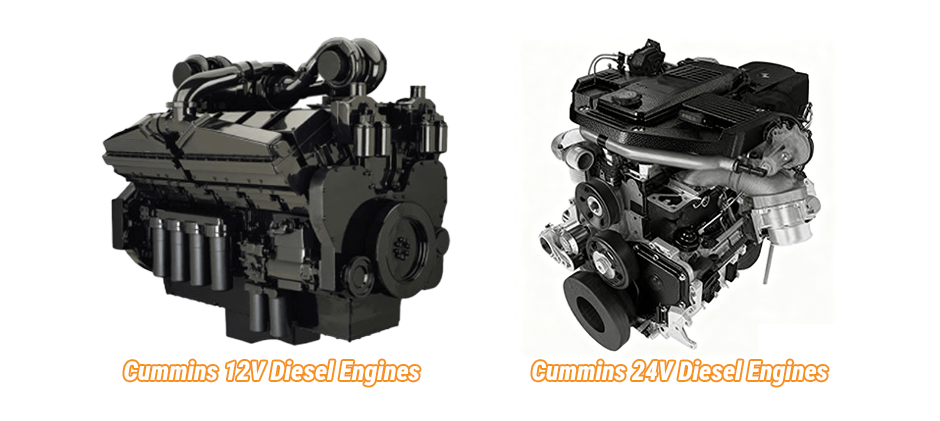
12V vs 24V Cummins: What are the Differences?
This is where the 12v vs 24v Cummins decision becomes clear. Valve count is part of it, but for off-road equipment owners, the bigger differences are fuel control style, failure risks, and how the engine behaves under hydraulic load.
1) Valvetrain and airflow
- 12V (2 valves/cyl): simpler head design, typically associated with a more mechanical “work engine” feel
- 24V (4 valves/cyl): improved airflow potential; paired with later fuel control changes, it supports higher factory output
In practice, airflow differences matter most when:
- You run high load for long stretches
- You need stable power across a working RPM band, not just a peak number
2) Fuel system control and troubleshooting style
- 12V: mechanical fueling—often easier to diagnose with mechanical checks (fuel supply, timing, injectors, boost leaks)
- 24V: electronic fuel control starting in the first 24-valve generation; later common-rail (from 2003 per the reference)
For off-road owners, this changes the support plan:
- With a 12V, you can often narrow down issues without scan tools
- With a 24V, you may troubleshoot faster if you have proper diagnostics and electrical health (grounds, harness condition, sensor integrity)
3) Known reliability flags
Killer dowel pin (KDP):
- Mentioned as affecting 12-valves and 24-valves up to 2002
- Risk: can come loose and damage the front gear drive
“53 block” cracking risk:
- The reference highlights certain 1999–2002 24-valve castings with “53” marking as more prone to cracking
- Outcome: coolant leakage; repair can require welding or replacement
What you do with that info:
If you’re shopping or planning a repower for off-road use, you don’t just ask “12V or 24V?”
4) Power and torque in a work context
Peak numbers are helpful, but off-road machines live by load response. The engine is feeding a hydraulic pump, and the pump is feeding cylinders/motors.
A simple way to think about it:
- Engine torque + RPM → pump flow/pressure potential
- Pump efficiency → how much of that becomes real work
- Motor/cylinder condition → whether the machine actually moves/lifts as expected
So if our excavator, loader, or power unit feels weak, you should confirm whether the limiting factor is the engine or the hydraulics.
Summary Table
| Category | 12V (6BT, through mid-1998) | 24V (ISB, mid-1998 to 2007) |
|---|---|---|
| Valves per cylinder | 2 | 4 |
| Fuel control (by era) | Mechanical | Electronic control introduced; common-rail noted from 2003 |
| Factory-era output (from provided content) | ~160 hp/400 lb-ft early; up to 215 hp/440 lb-ft later | 215–235 hp at launch; up to 325 hp/610 lb-ft late (mid-2004–2007) |
| Key reliability flags mentioned | KDP risk | KDP risk up to 2002; “53 block” cracking risk (1999–2002) |
| Best fit (typical off-road logic) | Remote work, simpler field diagnosis | Higher factory output, better controlled fueling (with stronger diagnostics needs) |
Which Diesel Engine is Right for You?
There’s no universal winner in 12v vs 24v Cummins. The “right” engine is the one that matches our workload, our maintenance setup, and our tolerance for electronics.
Step 1: Match the engine to the duty cycle
You can usually decide quickly by grouping our work into one of these patterns:
1. Long, steady load:
Examples: pumping, continuous material handling, sustained hydraulic drive, and high utilization.
- You prioritize cooling capacity, stable fueling, and parts availability.
2. Frequent load swings:
Examples: loading cycles, lifting and travel, intermittent heavy pulls.
- You prioritize response, clean fuel delivery, and easy troubleshooting.
3. Remote operations:
Examples: forestry, remote excavation sites, spread-out farms.
- You prioritize simplicity and predictable repairs.
Step 2: Don’t ignore the hydraulic side
If the machine feels weak, the engine may not be the main problem. Worn or inefficient hydraulic components can mimic engine problems:
- Slow boom or bucket cycles
- Weak travel torque
- Overheating hydraulic oil
- Noisy pumps or motors
- Loss of control precision
From the FridayParts hydraulic category overview: hydraulic pumps convert engine mechanical energy into hydraulic energy, while hydraulic motors convert that fluid energy back into mechanical motion (wheels, tracks, conveyors). System efficiency affects productivity, fuel use, and control.
That’s why an engine decision and a hydraulic inspection should happen together.
Mid-article parts planning:
If you’re troubleshooting low performance and you suspect the hydraulics (not just the engine), it helps to line up replacement pumps, motors, or seal kits before teardown. FridayParts lists hydraulic pumps and motors (gear, piston, tandem) plus motors (gear, piston, gerotor) and related repair components, with units tested for flow rate, torque output, and pressure tolerance. Here’s the parts page: Cummins parts.
Step 3: Practical recommendations
When you’d lean toward a 12V:
- You want a more mechanical setup with fewer electronic dependencies
- You operate in places where diagnosing electronic faults is harder
- You’re comfortable doing preventative work like addressing the KDP risk during front-cover service
When you’d lean toward a 24V:
- You want higher factory output potential (especially later 24V variants)
- You can support electronics (good batteries, solid grounds, protected wiring, diagnostic tools)
- You’re careful about the known 1999–2002 “53” casting risk and the KDP window up to 2002
If power is the main goal, using only the provided data:
The highest factory-rated outputs in the content are the mid-2004 to 2007 24-valve engines (325 hp / 610 lb-ft).
Step 4: Build a downtime-proof plan
Regardless of which side of 12v vs 24v Cummins you choose, you protect uptime with a short checklist:
- Keep cooling stacks clean (dust and chaff are silent killers)
- Protect wiring and connectors from vibration rub points (especially on electronic fuel control setups)
- Maintain clean fuel and proper filtration (critical for all high-pressure systems)
- Check hydraulic oil condition and filter health
- Test hydraulic pump flow/pressure when performance drops (don’t guess)
FAQs
1) What does “12V” vs “24V” actually mean?
It’s the number of valves in the 2-cylinder head. A six-cylinder with 2 valves per cylinder is a 12-valve; 4 valves per cylinder is a 24-valve.
2) Which one is more powerful from the factory?
Based on the provided reference numbers, late 24-valve 5.9L engines (mid-2004 to 2007) are the highest listed at 325 hp and 610 lb-ft. Earlier 12-valve engines ranged from about 160 hp / 400 lb-ft to as high as 215 hp / 440 lb-ft by the end of that era.
3) What reliability problems should off-road owners watch for?
From the provided content:
- Killer dowel pin risk on 12-valves and 24-valves up to 2002
- “53 block” cracking risk on some 1999–2002 24-valve engines (coolant leaks)
4) Are later 24-valves more reliable than earlier ones?
The reference suggests that by “process of elimination,” 2003–2007 24-valves come out on top, with a note that 2003 can have some “newness” issues. Practically, later systems can also mean more components to maintain, so support and maintenance habits matter.
5) For off-road machinery, should you focus more on engine choice or hydraulics?
Both. The engine sets the power source, but hydraulics decide how much work reaches the ground. If our machine is slow or weak, we should confirm the hydraulic pump/motor condition and system pressure/flow before blaming the engine.
Conclusion
The 12v vs 24v Cummins choice is less about valve count and more about how we run our off-road machines. The 12V favors mechanical simplicity and field-friendly diagnosis, while the 24V brings electronic fuel control and, in later years, much higher factory power. Reliability planning matters on both, especially the killer dowel pin window and the 1999–2002 “53” casting risk. The best pick is the one we can support with clean fuel, cooling, and parts access.
