

Picking the right forklift size is usually not about “bigger is better”—it’s about fitting your site, your load, and your service plan without wasting money or risking tip-overs. We built this 2026 guide to help you compare forklift sizes and forklift dimensions, measure the numbers that actually matter on off-road jobsites, and choose a machine that can work safely in yards, farms, construction areas, and rough ground.
What to Consider When Choosing a Forklift Size?
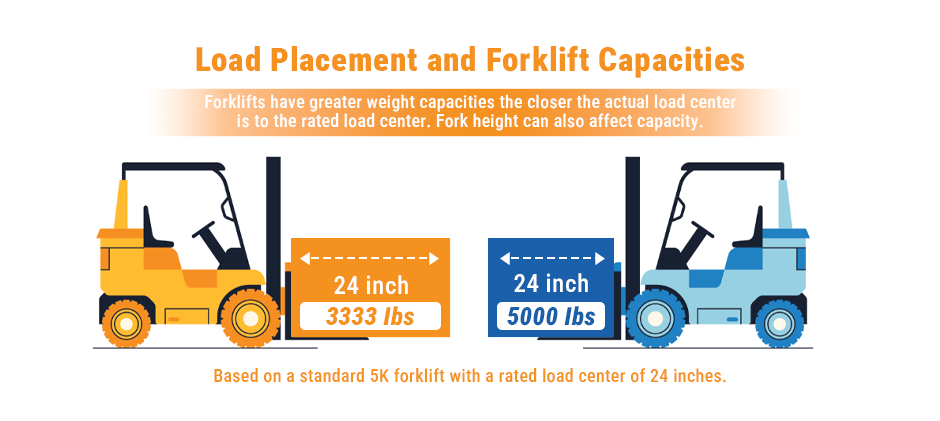
1) Load capacity is not just “weight.”
Capacity is tied to the load center (how far the load’s center of gravity sits from the fork face). On off-road sites, loads are often awkward: bundled lumber, pipe, stone pallets, fence posts, engines, or irregular crates. Even if the load weighs the same, a longer load or one sitting forward reduces safe capacity.
What to check before choosing a size:
- Heaviest load you will lift (not your average day)
- Load length/depth (long loads push the center of gravity forward)
- Lift height needed (capacity can drop as height increases)
- Attachments (fork positioners, clamps, booms) that add weight up front
2) Site fit: the “real” forklift dimensions you’ll fit every day
Off-road machinery owners often focus on lift height and forget basic fit. A forklift can have plenty of capacity yet still be a bad match if it cannot clear a gate, trailer, canopy, or tight turning area.
Key forklift dimensions to measure on your site:
- Overall width (gate openings, trailer ramps, work zones between stacks)
- Overall length (turning in tight pads, backing around obstacles)
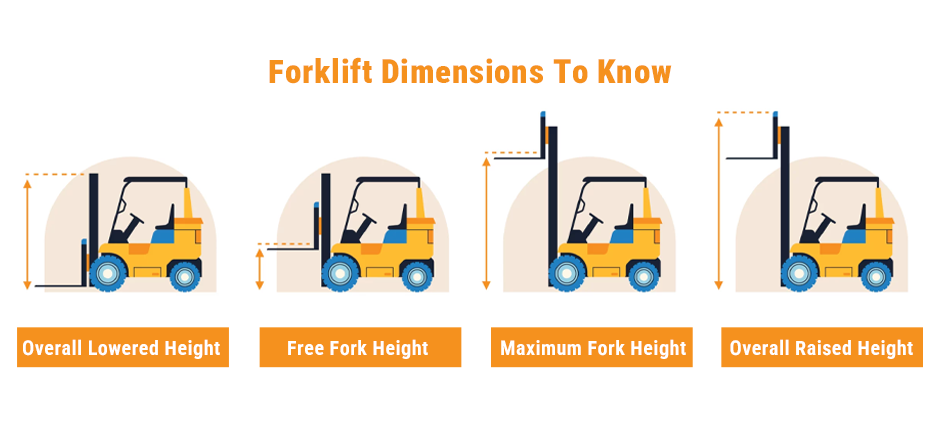
- Mast lowered height (carports, barns, sheds, low beams, trailers)
- Mast raised height (tree limbs, roof lines, temporary structures)
- Ground clearance (ruts, gravel piles, uneven pads)
3) Stability and terrain
Uneven ground changes everything. A forklift that feels stable on a slab can get sketchy on gravel, mud, or crowned surfaces. Wider stance and pneumatic tires help, but they also increase forklift sizes and turning space.
Terrain-driven factors that push you toward a different size/class:
- Pneumatic tires vs. cushion tires
- Wheelbase length (longer can feel steadier, but turns wider)
- Center-of-gravity changes during travel on slopes
- Wind exposure when moving tall loads outdoors
4) Maneuverability: turning radius and “right-angle stacking.”
If the jobsite has narrow lanes between stacks, you’ll care about turning radius and right-angle stacking width (the space needed for a 90-degree turn to place a load). On outdoor yards, this often shows up around container doors, trailer sides, and tight staging areas.
A simple rule that helps with planning:
- Right-angle stacking width + load length + 12 inches (clearance buffer)
5) Transport and storage limits
Off-road forklifts often get hauled. If you move equipment between properties or projects, transport limits matter:
- Trailer deck length vs. forklift length
- Ramp angle vs. ground clearance
- Tie-down points and travel height
- Storage door height with mast lowered
Forklift Dimensions by Type
Forklift sizes vary a lot by type. Below are typical ranges you’ll see in the field. Always check the spec sheet for the exact model, mast, and tire package.
Quick comparison table
Rough-terrain straight mast forklifts
These are the go-to for uneven ground. Forklift dimensions trend wider with larger tires and higher ground clearance. That extra width helps stability, but it demands more room around stacks and trailer doors. If loads are heavy and the ground is not flat, the wider stance is often worth the space.
Watch-outs:
- Wider turning path in tight staging
- Higher step-in height (operator access)
- Tire wear and steering components take a beating on rock and gravel
Telehandlers
A telehandler often solves the “reach” problem: loading high-sided trailers, placing pallets deeper into a stack, or setting materials over obstacles. Forklift sizes here can get long fast. That length can be a deal-breaker if you’re working inside fenced compounds or narrow farm lanes.
Best reasons to size up into a telehandler:
- Need lift height far beyond a standard mast
- Need forward reach, not only vertical lift
- Need to place loads on slopes with careful positioning (still requires safe practices)
Pneumatic-tire counterbalance forklifts
These can be a practical middle ground for off-road machinery owners who work on mixed surfaces but don’t need full rough-terrain capability. Dimensions are often closer to “standard” forklifts, with better outdoor traction than cushion-tire units.
Typical jobs:
- Loading supplies at a jobsite
- Yard staging on packed gravel
- Moving pallets between storage and trucks
Electric counterbalance forklifts
Electric units can work well on smooth pads and under canopies. For off-road operations, the biggest size questions are often battery/voltage configuration (36V/48V/80V systems) and duty cycle, not just width and length. If your forklift is electric and downtime is expensive, parts access matters as much as dimensions.
How to Choose the Right?
Step 1: Measure your “pinch points” first
Before comparing spec sheets, measure the places you must pass through:
- Narrowest gate/opening (inches)
- Tightest turn area (mark a turning circle if possible)
- Lowest overhead obstacle (door header, barn beam, canopy frame)
- Trailer deck length and ramp clearance (if hauling)
This prevents buying a forklift that “fits on paper” but can’t get through your workday route.
Step 2: Define the load in a way that matches capacity ratings
Write down:
- Max load weight (lb)
- Load length and how it sits on the forks
- The highest placement height needed
- Typical travel surface (mud, gravel, packed dirt, pavement)
- Wind exposure for tall loads
Then choose a forklift with a margin. Off-road movement adds shock loads and shifts the load center during travel.
Step 3: Choose a size range, then pick the type
A practical way to narrow choices:
- Pick the type that matches ground conditions (rough-terrain vs. pneumatic vs. telehandler).
- Pick the smallest footprint that still covers your heaviest load at your needed height.
- Confirm turning needs and transport needs.
Step 4: Plan the “parts reality”
On off-road sites, dust, vibration, and weather shorten the life of wear items. If a forklift is core to your operation, it’s smart to plan parts availability up front—especially for switches, filters, ignition components, and electric controls.
Mid-season symptoms that often point to replacement parts:
- Hard starting, rough idle, or stalling under load (fuel/ignition issues)
- Steering feels loose or jerky (steering and hydraulic wear)
- Power loss or overheating (cooling and airflow problems)
- The electric unit won’t travel or lift reliably (contactors, solenoids, directional switches, wiring)
When it’s time to source replacements, start here:
- Shop for forklift parts for a broad catalog across many forklift brands and models.
- For lift trucks running DC/AC electric systems and common-voltage setups, electric forklift parts cover motors, controllers, contactors, solenoids, resistors, accelerator modules, directional switches, and wiring.
- If your fleet relies on internal-combustion power, forklift engine parts are the fastest path to the heavy-equipment engine-side components that keep uptime steady.
Step 5: Don’t ignore “small dimension” details that drive safety
Two forklifts can share similar overall length/width but behave very differently:
- A taller mast-lowered height may block trailer loading under low doors
- Less free lift may force mast extension under overhead hazards
- A longer wheelbase may feel steadier, but it needs more room to turn
If you only record five numbers, make them these:
- Overall width
- Overall length (with forks you actually use)
- Mast lowered height
- Maximum lift height
- Right-angle stacking width or turning radius
Conclusion
Choosing among forklift sizes is easiest when the jobsite drives the decision: load center, lift height, turning space, ground conditions, and transport limits. Once the footprint and type are right, reliability comes down to maintenance and quick access to the parts that commonly fail in dust, vibration, and weather. As an aftermarket parts supplier, we focus on high-quality products at affordable prices, wide compatibility, and a deep inventory so off-road operations can keep moving.
