

A dull mower blade does more than leave a rough cut—it can raise fuel use, add load to spindles and belts, and turn a quick job into downtime. In this guide, we lay out clear replacement timing, the most reliable warning signs (physical and performance), and the job conditions that shorten blade life. So we can plan blade service before our mower starts vibrating, cutting unevenly, or damaging turf.
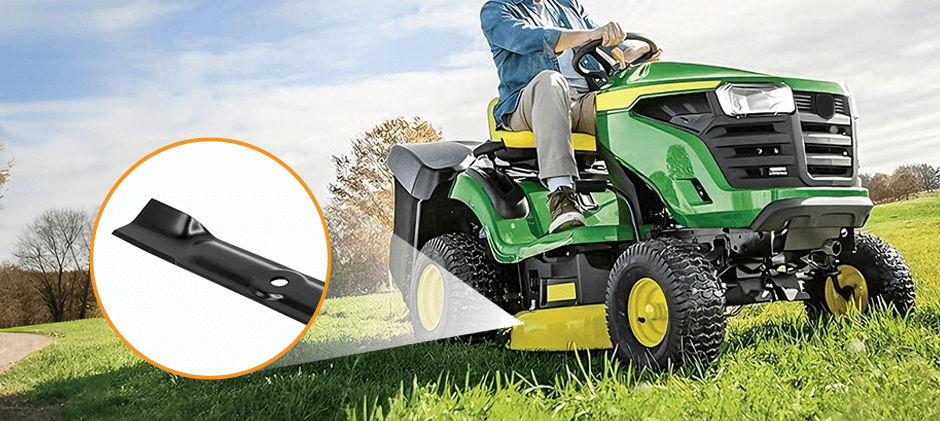
How Often to Replace Mower Blades?
For many off-road mowing machines—zero-turns, front mowers, riding units, and tractor-mounted decks—a practical baseline is:
- Replace blades every 1–2 years for normal duty cycles
- Inspect every ~20 hours of run time
- Sharpen every 20–25 hours (when the blade is still straight and thick enough)
That said, hour-based planning works better than date-based planning. A unit that cuts large acreage weekly, deals with gravel edges, or runs in sandy soil may need blades replaced once per season (or sooner if there’s impact damage). A lightly used machine on clean turf may go longer, as long as sharpening is done correctly and the blade remains within safe thickness.
A simple service schedule
| Use Pattern | Inspection | Sharpening | Typical Replacement |
|---|---|---|---|
| Light duty (clean turf, fewer obstacles) | Every 20 hours | Every 25 hours | 18–36 months |
| Light duty (clean turf, fewer obstacles)Mixed duty (fields, edges, some debris) | Every 10–20 hours | Every 20 hours | 12–24 months |
| Hard duty (sand, roadside, rocky lots, unknown debris) | Every 5–10 hours | As needed | 1 season or sooner |
Why we don’t push blades too far: once a blade gets dull, the machine tends to “tear” rather than cut. That extra drag can show up as higher engine load, more belt stress, more vibration, and faster wear in spindles and bearings.
When to Change Lawn Mower Blade?
We change a mower blade when it can no longer be restored to a safe, balanced cutting edge. As a quick decision guide:
Replace the blade when:
- There are cracks anywhere in the blade
- There is a bend (even if it seems minor)
- There are deep nicks that would require removing too much metal to grind out
- The blade has become thin from repeated sharpening
- The blade can’t be balanced after sharpening (or balance keeps drifting)
Sharpening may be enough when:
- The blade is straight, not cracked, and still has healthy thickness
- The edge is dull, but damage is limited to small edge wear
- After sharpening, the blade can be balanced and run smoothly
A good way to think about it: sharpening fixes an edge; replacement fixes a blade that is no longer structurally sound.
Common Signs of Replacement Blades
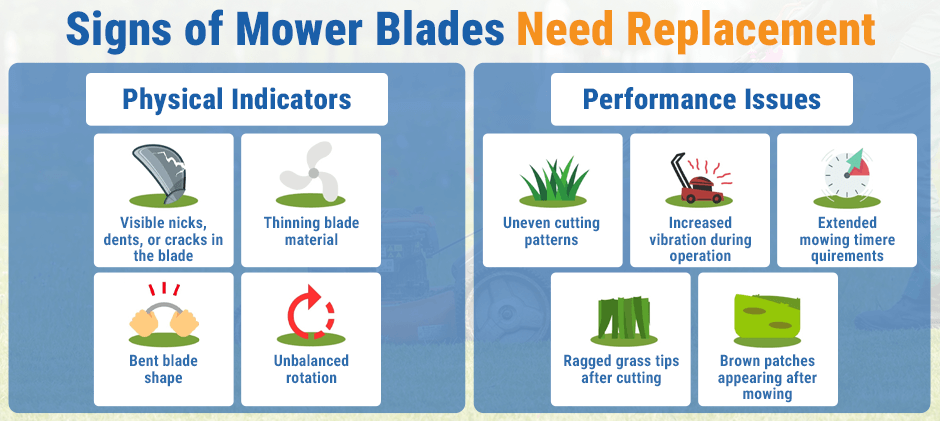
Physical Indicators and Performance Issues. We want both, because a blade can “look okay” but still run rough, or look bad before we feel it in the seat.
Physical Indicators
1) Visible nicks, dents, or cracks in the blade
Nicks and dents usually come from rocks, roots, wire, or hard debris. Small edge nicks can sometimes be ground out. Cracks are a hard stop—a cracked blade can fail under speed and load. Replace it.
2) Thinning blade material
Each sharpening removes metal. Over time, the blade loses mass and strength, and the edge can become too thin to hold up. If the blade looks noticeably thinner than a new blade (especially near the cutting edge and sail), we replace it rather than chasing more sharpenings.
3) Bent blade shape
A bent blade is not just a “cut quality” problem. It can create an imbalance that pounds the spindle, deck, and bearings. Straightening is unreliable in the field and often leaves hidden stress in the metal. Replace it.
4) Unbalanced rotation
Imbalance can come from uneven sharpening, missing metal from one end, or a slight bend. An unbalanced blade may still “cut,” but it shakes the machine and speeds up wear. If we can’t balance it cleanly, replacement is the safer choice.
Performance Issues
5) Uneven cutting patterns
Striping looks inconsistent, scalping happens in spots, or one side of the deck leaves grass longer. Some causes are deck leveling or tire pressure, but worn blades are a common trigger—especially when one blade is more worn than the others.
6) Increased vibration during operation
Vibration is one of the clearest warnings. It often points to an imbalance, bending, or a blade that took a hit. Don’t ignore this—vibration is how a small blade problem turns into spindle and bearing damage.
7) Extended mowing time requirements
If we have to slow down to get an acceptable finish, the blade edge may be tearing instead of cutting. This is easy to miss on busy days, but it costs time and increases machine load.
8) Ragged grass tips after cutting
A clean cut looks sharp and even. Torn tips look shredded, frayed, and can brown quickly. For fleets doing turf care on commercial sites, this also affects the “finished” look customers notice.
9) Brown patches appearing after mowing
Brown patches right after mowing often tie back to torn leaf tips that dry out fast. It can also point to scalping, but if deck height is correct and browning follows the cut path, look at the blades.
Factors That Influence Blade Longevity
Blade life changes a lot across off-road machinery work. Here are the factors that most often decide whether we get a season or several seasons from a set.
1. Ground conditions and hidden debris
Sand, gravel edges, landfill lots, and roadside shoulders dull blades quickly. Even clean turf can hide sticks and washouts that nick an edge.
2. Mowing hours and acreage
More hours = more edge wear. If we track engine hours, we can plan inspections and sharpening before the cut quality drops.
3. Grass density and moisture
Thick growth and wet cutting increase drag. Wet grass also clumps under the deck, which can raise resistance and heat.
4. Blade type and task match
Mulching, high-lift, and standard blades behave differently. Using the wrong blade style for bagging, discharge, or heavy growth can make the machine work harder and dull faster.
5. Sharpening method and balance
A sharp edge that’s out of balance is still a problem. Uneven grinding is a common cause of vibration after “maintenance.” We sharpen with consistent angles, then balance.
6. Deck condition and setup
A deck packed with buildup reduces airflow and cutting efficiency. Poor deck level can also force one side of the blade to do more work.
7. Storage and corrosion
Moist storage and exposure to fertilizer can pit metal over time. Surface rust isn’t always fatal, but pitting near the edge makes the blade harder to maintain.
Mid-job planning
Once we decide it’s time to replace, it helps to treat blade service like a short “cut system” check. Blades, spindles, and belts all share the load, so one worn part can mask another.
If you’re ready to order, we can start here: lawn mower blade.
And if the machine also shows hard starting or rough idle at the same time (common during seasonal transitions), it’s smart to handle ignition service in the same window: lawn mower spark plug.
If you notice blade slip, inconsistent blade speed, or belt dust around pulleys, it’s worth checking the drive system too: lawn mower belt.
For electric-start or battery-dependent units that sit between jobs, weak cranking can look like an engine issue when it’s really charging and storage. Keeping the charging stable reduces no-start calls: lawn mower battery charger.
For broader maintenance and cross-fit options across off-road mowing machines, browse the catalog here: mower parts.
FAQs
1) Is it better to sharpen a blade or replace it?
We sharpen when the blade is straight, not cracked, and not too thin. We replace the blade when there are cracks, bends, serious damage, or the blade can’t be balanced after sharpening. Replacement is also the better choice when downtime is expensive, and we need predictable results fast.
2) How many times can we sharpen before replacing?
There’s no safe universal number because blade thickness varies. A practical approach: track sharpenings and inspect thickness. If repeated sharpening makes the edge thin or the blade loses its stable shape, replace it. When in doubt, compare to a new blade profile.
3) Why do brown tips show up after mowing?
Brown tips usually come from tearing rather than cutting. A dull blade shreds leaf ends, and they dry out fast. If deck height is correct and browning follows the mowing path, blades are a top suspect.
4) How often should we check blades on off-road mowing equipment?
For fleet or commercial use, we recommend a quick check every week and a closer inspection about every 20 hours (or sooner in rocky/sandy areas). A 3-minute check beats a half-day spindle repair.
Conclusion
When blade wear starts costing time, it’s often best to replace the blade and handle the “frequently paired” service items in one order. FridayParts is an aftermarket parts supplier with high-quality products at affordable prices, a vast inventory, and wide compatibility across many heavy equipment brands. If you’re planning your next service window, start with the lawn mower blade and build a full tune-up list from mower parts.
