

A snow blade for a skid steer is the fastest way to turn your loader into a high-output snow-moving machine—if you pick the right blade type for your snow, site layout, and machine capacity. This guide breaks down the main blade styles and shows which specific skid steer models they’re commonly paired with, plus the sizing and hydraulic checks that prevent costly mismatches.
Two Core Factors to Consider Before Buying
- First, match the blade to your site. Tight sidewalks and narrow paths work best with a smaller straight blade for easy turning and clean edges. Long roads often need an angled straight blade (fast windrowing) or a V-plow to cut through drifts. Wide parking lots are most efficient with a snow pusher/box that holds snow and moves more per pass.
- Second, match the size to your skid steer. ROC, machine weight, tires vs. tracks, and counterweighting limit how wide/heavy you can safely push. Rule: the blade must still cover your tracks when angled
5 Main Types of Skid Steer Snow Blades
There are five practical categories you’ll see in the field. Each one solves a different snow problem.
1. Straight Blades
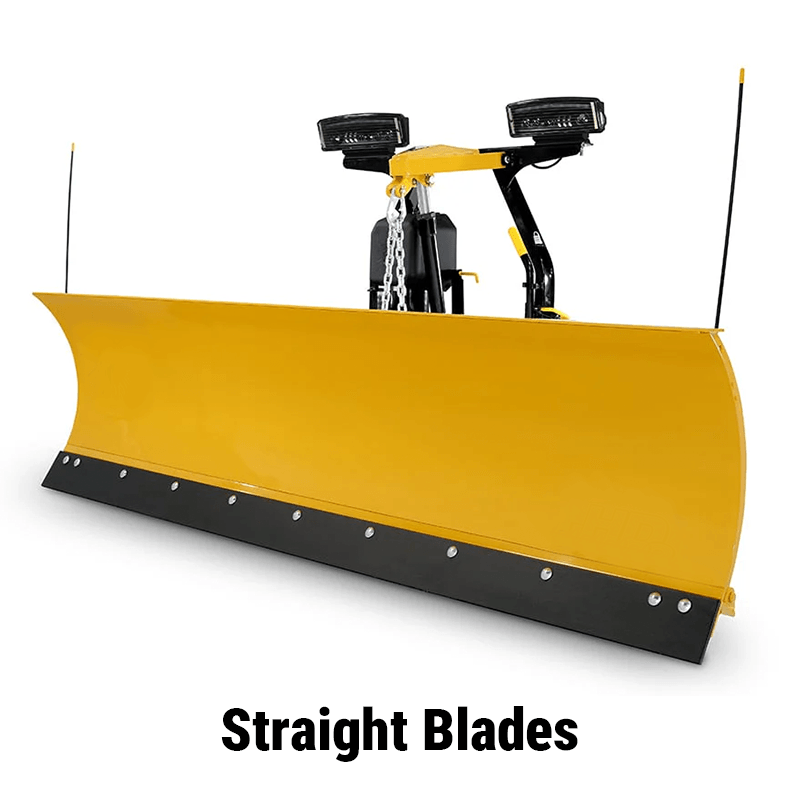
A straight blade is the simplest and cheapest option. It’s a fixed, straight moldboard that pushes snow forward.
Use it when you just need basic clearing. Small private drives, short lanes, and light snowfalls are where it shines.
Quote: “Fewer moving parts means fewer winter failures.”
Which Skid Steer Models Are Best for Straight Blades?
Straight blades work best on small-to mid-sized skid steers because weight and cost stay low. These models are commonly paired with straight blades in the 60–84 in range (final width depends on tire width and stability):
- Bobcat: S70 (small), S450, S570
- CAT: 216B3, 226D3, 242D3
- John Deere: 316GR, 318G, 320G
- Case: SR160B, SR175B
- New Holland: L218, L228
- JCB: 155, 205
Pick a straight blade if you rarely need to “windrow” neatly to one side. Straight blades tend to leave snow ridges on both edges, which can mean extra passes.
2. Angle Blades
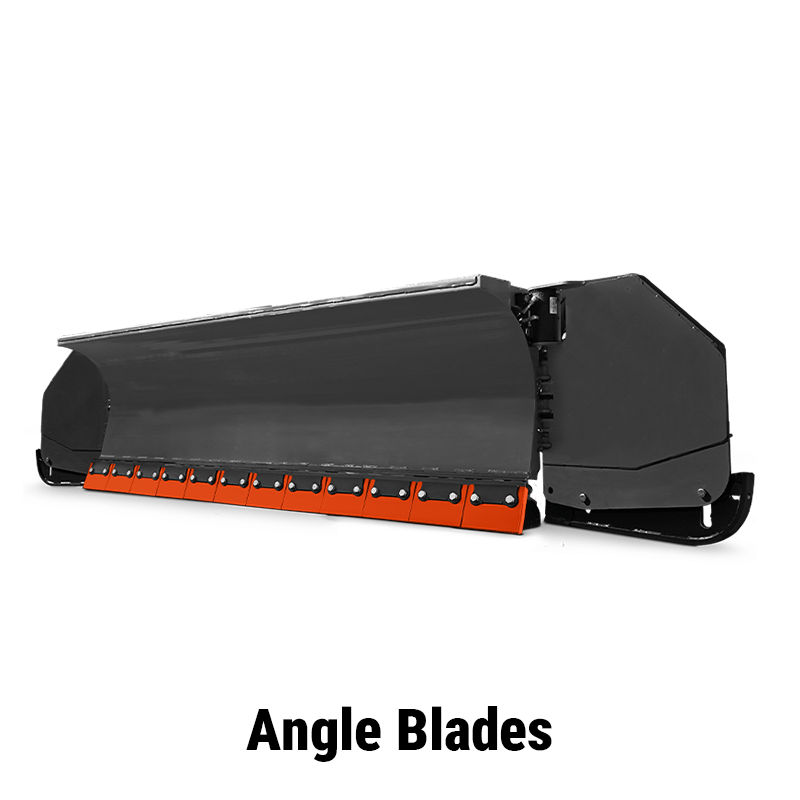
An angle blade lets you roll snow to the left or right without stopping. Hydraulic angling keeps you moving and keeps the cleared path open.
Choose it for roads and parking lots. Long runs are where angling saves the most time.
Clear statement: “If you clear more than a driveway, angling usually pays for itself.”
Which Skid Steer Models Are Best for Angle Blades?
Angle blades are the all-around favorite for mid-to-large skid steers. These models commonly run 84–108 in angle blades, depending on ROC and wheelbase:
- Bobcat: S590, S650, S750
- CAT: 242D3, 262D3, 272D3
- John Deere: 320G, 330G, 332G
- Case: SR240B, SR270B, SV250B, SV280B
- New Holland: L228, L234, L318
- JCB: 205, 270
Angle blades still can leave a small trailing ridge at the back corner. That’s normal at steeper angles and usually solved with overlap passes.
3. V-Plows
A V‑plow is the most versatile blade style. Two independently controlled wings let you run V-mode (cut/open), straight mode (push), and scoop mode (carry).
Buy it when you see heavy, compacted, or first-pass snow. V-mode breaks in, and scoop mode reduces windrows.
Quote: “V-mode opens the lane; scoop mode finishes the job.”
Which Skid Steer Models Are Best for V-Plows?
V‑plows usually need more machine and more hydraulics. These models are commonly used with V‑plows (often 84–108 in) because they handle the weight and hydraulic demand well:
- Bobcat: S650, S750, S770, S850
- CAT: 262D3, 272D3
- John Deere: 330G, 332G
- Case: SR270B, SV280B
- New Holland: L234, L318
- JCB: 270
Check auxiliary hydraulic flow and couplers before you buy. Wing control adds circuits and can require higher flow or specific valve setups depending on the plow design.

4. Snow Pushers
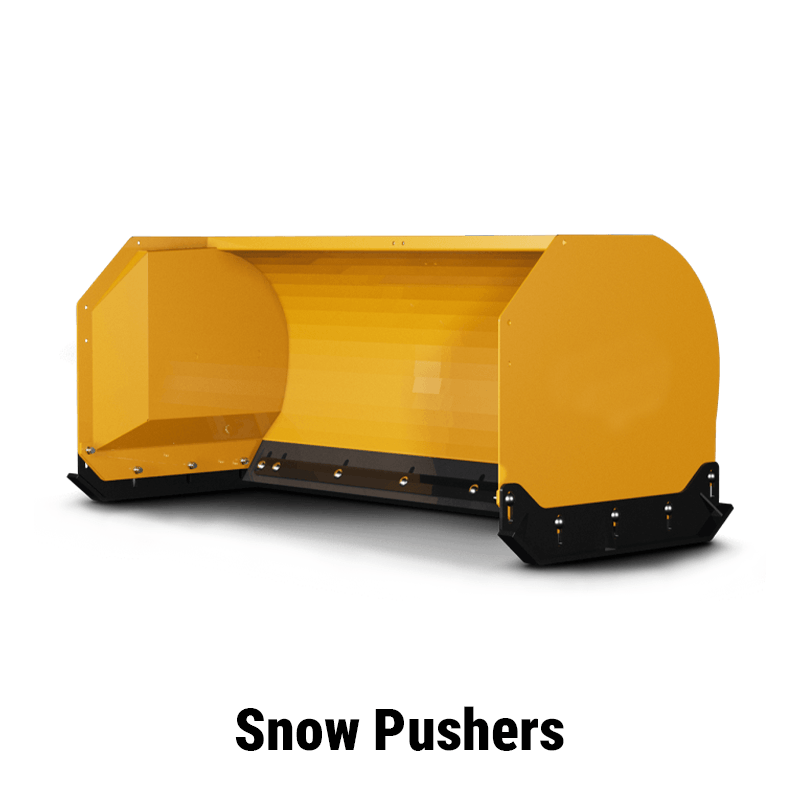
A snow pusher moves the most snow per pass on flat open lots. Side plates “box” the snow so it doesn’t spill off the edges.
Use it for wide, open, high-volume clearing. Airports, logistics yards, and big commercial parking lots are classic pusher territory.
Clear statement: “If your goal is maximum volume per pass, the box pusher wins.”
Which Skid Steer Models Are Best for Snow Pushers?
Pushers reward machine weight and traction more than hydraulics. These models are commonly paired with 8–12 ft pushers (site conditions and snow density matter):
- Bobcat: S650, S750, S770, S850
- CAT: 262D3, 272D3
- John Deere: 330G, 332G
- Case: SR270B, SV280B
- New Holland: L234, L318
- JCB: 270
Avoid oversizing a pusher on a light machine. Too wide/heavy can cause loss of steering control, excessive tire spin, and drivetrain stress.
5. Expandable Plows
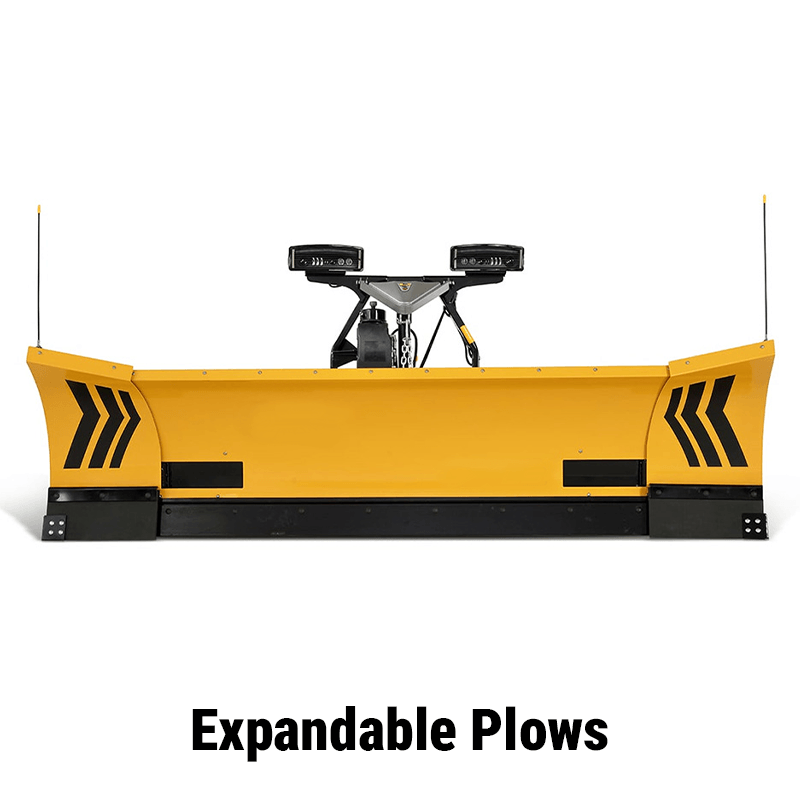
Expandable plows change width to match the space. Wings fold in for tight areas and extend for wide runs, combining some pusher capacity with angling flexibility.
Choose them when you bounce between narrow corridors and open lots. They reduce attachment swaps and keep productivity steady.
Quote: “One attachment that adapts can beat two attachments that sit on the trailer.”
Which Skid Steer Models Are Best for Expandable Plows?
Winged plows are heavier and more complex, so larger machines fit best. These models are commonly used with winged plows because they handle the weight and hydraulic requirements:
- Bobcat: S750, S770, S850
- CAT: 262D3, 272D3
- John Deere: 330G, 332G
- Case: SR270B, SV280B
- New Holland: L318
- JCB: 270
Confirm lift capacity at full height and stability on turns. Winged plows can shift snow load outward, increasing side load and tipping risk if you’re too aggressive.
Three-Step Check for Choosing Snow Blade Width
Blade width must cover your tires at full angle. If it doesn’t, you’ll leave tracks and waste passes.
- Measure your tire-to-tire width. The blade should clear that width even when angled. For more details on tire options, see our skid steer tires chart and buying guide.
- Confirm your machine ROC and operating weight. Heavier/wider blades require more stability.
- Match blade weight to your typical snow density. Wet snow can effectively “act heavier” than its depth suggests.
Clear statement: “Too narrow wastes time; too wide breaks traction and parts.”
4 Hydraulic and Mounting Details to Confirm Before Snow Blade Installation
Mount and hydraulics decide whether the blade is truly plug-and-play. Skid steers vary by quick-attach style and auxiliary plumbing.
- Quick-attach plate: Most modern units use a universal skid steer quick-attach, but always confirm.
- Aux couplers and hose routing: Winter work punishes hoses; protect pinch points.
- Flow needs: Angle blades and V‑plows use hydraulics more than straight blades and pushers.
- Electrical controls (if equipped): Some multi-function plows use cab switches/solenoids.
Quote: “The best blade is the one that fits your couplers, your flow, and your operator.”
7 Practical Tips to Avoid Plow Breakdowns
A few setup habits prevent most mid-storm failures.
- Run the right cutting edge for your surface. Rubber/poly edges protect pavers; steel edges cut packed snow better.
- Set skid shoes correctly. Shoes reduce gouging and protect the edge on gravel.
- Use relief/spring trip features when available. They reduce damage from hidden curbs and manholes.
- Grease pivot points on angle/V-plows. Cold weather accelerates wear when lubrication is ignored.
- Inspect hoses and couplers daily. Leaks and cracked jackets show up fast in freezing temps. Learn about common hydraulic hose failures so you know what to look for.
- Keep speed reasonable near obstacles. A bent moldboard costs more than a slower pass.
- Stage snow early. Don’t wait until the pile blocks visibility and turns into ice.
Conclusion
Choosing the right snow blade for a skid steer comes down to one rule: straight blades for simple pushing, angle blades for everyday efficiency, V‑plows for tough first passes, pushers for maximum volume, and winged plows for mixed sites.
When you’re ready to equip or upgrade for winter work, visit FridayParts and check our snow equipment options to match the right attachment to your skid steer and your snow conditions. Explore now!
