

A broken engine coupling can stop your whole machine and cost you hours or even days. Choosing the right coupling keeps your excavator, loader, or dozer running smoothly. This guide explains the most common coupling types used in off-road machines and shows you a simple step-by-step way to pick the one that fits your needs.
What Is a Coupling and Why Does Your Machine Need One?
A coupling connects two shafts so they turn together and safely move power from the engine to the pump or transmission. In heavy machinery, it’s not just for connection — it also protects your system.
Couplings do two main jobs: they handle misalignment and absorb shock and vibration. Engine and pump shafts are rarely in perfect line; a flexible coupling absorbs small angle or position errors, preventing damage to bearings and seals. It also softens vibration and shock from digging or lifting, keeping your engine and pump safe. As one field mechanic said, “A good coupling is cheap protection for your hydraulic pump.”
5 Common Coupling Types for Off-Road Equipment
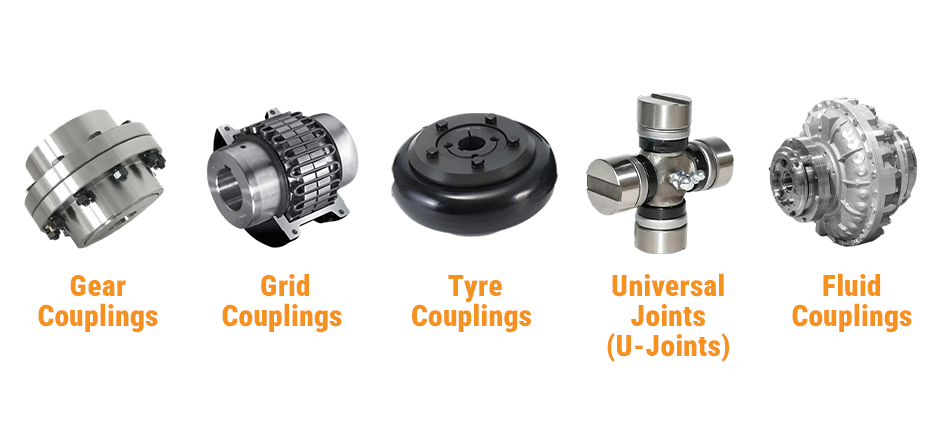
There are many coupling types, but these five are the most common and useful for off-road machinery.
1. Gear Couplings
Gear couplings are the strongest type, made for high torque and heavy work. Each end has gear teeth that fit into a centre sleeve, allowing power to pass even with small misalignment. They can handle rough conditions but need regular greasing.
Best For: Main drives on large excavators, dozers, mining trucks, and cranes that need maximum torque.
2. Grid Couplings
Grid couplings reduce shock and vibration from sudden loads. Inside, a metal spring (the “grid”) connects both hubs. When a big load hits, the spring flexes and softens the impact, protecting your parts.
Best For: Crushers, shredders, and conveyors where strong shock absorption is required.
3. Tyre Couplings
Tyre couplings are very flexible and good at absorbing vibration. They use a rubber “tyre” between two hubs. This rubber part bends under shock and allows more misalignment than most other couplings.
Best For: Engine-to-generator sets, pumps, or compressors that need smooth, quiet running and vibration control.
4. Universal Joints (U-Joints)
Universal joints are best when shafts meet at an angle. They are common in driveshafts that move with suspension changes. A U-joint can handle large angles that other couplings cannot.
Best For: Driveshafts between transmissions and axles on loaders, haul trucks, and other wheeled heavy vehicles.
5. Fluid Couplings
Fluid couplings use oil or fluid to transfer torque. They let the engine reach speed before engaging the load, making starts smooth and preventing stalls. If overloaded, they slip instead of breaking something, adding safety.
Best For: Belt conveyors, ball mills, and large fans where a gentle start is needed to protect the drive system.
How to Select the Right Coupling in 4 Steps
Choosing the best coupling means matching power, alignment, and working conditions. Follow these four simple steps.
Step 1: Calculate Your Torque and Speed Requirements
Start with the power your engine makes. Use this simple calculation:
Torque (T) = 9550 × Power (kW) ÷ Speed (r/min).
Then multiply your result by a service factor (usually between 1.5 and 3.0) to handle shock loads and long service hours. Always choose a coupling that can handle more, not less.
Step 2: Assess Misalignment and Operating Conditions
Check how your machine runs and where your shafts connect.
- For high torque and moderate misalignment, use a Gear Coupling.
- For heavy shocks and vibration, use a Grid or Tyre Coupling.
- For large fixed angles, choose a Universal Joint.
- For soft starting heavy loads, go with a Fluid Coupling.
A coupling that matches your operating style will last much longer.
Step 3: Match the Bore Size and Shaft Connection
Always measure before ordering. Measure both the engine shaft and the driven shaft diameters, along with keyway sizes. The coupling must fit them exactly. A poor fit causes wobble, misalignment, and early failure.
Remember the rule: “Measure twice, install once.”
Step 4: Consider Maintenance and Cost
Pick what’s easy to maintain and fits your budget over time.
Rubber or jaw couplings are simple to service because the middle part can be replaced easily.
Gear couplings need greasing, but last long under high loads.
Choose the one that fits your maintenance schedule — sometimes paying a little more upfront can prevent expensive downtime later.
Final Steps
Selecting the right coupling means balancing power, protection, and practicality. Once you know your torque, conditions, and measurements, you can make the right choice with confidence. The right coupling keeps your machine safe and saves money over time.
When it’s time for a new one, reliable parts make all the difference. To keep your machinery working smoothly, explore FridayParts for heavy-duty engine couplings and matching components built to handle tough off-road jobs — so your machine always stays connected and productive.
