

A worn or mismatched roller chain can turn a solid machine into a time-waster: noisy drive, uneven motion, fast sprocket wear, and surprise downtime. In this guide, we show you how to measure a roller chain the right way (even when it’s dirty or partially installed), so you can identify the correct replacement, avoid return cycles, and protect the rest of your drive system on off-road machinery.
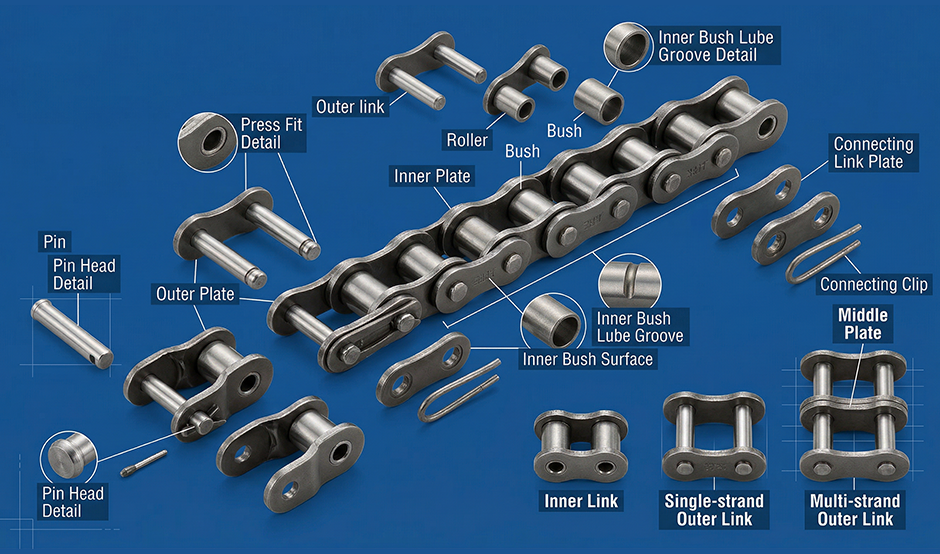
Basic Components of a Roller Chain
Before measuring, it helps to know what you’re actually measuring. A roller chain is a repeating set of precision parts that transfers power through sprockets. In off-road machinery, that usually means harsh dust, grit, shock loads, and stop‑start work—exactly the conditions that make small measurement errors costly.
Key parts you’ll see on most roller chains
- Outer plates (pin link plates): The outside plates that hold the pins.
- Inner plates (roller link plates): The inside plates that support the bushing.
- Pins: Press-fit into the outer plates; the chain “hinges” around these points.
- Bushings: The sleeve surface that wears against the pin.
- Rollers: The round parts that contact the sprocket teeth.
- Master link/connecting link (service link): A removable link used to install/remove the chain.
- Strands: Single (simplex), double (duplex), triple (triplex), etc.
Where “chain stretch” really comes from
Most “stretch” is not the plates pulling longer. It’s worn at the pin-and-bushing surfaces. As those wear surfaces lose material, the effective distance from pin to pin grows, and the chain no longer seats correctly on the sprocket.
That idea connects directly to measurement: if pitch is off, the sprocket and chain stop sharing load evenly, and both wear faster.
The Three Key Roller Chain Measurements
For correct identification, focus on three measurements first. These are the fastest ways to match a replacement roller chain to your sprockets and drive layout.
1) Pitch
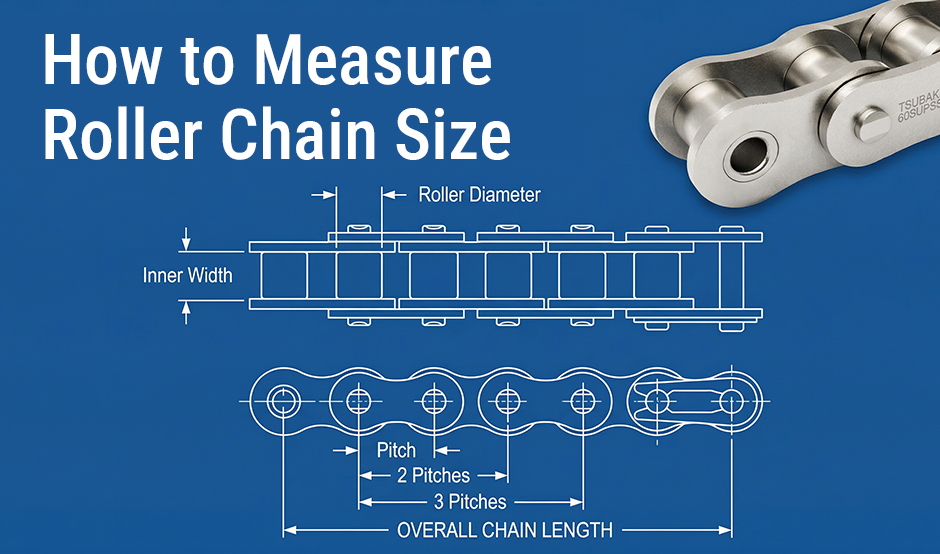
Pitch is the center-to-center distance between two adjacent pins. Pitch is what decides the chain size class and sprocket fit.
Best practice: measure multiple pitches and divide. One-pitch measurements are easy to mess up on a worn chain.
2) Roller diameter
Roller diameter is the outside diameter of the roller. It helps confirm you’re in the right chain series and that the chain will sit properly in the sprocket tooth space.
3) Inner width
Inner width is the clear space between the inner plates (measured at the roller area). It helps ensure the chain matches the sprocket tooth thickness and runs straight without binding.
How to Measure a Roller Chain?
This section is the “do it once, do it right” workflow. It’s written for off-road machinery owners and techs who may be measuring on equipment that’s dirty, worn, and not always easy to access.
Step 1: Safety and access
- Shut the machine down and follow site lockout rules.
- Keep hands away from pinch points and sprocket engagement zones.
- Brush off mud/grit on the measurement area so caliper jaws sit on metal, not debris.
If the chain is still installed, measure the tight span (the loaded side). Measurements taken on a slack loop can be misleading.
Step 2: Check for markings and chain type clues
Some roller chains have size markings stamped on the outer plates at intervals. If a clear marking is present, write it down and still verify at least pitch (wear can make markings “right” while the chain is no longer usable).
Also note:
- ANSI vs BS (British Standard): both exist in real-world machines; the measurement process is the same, but the code system differs.
- Strand count: simplex/duplex/triplex matters for load and fit.
Step 3: Measure pitch using the “12-pitch method”
Pitch is the number that causes the most wrong orders, especially when the chain is worn.
12-pitch method:
- Pick a straight, clean section on the tight span.
- Mark a pin as your starting point.
- Count 12 pitches (that’s 13 pins).
- Measure from the center of the first pin to the center of the 13th pin.
- Divide by 12.
This reduces error from:
- worn joints
- hand placement
- slight chain curve
If only a tape measure is available, the multi-pitch method still works. Just take your time and measure pin centers as carefully as possible.
Step 4: Measure roller diameter
Use a caliper and measure the outside diameter of a roller.
Tips that matter on jobsite equipment:
- Take 2–3 readings on different rollers.
- Avoid a roller that is visibly gouged or flat.
- Clean packed grit before measuring; grit can “add” to the reading.
Step 5: Measure inner width
Measure the space between the inner plates at a roller position (inside faces of the plates).
Why this matters:
- Too narrow: the chain binds and heats up.
- Too wide: poor guidance on sprocket teeth, more slap, and uneven load.
Step 6: Identify strand count and any attachments
Off-road machinery drives are not always simple single-strand chains.
Record:
- Simplex/duplex/triplex (count the rows)
- Any attachments (extended pins, special tabs, or mount points)
- Master link style (helpful for service planning)
Step 7: Check wear elongation
You’re measuring for ID—but also to decide if the chain is worn beyond use.
A practical way to check elongation:
- Use the same measured length across 12 pitches (under tension).
- Compare it to the nominal length.
Nominal length across 12 pitches:
Ln=12×P
Where P is pitch.
Elongation percent:
Elongation %={(Lm−Ln)/Ln × 100
Where Lm is your measured length.
Common field guideline: Many general chain drives treat around 3% wear elongation as a typical “replace” point, while smoother or fixed-center drives may need a tighter limit (often closer to 1.5%). Larger sprockets can sometimes tolerate a different limit, so if the system is sensitive (parallel chains, fixed centers, precision feed), aim conservative.
What to do with that result
- If elongation is high, don’t be surprised if the sprockets show hooked or sharp tooth profiles.
- A new roller chain on badly worn sprockets can still run rough. Inspect sprockets and alignment so the new chain isn’t sacrificed early.
Step 8: Build a clean “order-ready” spec
Before purchasing, write your chain spec in a consistent format:
Minimum order-ready info
- Pitch
- Roller diameter
- Inner width
- Strand count (simplex/duplex/triplex)
- Approx. length (number of pitches/links or total pitches around the loop)
- Any attachments/master link needs
Common measurement mistakes to avoid
- Measuring a curved, twisted, or slack chain (gives short, inconsistent numbers)
- Measuring only one pitch on a worn chain
- Ignoring inner width (leads to poor sprocket fit)
- Rounding too early (keep raw caliper readings; round only when matching a known standard)
Once your measurements are written down, sourcing becomes faster. If you’re replacing chains on off-road machinery and want compatible options across equipment types, browse the heavy-equipment chain category. It includes chain-related parts used across machines like excavators, loaders, and forklifts, and it’s a practical place to match what you measured to a replacement.
Now take one more step that many people miss: protect the chain you just paid for. Debris strikes and contamination are common chain killers on harsh sites. A guard can reduce direct hits and help keep dirt where it belongs. For excavator undercarriage protection, the chain guard category includes chain guard frames designed to shield vital components from debris and damage.
FAQs
1) What’s the easiest way to measure a roller chain if it’s still installed?
Measure on the tight span with the machine off and secured. Use the 12-pitch method for pitch, then measure roller diameter and inner width with calipers.
2) Why does the chain “stretch” even if steel plates don’t stretch much?
Most “stretch” is wear elongation from pin-and-bushing wear. That increases effective pitch, which changes sprocket engagement and speeds up wear.
3) Can you identify a roller chain by overall length only?
Not reliably. Two chains can share a similar loop length but differ in pitch, roller diameter, inner width, and strand count. Pitch must match the sprocket.
4) Should sprockets be replaced when replacing a worn roller chain?
If sprocket teeth are hooked, sharp, or uneven, replacing sprockets (or at least inspecting them carefully) can prevent fast wear on the new roller chain.
5) What tools are worth having in a field toolbox for chain measurement?
- Digital/vernier caliper
- Tape measure (for multi-pitch checks)
- Marker or paint pen (to mark the start pin)
- Brush and rag (clean measuring points)
Conclusion
Measuring a roller chain comes down to three numbers—pitch, roller diameter, and inner width—plus strand count and a wear check under tension. Get those right, and replacement becomes simple, predictable, and safer for your sprockets. When it’s time to source parts, we support heavy equipment owners as an aftermarket parts supplier with high-quality products at affordable prices, a vast inventory, and wide compatibility across many heavy equipment brands.
