

If you own or operate off‑road diesel equipment — like an excavator, loader, or tractor — you know that uptime means profit. Every hour matters.
In recent years, though, one topic keeps popping up on job sites and online groups: “What is a DPF delete, and will it fix my diesel problems?” We understand operators want to delete the DPF. But it isn’t a shortcut — it’s a serious risk. This practical guide explains what a DPF delete really is, why some try it, and smarter, legal ways to keep your machine running strong.
What Is a DPF and Why Do Off‑Road Machines Need It?
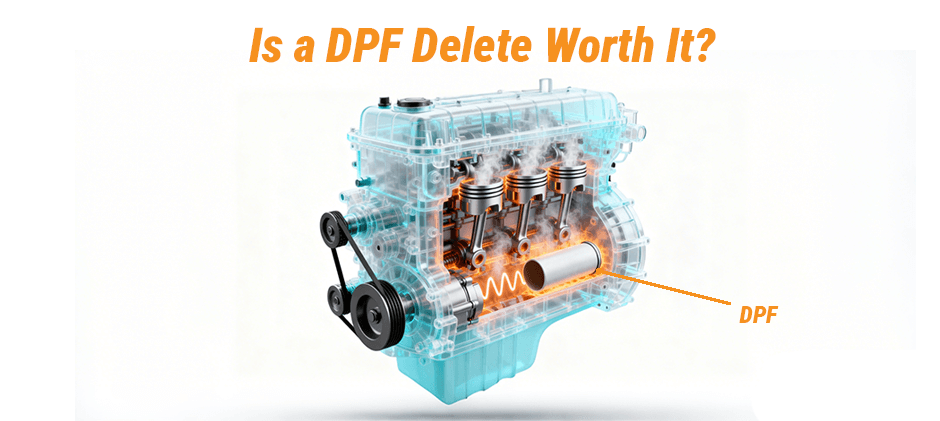
The Diesel Particulate Filter (DPF) is a critical emission‑control device required on most modern diesel engines.
Think of your DPF as a soot trap inside the exhaust system. Its job is to capture fine black carbon particles (soot) that are harmful to people and the environment.
Machines that meet EPA Tier 4 Final or similar standards must have a DPF to reduce emissions and pass inspection.
To stay clear, the system occasionally performs a regeneration cycle — your Engine Control Unit (ECU) raises exhaust temperatures up to 1,100°F (600°C) to burn off the soot. What remains is a small amount of harmless ash.
Pro Tip: A working DPF keeps your machine compliant, quieter, and cleaner — all while protecting your brand’s reputation on job sites.
What Is a DPF Delete and What It Actually Does
A DPF delete is when a technician removes the DPF and reprograms the ECU to pretend it’s still there.
This process usually involves two steps:
- Physical removal: Cutting out the DPF canister and replacing it with a straight DPF delete pipe or DPF delete kit.
- Software tuning: Flashing the ECU with a custom map to disable fault codes and warning lights from the missing filter.
Sometimes, the delete goes further — removing other systems too, such as:
- EGR (Exhaust Gas Recirculation) → an EGR delete
- SCR (Selective Catalytic Reduction) systems
Combined, these are often sold as “DPF and EGR delete kits.”
While the promise sounds tempting (“fewer parts, better performance”), the reality tells a very different story.
Why Some Operators Consider a DPF Delete
We get it — the frustration is real. Here’s why owners ask about DPF delete on diesel engines:
- Supposed Performance Boost: People think removing the DPF will help the engine “breathe easier,” increasing horsepower.
- Avoiding Downtime: A failing or clogged DPF can force the machine into regeneration cycles or limp mode, stopping work at critical times.
- Saving on Repairs: Cleaning or replacing a DPF can be expensive, so bypassing the system seems like a cheaper, quicker solution.
However, those short‑term gains come with major long‑term damage, both mechanical and financial.
Why DPF Deletes Are a Dangerous Gamble
Here’s what equipment owners must know before considering any DPF delete pipe or tuning kit.
1. It’s 100% Illegal—With Serious Penalties
Tampering with or removing emissions equipment violates the U.S. Clean Air Act.
- Fines can hit $45,000 or more per machine, per violation.
- Shops caught performing the work face multi‑million dollar penalties.
- Even if you think you’ll “fly under the radar,” EPA enforcement is expanding into off‑road equipment and aftermarket parts sellers.
2. Your Warranty Is Gone
Once a DPF is removed or a delete tune is detected, your engine and powertrain warranty is void.
If something catastrophic happens — turbo failure, cracked piston, damaged injector — you’ll pay full repair cost out of pocket.
3. Delete Tunes Can Damage the Engine
Modern diesel engines are built with precise exhaust flow and backpressure in mind.
Deleting the DPF throws off that balance:
- The turbocharger may overspeed, leading to failure.
- Exhaust Gas Temperatures may spike, melting pistons or valves.
- Engine sensors feed incorrect data, causing further inefficiency.
One engineer summed it up perfectly:
“Tampering with these precision‑engineered systems throws everything out of sync — from turbo speed to combustion balance.”
Resale Value Tanks
A machine with a DPF delete cannot be sold legally to most buyers. Dealers and rental fleets will reject it.
Even private buyers know it’s a liability, so the value drops sharply.
Smarter, Legal, Reliable Alternatives
At FridayParts, we see hundreds of machines every week that develop DPF issues — and nearly all of them can be fixed without a delete.
Here’s the right way to prevent downtime and save money:
1. Proactive Maintenance
- Use low‑ash engine oil exactly as your manufacturer specifies.
- Let regeneration cycles finish — don’t shut down mid‑process.
- Clean the DPF at recommended intervals.
2. Proper Diagnostics Before Panic
Repeated regenerations or warning lights usually mean a related sensor or injector issue, not a “bad DPF.”
Common culprits:
- Clogged air filters
- EGR valve malfunction
- Exhaust temperature or pressure sensor faults
Diagnose first — you’ll often fix the root cause for a fraction of the delete cost.
3. Use High‑Quality Replacement Parts
When something does fail, rely on FridayParts DPF replacements and sensors.
Our high-grade parts ensure full system compatibility so you can keep your machine compliant and productive.
4. Consider Professional DPF Cleaning
If your filter is full, that doesn’t always mean it’s dead.
Professional DPF cleaning restores air flow and efficiency for less than half the cost of a new filter.
DPF Delete FAQ for Off‑Road Equipment
Q: What is a DPF delete?
A: It’s removing your Diesel Particulate Filter and tricking the ECU to ignore missing emissions parts.
Q: Is it legal to delete a DPF on heavy equipment?
A: No. Under the Clean Air Act, all diesel machinery — on‑road or off‑road — must keep its emission controls intact.
Q: Will a DPF delete give more power?
A: Not reliably. Modern diesel ECUs are tuned for emissions systems. Any short‑term “gain” is usually outweighed by long‑term engine stress or failure.
Q: My machine keeps clogging the DPF. What should I check first?
A: Look for underlying issues — faulty injectors, EGR problems, or sensor errors. Fix those before replacing or deleting the DPF.
Q: How much does a DPF delete cost in the long run?
A: Beyond the upfront cost of the pipe or tune, you risk government fines, warranty loss, major repairs, and a destroyed resale value.
FridayParts: Your Partner for the Long Haul
At FridayParts, we’re more than a parts supplier — we’re your equipment uptime partner.
We carry a full range of genuine and aftermarket components for your emission systems, including:
- DPF filters and sensors
- EGR valves and coolers
- Exhaust temperature sensors
- Seals, clamps, and regeneration components
Visit FridayParts.com to find high‑quality DPF replacements, sensors, and exhaust parts engineered for your specific machine.
