

When operating in off-road or heavy-terrain environments, the suitable machinery directly decides whether your project can proceed with efficiency or will fall behind the arranged schedule. The selection frequently concentrates on two kinds of workhorses: the skid steer and the bulldozer. This guide carries out a breakdown of their core differences, relative advantages, and cost-efficiency consideration factors—thereby assisting off-road machinery owners and contractors to make decisions that are grounded in facts and reality.
What Is a Skid Steer and a Bulldozer?
A skid steer loader is one kind of compact and multi-functional machinery, which is designed for agility and precision in operation. Its most distinctive characteristic is that it can make a turning movement directly to the original position, thereby giving the operator very good control ability when working in limited and confined spaces. The majority of skid steer machines can be configured either with wheels or with tracks, and they can still perform in a stable manner on dirt ground, gravel surface, or uneven off-road conditions.
Typical applications include:
- Loading and unloading materials
- Grading small plots
- Site cleanup and landscape preparation
- Snow and debris removal
With various attachments — from forks and augers to grapples and trenchers — skid steers can handle multiple tasks in a single day.
A bulldozer, in contrast, is built for sheer strength and stability. Its core feature — a large front-mounted blade — allows it to push, grade, and level extensive terrain. Bulldozers are most commonly used in large-scale construction, mining, land clearing, and heavy grading projects. Their tracked undercarriage gives them superior grip and traction on mud, sand, or steep terrain.
In short, the skid steer is your task-flexible machine; the bulldozer is your heavyweight ground mover. Both have a place in off-road projects — the key is determining which aligns better with your workload.
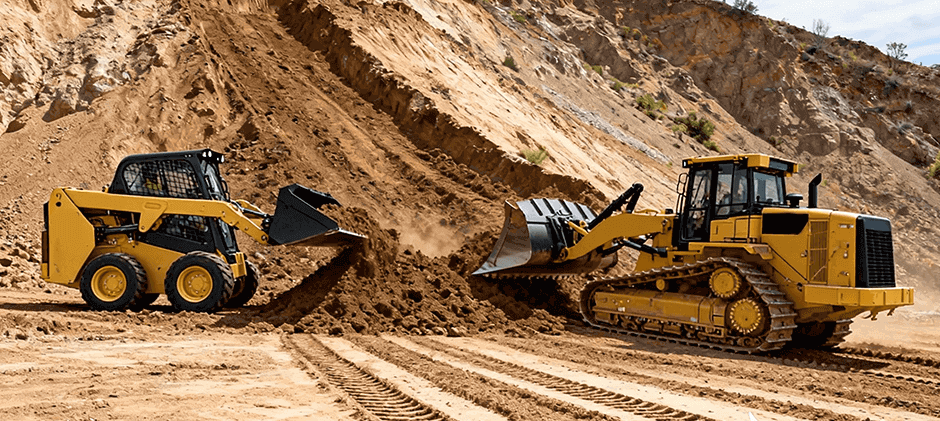
Skid Steer vs. Bulldozer: The Key Differences
Below is a summary of the core aspects that differentiate these two machines:
| Feature | Skid Steer | Bulldozer |
|---|---|---|
| Size & Mobility | Compact, fits tight spaces, quick turning radius | Large, stable, ideal for open terrain |
| Primary Function | Material handling, light earthmoving | Heavy earthmoving, grading, pushing soil |
| Power Range (HP) | 25–110 HP | 65–900 HP |
| Traction System | Wheels or tracks | Tracks only |
| Versatility | High—supports attachments for diverse tasks | Moderate—focused on blade and ripper use |
| Best Environment | Construction yards, landscaping, snow or debris clearing | Large earthwork sites, slope grading, and quarrying |
| Maintenance | Simple fluid checks and belt/hose inspections | More complex; includes undercarriage and hydraulics |
1. Size and Maneuverability
Skid steers are designed for confined or urban work zones where agility matters most. Their ability to “skid” around corners allows efficient work in areas less than 8 feet wide.
Bulldozers, on the other hand, dominate wide-open jobs — road building, mine development, and rough grading. Their heavy undercarriage limits maneuverability but enhances stability on challenging ground.
2. Power and Application
When raw power is needed, nothing beats a bulldozer. Its high horsepower and hydraulic pressure can shift thousands of cubic meters of soil daily. For land-clearing tasks across large plots or uneven ground, bulldozers deliver unmatched traction and torque.
Skid steers focus on versatility over brute force. They’re excellent for light-to-medium earthmoving and material handling in areas a bulldozer might not even fit. Attachments — such as trenchers, augers, and brush cutters — easily convert one machine into a multi-tool solution for smaller construction and landscaping environments.
For operators managing multiple work types across a day, the skid steer wins on time savings and adaptability.
3. Terrain Suitability
Tracked bulldozers outperform other machines in traction-heavy or soft-soil conditions. Their tracks spread weight evenly to prevent sinking, making them ideal for muddy construction fields and hilly areas.
Tracked skid steers can perform similarly in light off-road terrain but lack the torque output that bulldozers have for deep digging or pushing. Wheeled skid steers, on the other hand, should stick to compact or semi-firm ground.
Which Is Better for Your Project?
The right choice depends on scale, site conditions, budget, and operational goals.
Choose a Skid Steer If:
- You need versatility — switching between grading, lifting, or sweeping.
- Your operations take place in tight workspaces or construction yards.
- You need a machine that’s fuel-efficient and easier to transport.
Choose a Bulldozer If:
- You face large-scale terrain leveling or land clearing over rough ground.
- The priority is raw pushing power rather than fine maneuvering.
- You need a machine designed for continuous, heavy-duty operation on remote sites.
Key Factors to Consider When Choosing
| Factor | Importance | Skid Steer Strength | Bulldozer Strength |
|---|---|---|---|
| Power & Load Capacity | Critical | Good for 1–3 tons | Exceptional for 10+ tons |
| Maneuverability | High | Superior in narrow zones | Moderate |
| Maintenance | Moderate | Simple & quick | Detailed servicing |
| Cost Efficiency | Important | Lower upfront & fuel cost | Higher investment, longer lifespan |
| Versatility | Very high | Supports 60+ attachments | Limited to blade/ripper use |
| Terrain Adaptability | High | Performs well on soft/mixed ground | Optimal on rugged terrain |
Maintenance and Aftermarket Support
Proper maintenance is essential for keeping heavy off-road machinery in continuous operation.
For Skid Steers
Belts and hydraulic systems are key wear points. A reliable belt system maintains torque transfer and engine stability. Explore skid steer parts such as drive belts, fan belts, or alternator belts from FridayParts—engineered to resist high temperatures and demanding off-road loads.
For Bulldozers
Bulldozers rely heavily on hydraulic torque. Components such as tandem pumps, hydraulic steering valves, and motor assemblies should be replaced with compatible parts to maintain efficiency. Browse bulldozer parts for high-torque, long-lasting aftermarket solutions compatible with top off-road brands.
| Component Category | Skid Steer Example | Bulldozer Example |
|---|---|---|
| Hydraulic System | Valve & cylinder seal kits | Hydraulic pumps & motors |
| Power Transmission | Drive & alternator belts | Transmission oil pumps |
| Cooling Components | Fan belts | Radiator hoses, cooling pumps |
| Control Assemblies | Joystick modules | Steering valves |
| Maintenance Kits | Repair belts & kits | Complete hydraulic rebuild kits |
What Is the Best Machine: Skid Steer or Bulldozer?
There’s no one-size-fits-all verdict, but we can frame the comparison this way:
| Condition | Preferred Machine |
|---|---|
| Tight jobsite, limited space | Skid Steer |
| Large open terrain | Bulldozer |
| Frequent equipment changeovers | Skid Steer |
| Long-term land grading | Bulldozer |
| Lower fuel and maintenance costs | Skid Steer |
| Pushing dense materials (rock, soil) | Bulldozer |
In mixed operations — for example, site preparation followed by fine finishing — teams often use both. A bulldozer performs the heavy ground work; a skid steer handles detail grading and debris removal afterward.
Conclusion
No matter whether your project requires the powerful force of a bulldozer or the flexibility of a skid steer loader, success depends on combining the suitable machine with dependable components. Skid steer loaders possess both flexibility and cost effectiveness, while bulldozers are able to provide strong power for large-scale and high-intensity operations. FridayParts offers all-around support for these two types of machines — we supply durable hydraulic pumps, belts, and replacement components for all major off-road equipment. Browse our bulldozer and skid steer parts to ensure your equipment can operate reliably even on the most rugged terrain.
