

If your engine runs too cold or overheats fast, the thermostat could be to blame. It’s a small but really important part that keeps your engine at the right temperature. If it gets stuck open or closed, you might use more gas, have weak performance, or even overheat your engine. Next, look at the common symptoms of the thermostat stuck open vs closed, and how to diagnose.
What Does a Thermostat Do?
Before we get into what happens when things go wrong, we need to look at what the thermostat actually does. In the world of heavy equipment, it isn’t just a valve—it’s the component that dictates your engine’s thermal health.
When you crank up a cold excavator, the thermostat stays shut. It forces the coolant to stay within the engine block, skipping the radiator entirely. Why?
Because a diesel engine needs to hit its “sweet spot” quickly to ensure the oil is lubricating properly and the fuel is burning clean. Once the heat hits that 180-220°F (82-104°C) threshold, the valve reacts. It opens up, sending that scorching coolant toward the radiator to shed some heat before looping back in. It’s a simple mechanical cycle, but if that valve hangs even slightly, the balance is gone.
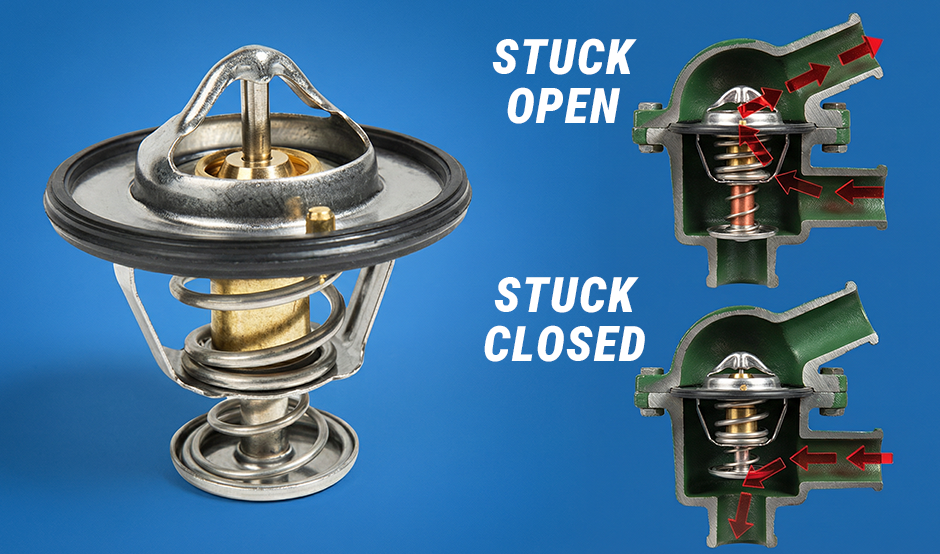
Signs the Thermostat Is Stuck Open
While a thermostat stuck in the open position won’t cause an immediate meltdown, it’s a silent productivity killer. Think of it as a gate that’s lost its lock—coolant is constantly rushing to the radiator even when the engine is freezing. This “overcooling” might seem harmless, but here is what it’s actually doing to your machine:
1. A Temperature Gauge That Won’t Budge
You’ve been running the machine for thirty minutes, yet the needle is still sitting in the cold zone. In chilly weather or during light work, the engine might never hit its “sweet spot.” If your dash stays cold despite a heavy workload, your thermostat is likely stuck wide open.
2. No Heat in the Cab
If you’re shivering in the operator’s seat, don’t blame the heater core just yet. The cabin heater relies on hot coolant to keep you warm. If the engine stays lukewarm, so does the air coming out of your vents. This isn’t just about comfort—it makes defrosting windows on a winter morning nearly impossible.
3. You’re Burning Through Fuel
Diesel engines are most efficient when they’re hot. When they run cold, combustion is incomplete and “sloppy,” forcing the machine to burn more fuel just to maintain power. Over time, that extra fuel consumption adds up to a massive hit on your operating margins.
4. Accelerated Internal Wear
Engine oil is designed to work best at specific temperatures. When the engine stays cool, the oil remains thick and sluggish, failing to lubricate critical parts like piston rings and liners effectively. You’re essentially inviting premature wear every time you start the machine.
5. The Tier 4 Nightmare (DPF & EGR)
For modern equipment, this is the most expensive consequence. Your DPF needs high exhaust heat to burn off soot. A cold engine produces more soot and less heat, leading to clogged filters and constant, forced regenerations. Eventually, the machine will derate or shut down entirely, leading to a service call that costs way more than a simple thermostat replacement.
Signs the Thermostat Is Stuck Closed
Unlike a stuck-open valve, a thermostat stuck closed makes your engine run at a high temperature. To act before you’re looking at a melted head gasket or a cracked engine block.
1. The Needle Hits the Red Zone
This isn’t a slow creep. Within minutes of reaching operating temperature, your gauge will redline. If you notice the temperature climbing at an unnatural speed, your thermostat has likely “locked the gate,” and the radiator is sitting idle while the engine cooks.
2. Warning Lights and Alarms
Expect piercing audible alarms and a dashboard lit up with high-temp warning icons. If the screen tells you to shut down, don’t ignore it to finish “just one more bucket load.”
3. Sudden Power Loss (Limp Mode)
To protect the engine, the ECM will put the machine into low-power mode. You’ll feel a big, sudden drop in power. Often, the machine will shut off completely to keep the pistons from getting stuck.
4. Steam or “Smoke” from the Engine Bay
When the trapped coolant boils, pressure builds up and escapes. You’ll see steam coming out under the hood or hissing from the radiator cap and overflow tank. That white, quickly disappearing “smoke” is actually just steam.
5. Coolant Leaks and Sweet Smell
Extreme heat softens the cooling hoses and makes pressure jump high. Hoses can burst or clamps can break. The sweet smell comes from boiling antifreeze. If you see bright green or red puddles under the machine, your cooling system has probably failed.
How Bad Is It to Operate with Your Thermostat Stuck Open?
It’s easy to think a thermostat stuck open is no big deal. The machine still runs, and it’s not overheating. But while it doesn’t cause an immediate failure like a stuck closed thermostat, it can still cause long-term engine damage.
When the engine runs too cold, fuel doesn’t burn properly because it doesn’t atomize well. This leads to incomplete combustion and can increase fuel consumption by about 5% to 10%. For example, if a loader uses 50 gallons of diesel per day, that’s an extra 2.5 to 5 gallons wasted.
Beyond fuel use, it also increases engine wear. Internal parts don’t reach their designed operating temperature, and lubrication is less effective, which slowly shortens engine life and can lead to early and costly repairs.
But the biggest risk in modern engines is the emissions system. Long-term low-temperature operation can cause Diesel Particulate Filter (DPF) clogging, which may eventually make the machine unusable. A forced regeneration by a technician—or even worse, a full DPF replacement—can cost thousands of dollars, all because the engine never reaches the temperature needed to clean itself.
How to Confirm a Thermostat Problem?
If you think your thermostat is broken, you can use two simple ways to check it before replacing it.
Infrared Thermometer Test
This is safe and easy, and you don’t have to take the thermostat out. Get an infrared temperature gun. Start the cold engine and let it idle. Aim the gun at the upper radiator hose (from the thermostat to the radiator) and the lower hose (from the radiator back to the engine).
- Stuck open: Both hoses warm up at about the same speed. That means coolant is flowing right away, which isn’t normal.
- Stuck closed: The upper hose gets very hot, but the lower hose and radiator stay cool. This means hot coolant is trapped in the engine.
Hot Water Test
This test is more accurate, but you have to remove the thermostat first. Check the temperature printed on it (like 180°F). Put it in a pot of cold water on the stove, and place a thermometer in the water. Heat the water slowly.
The thermostat should stay closed at first. When the water reaches or passes the marked temperature, it should open fully and smoothly.
- If it never opens, it’s stuck closed.
- If it’s already open in cold water, it’s stuck open.
- If it only opens a little or at the wrong temperature, it’s bad and needs to be replaced.
Final Thoughts on Thermostat Replacement
A thermostat stuck open vs closed can both lead to big trouble. But the signs are usually easy to see if you keep an eye on them.
For heavy equipment, a new thermostat costs around $10 to $600 for the part only, depending on the brand, model and year. When picking a replacement, always go with one that fits your machine. The opening temperature is especially important — it has to match the original so your engine stays at the right working heat. See the full guide on coolant thermostat replacement cost here.
Changing a thermostat is usually pretty easy, and you don’t need many special tools. But the cooling system can be tricky, and you may have to get rid of air in the lines after installing it. If you’re not sure how to top up coolant or bleed the system, just let a pro do it.
