

When owning or operating off-road machinery, one of the most frequent questions we hear from equipment owners is simple yet impactful: What size Kubota tractor do I actually need? Choosing the correct size affects daily productivity, ease of maintenance, and the overall return on investment. This article gives a detailed breakdown of Kubota tractor sizes, explains how each category fits different tasks, and shows how to match these machines with suitable aftermarket components to keep your operations running smoothly—saving both downtime and cost.
How Kubota Classifies Tractor Sizes?
Kubota manufactures a diverse lineup designed to serve everything from small property care to large-scale agricultural and industrial work. The company generally classifies its tractors into sub-compact, compact, utility (mid-size), and full-size agricultural categories. Each level offers a balance between horsepower, weight, and compatibility with attachments for real off-road applications.
Here’s how these tiers compare in general performance and function:
| Category | Horsepower Range (HP) | Best For | Example Kubota Series |
|---|---|---|---|
| Sub-Compact | 16–25 HP | Home-based landscaping, light hauling, snow removal | BX Series |
| Compact | 25–40 HP | Property maintenance, small farms, equipment transport | B & L Series |
| Mid-Size Utility | 40–80 HP | Livestock upkeep, site clearing, and lifting tasks | MX & M Series |
| Full-Size / Ag | 90–130+ HP | Field preparation, heavy pulling, and large farm work | M6 & M7 Series |
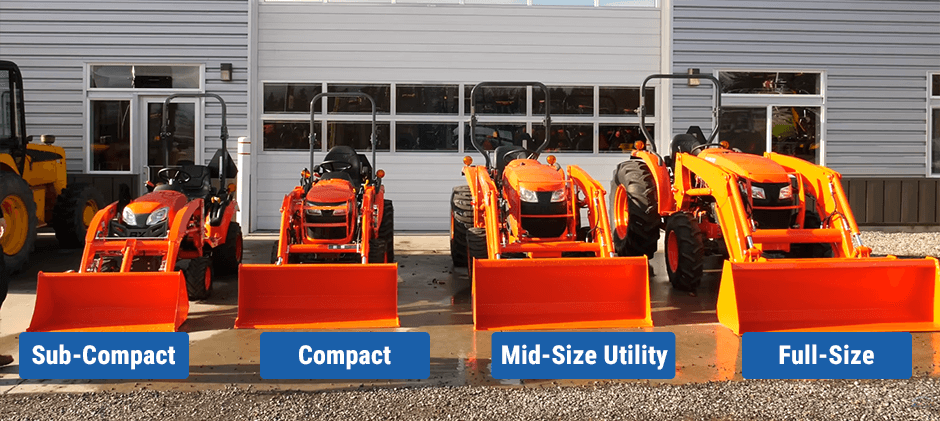
Sub-Compact Tractors: Lightweight Efficiency
These are the smallest Kubota tractor sizes, typically in the 16–25 HP range. Sub-compacts fit easily into garages or small trailers, making them practical for individuals maintaining small properties or driveways.
Tasks like snow pushing, mulching, and small foundation work are straightforward with mid‑PTO attachments. Despite their size, the BX Series handles loaders or mid‑mount mowers effectively while staying fuel-efficient.
Advantages:
- Tight turning radius for narrow property zones
- Compatible with limited Category‑1 hitches
- Low center of gravity for hilly terrain stability
For small plot owners, a sub‑compact tractor provides just enough power to do meaningful mechanical work while remaining easy to transport.
Compact Tractors: The Multi‑Purpose Class
Compact models are the backbone of the Kubota tractor sizes category, designed for users who need versatility across landscaping, light construction, and mid‑acre agriculture. The B and L Series—ranging from 25 HP to about 40 HP—offer higher lift capacities and greater hydraulic output than sub‑compacts but remain manageable.
Key advantages include:
- Stronger frame for loader or tiller attachments
- Hydrostatic transmission options for precision control
- Comfortable operator stations and optional climate cabs
A compact tractor becomes especially practical for small farms or off‑road earthmoving where multiple jobs—grading, trenching, hauling—are done daily. Unlike larger machines, these tractors maintain accessibility without sacrificing reliability.
Mid-Size Utility Tractors: Built for Heavy Off‑Road Demands
Stepping into utility territory (40–80 HP range), operators experience tractors designed for ongoing off-road workloads. The MX and M Series fit this category perfectly. These machines handle front loader attachments, heavy soil tillers, and backhoes, making them reliable partners in construction or large property management.
Common features:
- Reinforced drive systems for sustained torque under heavy load
- High hydraulic flow for improved implement response
- Cab comfort options for extended working hours
In many real off‑road environments, the MX5200 or M6060 tractors balance size with the stamina needed for high‑density soil digging, feed distribution, and excavation.
Full‑Size agricultural Tractors: Maximum Power and Capability
For operators managing hundreds of acres or extensive construction zones, the highest Kubota tractor sizes — notably the M6 and M7 series — deliver consistent power output above 90 HP. These full-size tractors come fitted with advanced transmissions, multi-mode hydraulic systems, and heavyweight frames for industrial‑level durability.
Tasks such as deep tillage, gravel hauling, or large‑scale road maintenance rely on their tougher structure and precision hydraulics. High‑clearance configurations are particularly useful in regions that demand strong traction and load stability.
| Model | Engine HP | Length (in) | Weight (lbs) |
|---|---|---|---|
| M6‑111 | 111 HP | 165 | 9,600 |
| M7‑171 | 170 HP | 175 | 10,650 |
These specifications make full‑size Kubota tractors the powerhouse of off-road heavy applications, ensuring durability in climates and conditions where smaller units simply can’t sustain performance.
Dimensional Comparison Summary
Below is a quick reference to compare Kubota tractor sizes side by side:
| Tractor Class | Power Range | Typical Weight | Typical Use Case |
|---|---|---|---|
| Sub‑Compact | 16–25 HP | 1,300–1,800 lbs | Residential or small acreage |
| Compact | 25–40 HP | 2,000–3,500 lbs | Landscaping, hobby farming |
| Mid‑Size Utility | 40–80 HP | 4,000–6,500 lbs | Agriculture, construction, livestock |
| Full‑Size | 90–130+ HP | 8,000–10,500+ lbs | Large‑scale field and industrial operations |
How to Choose the Right Kubota Tractor Size?
Selecting the correct tractor size depends on the terrain, the type of attachments, and how often you intend to use it. Here’s how to evaluate your need step‑by‑step:
1. Acreage and Terrain Condition
- For less than 5 acres, sub‑compact or compact models are often sufficient.
- For hilly or muddy conditions, prioritize models offering 4WD and larger tires for traction.
2. Types of Implements Used
Every tractor connects differently to attachments such as loaders, box blades, and rotary cutters. Ensure horsepower compatibility with each implement’s requirements.
3. Transport and Storage
Larger tractors weigh significantly more and may exceed trailer capacity. Always check towing limits.
4. Operator Requirements
Tractors equipped with hydrostatic transmissions are more comfortable for heavy shifting environments such as material transport yards or forested paths.
If you regularly operate skid steers, excavators, or implements alongside tractors, the middle range (40–80 HP) is usually the “balance zone” — enough force without extending maintenance complexity.
In real‑world practice, many operators start small and scale upward. As one veteran field engineer explained:
During extended field work, preventive maintenance remains essential. Replacement of wearable components such as fuel pumps, air filters, and glow plugs ensures equipment longevity. Midway through your buying decision, it’s worth reviewing reliable sources of replacement components.
You can explore a full selection of aftermarket Kubota tractor parts — including filters, injectors, and engine rebuild kits — suitable for BX, L, MX, and M Series models. FridayParts provides verified compatibility and affordable shipping, helping operators avoid costly downtime on-site.
Maintenance and Parts Consideration
Maintenance schedules vary across Kubota tractor sizes due to differences in design complexity, which is dependent on the horsepower rating. However, three rules remain constant across all classes:
- Routine Oil and Filter Changes: Every 100–200 hours of operation, depending on load conditions.
- Inspection of Fuel and Hydraulic Lines: Off-road sediment buildup causes early clogging.
- Periodic Cooling System Service: Prevents overheating during extended engine use in dusty environments.
Tractor owners using equipment for grading or excavation often face quicker wear of seals, injectors, or solenoids. Affordable aftermarket alternatives have equivalent function and are a cost-efficient solution for frequent maintenance cycles.
FridayParts, for example, offers parts like:
- Fuel Injector 1J801‑53052 for Kubota V2403 Engine
- Oil Separator Filter 1J5080‑5810 for M Series Loaders
- Cylinder Head Kits for D1105 Engines
- Air Filter Kits for M5040 to M7‑131P tractors
Replacing such parts early not only prevents breakdowns but keeps your off-road fleet at full performance levels.
Conclusion
Choosing between Kubota tractor sizes isn’t just about horsepower—it’s about aligning tasks, land conditions, and maintenance strategies. From compact precision to full-sized strength, these machines define off-road productivity. To keep them running longer and stronger, explore Kubota tractor parts at FridayParts—where reliable aftermarket solutions meet affordability and wide model compatibility for heavy-duty equipment owners.
