

Did you know fuel can go bad? As it breaks down, it becomes less stable and can damage your equipment, especially if you don’t use it very often. But don’t worry — we’ve got you covered. The Fuel stabilizer is an additive that stops fuel from going bad. It keeps fuel fresh for stored or rarely used equipment. Protects the engine from corrosion, and lets you start it up easily even after long periods of sitting.
What Is Fuel Stabilizer?
The fuel stabilizer is a chemical additive used to prevent fuel in the tank from deteriorating over time. You can think of it as a “preservative” for gasoline and diesel. If heavy equipment is left idle for weeks or even months, the oil in the tank will come into contact with air and moisture. Coupled with temperature fluctuations, the oil quality will quickly deteriorate. Fuel stabilizers mainly solve oxidation problems. Over time, the air reacts with the components in the oil to produce harmful substances. The strong antioxidant components in the stabilizer can directly stop this reaction and prevent fuel breakdown.
Moreover, a good stabilizer also has an anti-rust function, which will form a protective film on metal parts such as the inner wall of the oil tank, the fuel line, and the injector to prevent moisture from rusting the parts. With the addition of fuel stabilizer, the fuel will stay fresh, strong and burn clean for a long time (up to 2 years), and the equipment will be easy to start, no matter how long it is left.
How Does Fuel Stabilizer Work?
Fuel stabilizer protects your fuel from the two biggest threats while in storage: air and water. Here’s how it works:
- It stops fuel from going bad: Without treatment, fuel reacts with air — this is called oxidation. It turns into sticky gum and varnish that can clog filters and injectors. Stabilizer uses special ingredients to block oxygen, so your fuel stays clean and fresh.
- It controls water: Water always gets into fuel tanks, either from the air or when you refuel. It causes rust, and in diesel, it can even grow slimy germs known as diesel bugs. The stabilizer keeps water separated from fuel and stops corrosion.
- It protects metal parts: A good stabilizer leaves a thin protective layer inside your fuel tank and lines. This invisible barrier prevents rust and keeps your whole fuel system safe while your machine is sitting unused.
How to Use Fuel Stabilizer?
Using a fuel stabilizer is one of the easiest maintenance jobs you can do. No special tools, and it only takes a few minutes.
- Pick the right stabilizer & measure it: Make sure it matches your fuel type (diesel or gas). Check the bottle for the mix ratio—usually something like “1 oz treats X gallons.” Big machines have big tanks, so getting the amount right matters.
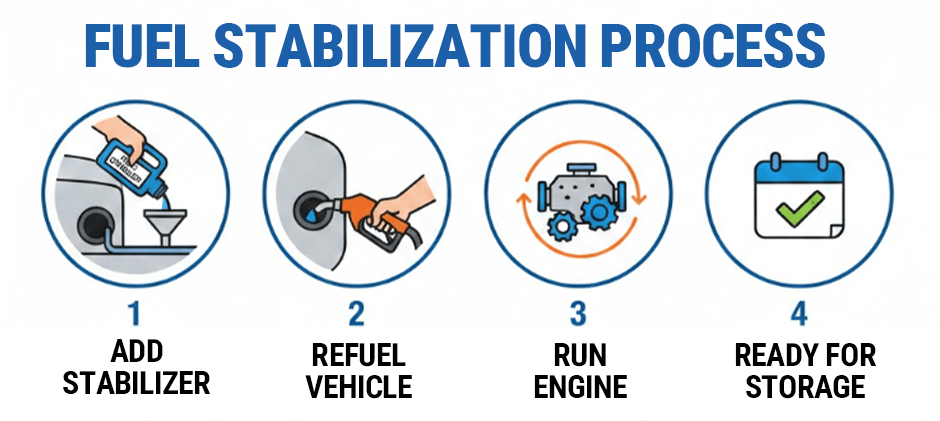
- Add it before filling up: Pour the stabilizer into the tank when it’s almost empty, then go fill up. This helps it mix properly.
- Fill the tank to about 95%: Don’t top it all the way off—leave a little space. A full tank means less air inside, which helps prevent moisture and fuel breakdown. The fuel rushing in also mixes the stabilizer well.
- Run the engine for 10–15 minutes: Start the machine and let it run. This pushes the treated fuel through the whole system—lines, filters, pump, and injectors—not just the tank. Even just driving it back to the parking spot is usually enough. After that, shut it down and store it. Your fuel system is protected and ready for the next start-up.
What Happens with Expired Fuel?
The scary part is that old fuel can completely destroy your engine. If you let fuel sit unused in the tank for more than a few months, it can damage the inside of your fuel system. That will lead to all kinds of trouble when you try to start your machine next time. Here are the most common issues from bad fuel:
| Problem | Cause | Consequence for Your Machinery |
|---|---|---|
| Clogged Fuel System | Gum and varnish deposits from oxidation. | Hard starting or no-start conditions. Clogged fuel filters, injectors, and high-pressure pumps lead to reduced power, poor fuel economy, and eventual component failure. |
| Fuel System Corrosion | Water contamination and phase separation. | Rust forms inside steel fuel tanks and lines. This rust can flake off and cause further clogs. Water can destroy high-pressure injector pumps, leading to a multi-thousand-dollar repair. |
| Engine Damage | Lean fuel conditions or water ingestion. | A clogged injector can fail to deliver enough fuel, causing a cylinder to run lean and hot, potentially damaging pistons. Sucking in a slug of water can cause catastrophic failure. |
| Microbial Growth (Diesel) | Water settling at the bottom of the diesel tank. | Algae, bacteria, and fungi (the “diesel bug”) grow at the water-fuel interface, creating a thick slime that clogs filters and starves the engine of fuel. |
When to Use Fuel Stabilizer?
For machinery that operates daily or even weekly, fuel stabilizers are usually not needed because the fuel is constantly consumed and replaced before it deteriorates. However, fuel stabilizers are absolutely necessary for any equipment that has been parked for more than 30 days. This is particularly important for machinery common to industries such as construction, agriculture and landscaping. Fuel stabilizers are recommended in the following situations:
- Seasonal storage: for example, agricultural equipment such as combines and harvesters after harvesting, or construction equipment such as pavers and excavators during winter downtime.
- Snow Removal Equipment: At the end of winter, fuel for loaders, skid steer loaders, and trucks is treated.
- Intermittent use of equipment: for example, backup generators, water pumps or specialized equipment that operates only a few weeks a year.
- Extended downtime: If the machine needs to be shut down for weeks or months waiting for major components, then treating the fuel in the tank is a wise precaution.
Most high-quality fuel stabilizers protect fuel for at least 12 months, and many products can even provide protection for up to 24 months. This is more than enough for any typical off-season.
Protecting Your Machine
At the end of the day, fuel stabilizer protects your whole fuel system. For any other parts you need to maintain or replace, you can get everything at FridayParts in one place—good quality, fits perfectly, and at affordable prices.
