

Clogged DPF symptoms usually show up as power loss, frequent regens, and warning lights. Off-road machines (Tier 4 Final / Stage V) rely on the diesel particulate filter to trap soot, so restrictions create backpressure and trigger derate strategies. This guide explains the most common Clogged DPF symptoms, why they happen, how to separate a real blockage from a sensor issue, and what to do next—using clear, jobsite-friendly steps.
“Derate isn’t the problem—it’s the machine trying to save the engine and aftertreatment.”
What Is A DPF And How Does It Work?
A DPF is an exhaust filter that captures soot. It sits in the aftertreatment system and prevents particulate emissions from leaving the tailpipe.
Regeneration burns soot to keep the DPF open. Passive regen happens during hot, steady operation, while active/parked regen raises exhaust temperature to clean the filter when duty cycles are too light.
Clear Statement: A DPF is a “soot filter,” so anything that increases soot production or reduces regen temperature pushes it toward restriction.
12 Clogged DPF Symptoms You Should Watch For
- Loss of power under load. Higher exhaust backpressure makes the engine work harder, so the machine feels weak when pushing, digging, climbing, or running hydraulics.
- Frequent regeneration requests. A machine that asks for regens more often than normal is telling you the soot load is rising faster than it can burn off. This often triggers codes like P2459.
- A failed or interrupted regen. If parked regen won’t complete, the DPF may be too restricted, or a sensor/temperature condition may be preventing the process.
- Derate or limp mode. Many off-road ECMs will limit torque, RPM, or travel speed when soot load or backpressure crosses a threshold.
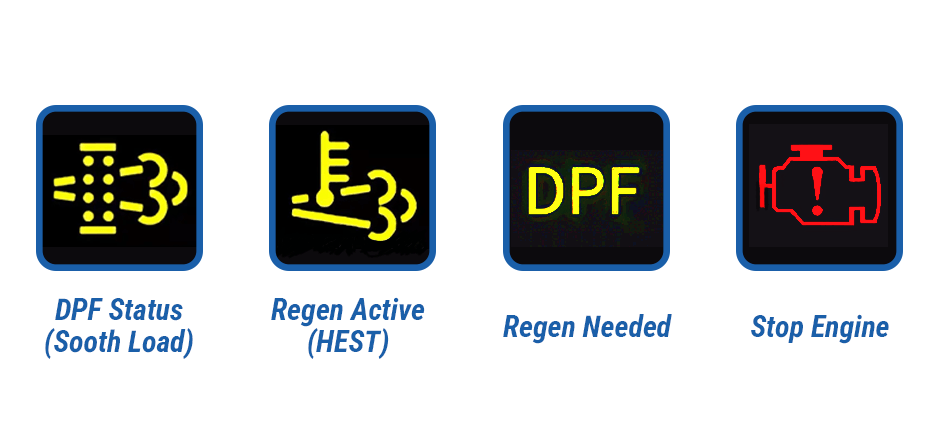
- DPF or check-engine lights. Dash icons for aftertreatment, DPF, or “stop engine” often appear as restriction increases.
- Higher fuel consumption. Active regen uses extra fuel (directly or indirectly), and restriction reduces efficiency.
- High exhaust temperature events. Repeated hot cycles may occur because the system keeps trying to regenerate.
- Rising differential pressure readings. A restricted DPF shows increased pressure drop across the filter, especially at higher RPM.
- Turbo lag. Excess backpressure can slow turbo response and make acceleration feel flat.
- Unusual exhaust smell/heat. Active regen can produce strong odors and very hot exhaust, which becomes more frequent when the soot load stays high.
- Excessive fan run time. Cooling demands rise during regens and with reduced efficiency.
- Poor throttle response. The engine may feel “held back” as the ECU manages airflow, EGR, and fueling to protect components.
“Frequent regens are not a fix—they’re a symptom.”
Why Do Clogged DPF Symptoms Happen?
- Light-load operation. Idling, short cycles, and low exhaust temperatures prevent passive regen and force frequent active regens.
- Engine soot production. Faulty injectors, poor combustion, boost leaks, EGR issues, or restricted air filters can create more soot than the DPF can handle.
- Ash accumulation. Ash (from oil additives and normal wear) does not burn off during regen, so it eventually requires cleaning or replacement.
- Poor fuel quality. Contaminated fuel or incorrect fuel can increase soot and disrupt combustion.
- Oil consumption. Burning oil increases ash loading and can rapidly reduce DPF capacity.
- Exhaust leaks. Leaks upstream of sensors can skew readings and cause bad regen control.
- Sensor faults. Bad differential pressure sensors, EGT sensors, or damaged tubing can mimic “clogged DPF” behavior.
- Interrupted regen habits. Shutting down during active regen repeatedly can leave soot partially burned and harder to remove.
Clear Statement: A DPF rarely “clogs for no reason”—it usually reflects duty cycle, engine condition, or maintenance history.
How Can You Tell “Clogged DPF” Vs “Bad Sensor”?
Compare symptoms to data instead of guessing. If you can view live data, look at DPF differential pressure, commanded regen status, and exhaust temperatures.
6 Quick Checks To Confirm The Root Cause
- Look for cracked or plugged pressure tubes. A blocked line can read high or low and trigger false restriction codes.
- Inspect wiring and connectors at DPF sensors. Heat and vibration often damage harnesses near the aftertreatment.
- Compare the differential pressure at idle vs high idle. A truly restricted filter typically shows a bigger pressure increase as flow rises.
- Verify regen prerequisites are met. Low fuel level, coolant temp too low, certain fault codes, or safety interlocks can block regen and create “clogged” behavior.
- Check the air filter and intake boot condition. Air restriction and leaks can change soot output dramatically.
- Watch for abnormal smoke under load. Excess black smoke often points to engine-side soot production, not only an aftertreatment issue.
“If the data doesn’t make sense, suspect the sensor or the plumbing before replacing the DPF.”
7 Steps To Follow When Clogged DPF Symptoms Appear
- Reduce load and avoid extended high-RPM work. Continuing to push a restricted DPF can increase temperatures and force deeper derate.
- Check the dash messages for regen instructions. Many machines clearly indicate “regen required,” “parked regen required,” or “stop engine.”
- Attempt an active/parked regen the correct way. Follow the OEM procedure, keep the area clear of combustible material, and let the cycle complete.
- Inspect for basic airflow and fueling issues. A dirty air filter or an obvious boost leak can turn into rapid soot loading.
- Scan fault codes and record freeze-frame data. Codes for differential pressure, EGT, or regen inhibition point you toward the right subsystem.
- Evaluate whether the DPF is soot-loaded or ash-loaded. Soot can often be corrected with proper regen; ash typically requires cleaning service or replacement. Some owners consider a DPF delete, but be aware of the legal and machine risks involved.
- Fix the cause before clearing codes and returning to work. If you clear codes without fixing the root cause, the same diesel particulate filter clogged symptoms come back quickly.
Clear Statement: Repeated regens without solving the cause is how minor issues become expensive aftertreatment repairs.
When Should You Stop Running The Machine Immediately?
- Stop if you see a “Stop Engine” warning or severe derate. These are designed to prevent engine and aftertreatment damage.
- Stop if you smell extremely hot exhaust near combustibles. Parked regens can exceed typical exhaust temperatures and can ignite dry grass, oil residue, or debris.
- Stop if the engine runs abnormally. Misfire, heavy smoke, or runaway-like behavior can overload the DPF and risk turbo/engine damage.
“If the machine says stop, believe it—the ECU is watching temperatures you can’t see.”
How To Prevent Clogged DPF?
- Run the machine hot enough often enough. Periodic sustained work at proper operating temperature supports passive regeneration.
- Avoid long idle time whenever possible. Idling is one of the fastest ways to create soot without creating heat to burn it.
- Complete regens when requested. Letting a regen finish is better than repeatedly interrupting and forcing deeper soot loading.
- Maintain the engine to reduce soot. Clean air filters, correct oil, healthy injectors, and sealed intake/exhaust joints all reduce particulate output.
- Use the correct oil and service intervals. Low-ash oil (when specified) slows ash accumulation and extends cleaning intervals.
- Keep cooling and exhaust paths clear. Blocked radiators and debris-packed compartments can disrupt regen conditions and heat management.
Clear Statement: The cheapest DPF maintenance is preventing soot in the first place.
Summary
Clogged DPF symptoms usually mean rising backpressure, frequent regen requests, and eventual derate. Use the symptom list to spot the issue early, confirm with sensor/plumbing checks, complete regens correctly, and fix engine-side soot causes so the problem doesn’t return. If diagnostics point to a failed sensor that’s misreporting restriction or blocking regen, explore FridayParts options for a compatible DPF Differential Pressure Sensor to help restore accurate readings and reliable operation.
