

No crank? Starts and dies? Power to the dash drops out the moment you turn the key? More often than not, the ignition switch is behind it. But here’s the catch—a weak battery, a starter on its way out, or a wiring gremlin can produce the same act. This guide covers bad ignition switch symptoms, helps you separate them from other no-start causes, and walks you through a simple testing plan so you don’t end up replacing parts you don’t need.
Common Signs of a Bad Ignition Switch
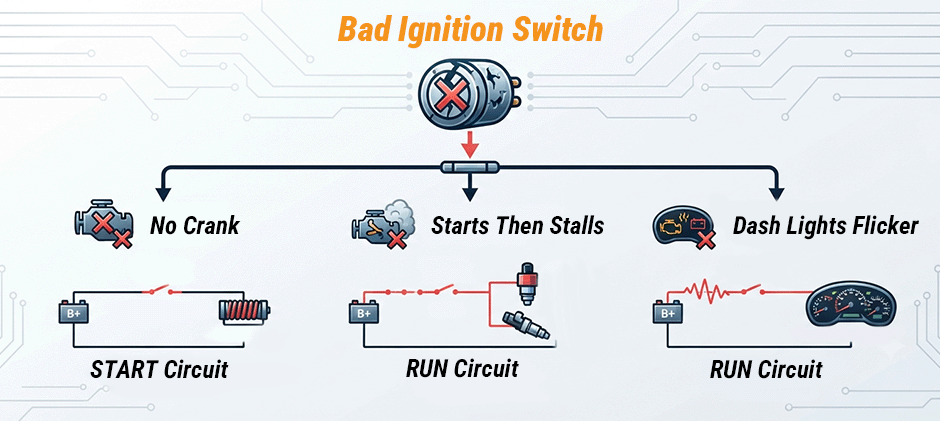
Most bad ignition switch symptoms show up as a pattern, not just one failure. The switch sends power to the start and run circuits. Contacts worn? Connector damaged? Expect power to cut in and out, not fail. Quick check: if electrical symptoms change as you turn the key, move the ignition switch to the top of your suspect list.
| Symptom | What It Often Means | Why It Matters |
|---|---|---|
| No crank when the key is turned | Start circuit is not getting power | The engine may not start at all |
| Starts, then stalls | Run circuit drops out after startup | The machine may shut down without warning |
| Dash lights or gauges cut in and out | Contact inside the switch is unstable | The fault can worsen with vibration |
| Key feels stiff or rough | Wear in the switch or key cylinder area | Starting becomes less reliable |
| Power returns when the key is moved slightly | Internal contacts may be loose or worn | This strongly points to switch trouble |
No crank when the key is turned
This is one of the clearest signs of a bad ignition switch. The key turns to the start position, but the starter does not respond. In some cases, the panel still lights up. That tells you some power is present, but the switch may not be feeding the start circuit.
This symptom matters because it can waste time fast. Many owners go straight to the battery or starter. Sometimes that is correct, but not always. If the machine has normal battery voltage and still gives no crank with no consistent starter response, the ignition switch deserves a close look.
When this happens, checking the starter relay and the ignition switch connector together can save time. A relay that never gets a start signal can point back to the switch side of the circuit.
Starts and then stalls
A machine that fires up and then dies a few seconds later may have a switch that powers the start circuit but fails to hold the run circuit. This is another classic example of bad ignition switch symptoms.
The clue becomes stronger when the problem happens after vibration or right after the key springs back from the start position. In that case, the engine is not simply “hard to start.” It may be losing run power as soon as the switch changes position.
If the engine catches normally but dies as the key returns, the switch is more suspect than the battery.
Dash lights, gauges, or work lights cut in and out
Intermittent dash power is often easier to notice than a full no-start. Gauges may drop to zero. Warning lights may flicker. Work lights may go off and then come back. These are useful signs because they suggest unstable electrical contact, either inside the switch or at its connector.
If moving the key slightly makes the panel wake up again, that is a strong diagnostic clue. Battery faults usually do not improve just because the key moves a little.
At this stage, a close look at the wiring harness connector is worth the effort. If burn marks, loose pins, or corrosion are found, replacing it with a wiring harness connector kit is the most reliable fix.
The key feels hard to turn or inconsistent
A sticking or rough key should not be ignored. Sometimes the wear is inside the electrical switch. In other cases, it is in the key cylinder or the coupling between the key and the switch. Either way, forcing the key can make the failure worse.
This symptom alone does not prove the switch is bad, but it becomes more meaningful when combined with no-crank, stalling, or power loss at the dash.
Power comes back when the key is moved
Among bad ignition switch symptoms, this is one of the most useful. If the dash, gauges, or crank response returns when the key is nudged, worn contacts are a likely cause. That is different from a dead battery, which does not usually recover because the key position changed by a few degrees.
That said, a loose connector can act the same way. This is why inspection matters before parts replacement.
How to Tell It Apart from Battery or Starter Problems?
This is the part many readers care about most: how to tell whether the ignition switch is truly at fault. The answer is to look for patterns, not just symptoms in isolation.
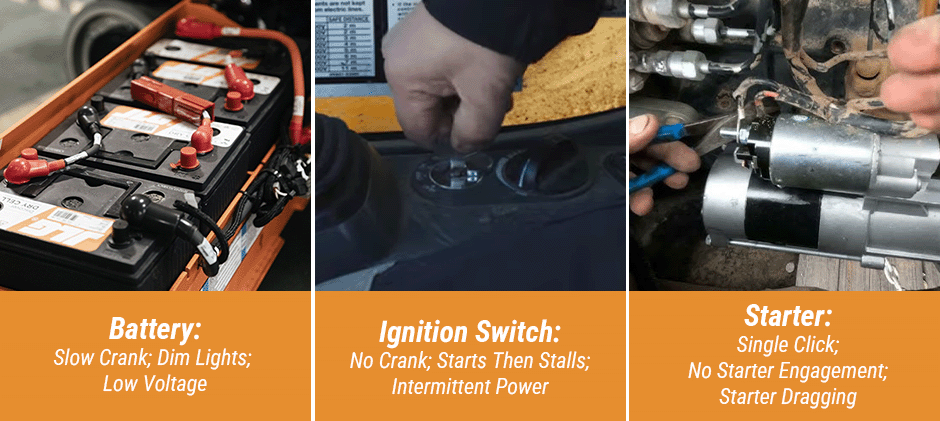
A battery problem usually affects the whole electrical system more evenly. A starter problem usually affects cranking more than dash power. A switch problem often changes with key position and may affect both start and run functions.
Signs that point more to the battery
A weak battery often shows these signs:
- Slow cranking
- Dim lights across the system
- Heavy voltage drop during startup
- Hot, loose, or corroded battery terminals
If the machine is slow and weak everywhere, start with battery testing. Also check the battery cable ends and ground points. A poor cable connection can mimic bad ignition switch symptoms and should be ruled out first.
Signs that point more to the starter
Starter faults often show up like this:
- A single click with no crank
- Slow or dragging engagement
- No crank even though the start signal is present
- Repeatable failure that does not change much with key position
If power leaves the switch correctly but the starter still does not respond, the fault is more likely in the relay, solenoid, starter motor, or related wiring.
Signs that point more to the ignition switch
The switch moves higher on the suspect list when you see one or more of these:
- The machine behaves differently each time the key is turned.
- Dash power drops out when the key is touched or released.
- The engine starts, then stalls as the key returns from start to run.
- Crank response comes back when the key is moved slightly.
- Battery voltage tests normal, but the start circuit stays inconsistent.
These patterns are why bad ignition switch symptoms can be tricky at first. The machine may work one moment and fail the next, especially after vibration, dust exposure, or repeated start cycles.
Why do intermittent faults matter so much?
Intermittent failures are frustrating, but they are also useful clues. A fully dead part is often easier to diagnose. A failing switch usually gives warning signs first. It may lose contact only when warm, only after several starts, or only when the key sits in one narrow position.
That is why short tests can miss the problem. A machine may start once in the shop and still fail later in the field.
When electrical power changes with key movement, treat that as a test result, not just a random symptom.
What to Check Before Replacing the Switch?
Before replacing the switch, a short inspection can prevent the wrong repair. This does not need to be complicated, but it does need to be methodical.
Start with the basic power supply
Check these first:
- Battery voltage at rest
- Battery terminal tightness
- Ground strap condition
- Main fuse and start fuse condition
If the power supply is weak, switch testing can become misleading.
Check how the machine responds during crank
Next, turn the key and watch what changes.
- Does the dash stay live?
- Does the relay click?
- Does the starter receive a signal?
- Does anything change when the key is held firmly or moved slightly?
If crank response changes with key movement, that supports the case for the switch. If nothing changes at the switch output, tracing the control side becomes the next step.
Inspect the connector and nearby wiring
Connector damage is common in machines that see vibration, moisture, dust, and heat. Look for:
- Melted plastic
- Discolored terminals
- Loose pins
- Corrosion inside the connector
- Stiff or strained wires near the switch
In many cases, replacing only the switch is not enough if the connector has heat damage. A clean repair may require both parts.
Keep the repair focused
Once the fault points clearly to the switch circuit, replacing the correct parts is the fastest way back to reliable starting. Depending on the condition found, that may include the switch itself, the connector, a relay, or related electrical pieces such as an ignition switch or matched harness pigtail.
Final Thoughts
Bad ignition switch symptoms are easiest to confirm when the same pattern repeats: no crank with normal battery power, start-then-stall behavior, or dash power that changes with key movement. Check the battery, relay, grounds, and connector first, then replace only what the test results support. If you need reliable replacement parts, FridayParts offers aftermarket options with solid quality, fair pricing, broad compatibility, and a large inventory for many equipment brands.
Related Reading: How Much Does It Cost to Make Ignition Switch Replacement?
