

When an alarm code pops up on your Carrier reefer container display, it’s your reefer’s way of telling you your refrigeration unit or your cargo needs attention. This guide walks you through what Carrier reefer alarm codes mean and what action to take immediately. Let’s dive in together.
What Are the Types of Carrier Reefer Alarm Codes?
Based on the severity, the Carrier reefer alarm codes can be categorized into three major types that require different operational responses. The table below shows you the details:
| Types | Descriptions |
Examples |
|---|---|---|
| Information Alarms | Temporary or non-critical conditions; reefer usually continues operating normally. |
|
| Warning Alarms | Abnormal conditions that may eventually affect performance |
|
| Critical Alarms | These alarms may stop refrigeration operation to protect the system. |
|
Carrier Reefer Alarm Categories
In this part, we’ll dive into common carrier reefer alarm categories and their typical causes. You can learn to identify refrigeration system issues and respond properly to protect your cargo.
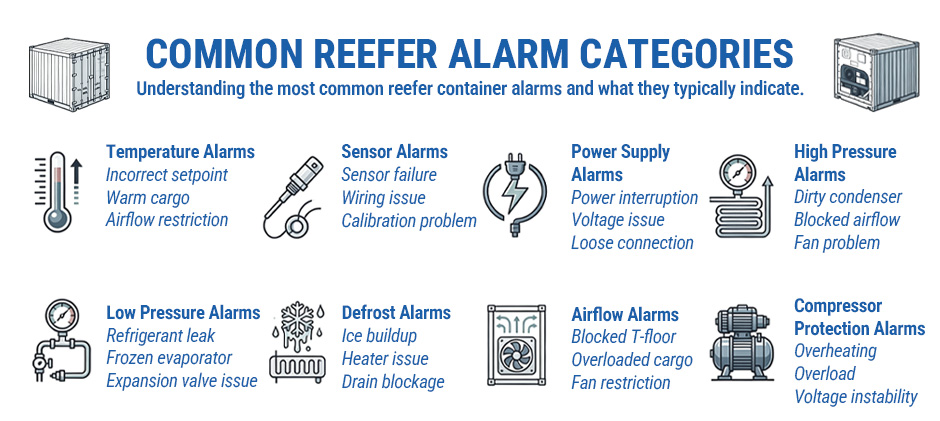
1. Temperature Alarms
Temperature alarms are the most common alarms on the refrigeration unit.
Possible Causes
- Incorrect setpoint
- Warm cargo loaded into container
- Improper air circulation
- Door leakage
- Blocked airflow
- Unit unable to pull down temperature
What to Do
- Confirm set temperature
- Verify cargo was pre-cooled
- Inspect airflow gaps
- Check door sealing condition
- Ensure cargo is not blocking T-floor airflow
Your reefer container is designed for cargo temperature maintenance. You can manage the airflow and follow cargo loading practices to maintain stable temperatures inside a reefer container.
2. Sensor Alarms
Your Carrier reefer units rely heavily on temperature sensors, such as the supply air sensor, return air sensor, defrost sensor and ambient sensor.
Possible Causes
- Damaged sensor
- Loose connection
- Moisture intrusion
- Wiring issues
- Sensor out of calibration
What to Do
- Inspect visible wiring
- Check for loose connectors
- Record actual cargo temperature if possible
- Notify reefer technician
You shouldn’t ignore these sensor alarms as the controller depends on accurate readings to regulate cooling.
3. Power Supply Alarms
The power-related alarms occur during vessel operations, terminal handling, trucking, or generator usage.
Possible Causes
- Incorrect voltage
- Power interruption
- Loose cable connection
- Damaged plug
- Generator malfunction
What to Do
- Confirm power source availability
Inspect reefer plug and cable condition
Verify generator fuel and operation
Ensure proper connection to power outlet
Even short power interruptions can affect sensitive cargo. Reliable generator operation is essential during trucking and intermodal transport.
4. High Pressure Alarms
High pressure alarms can indicate condenser performance issues or restricted heat rejection.
Common Causes
- Dirty condenser coil
- Blocked airflow
- High ambient temperature
- Condenser fan failure
- Refrigerant problems
What to Do
- Check condenser cleanliness
- Inspect airflow around the unit
- Fan operation
- Obstructions near ventilation area
To protect your compressor, these alarms may eventually cause an automatic shutdown.
5. Low Pressure Alarms
Low-pressure conditions are usually associated with insufficient refrigeration flow or evaporator problems.
Possible Causes
- Refrigerant leak/expansion valve issue
- Low load condition
- Frozen evaporator coil
- Operator Actions
What to Do
- Observe frost or ice buildup
- Verify airflow condition
- Contact qualified technician
- Refrigerant systems should only be serviced by trained personnel.
6. Defrost Alarms
These Carrier alarms help prevent excessive ice buildup on the evaporator coil
Possible Causes
- Defrost heater failure
- Sensor malfunction
- Excessive humidity/frequent door opening
- Drain blockage
What to Do
- Heavy ice accumulation
- Water drainage condition
- Airflow reduction
- Unusual frost patterns
- Improper defrost performance can severely reduce cooling efficiency.
7. Airflow Alarms
Airflow is critical inside a reefer container. Even if refrigeration is functioning properly, poor airflow can damage cargo.
Common Causes
- Cargo blocking T-floor
- Overstuffed loading
- Collapsed packaging
- Ice restriction
What to Check
- Proper cargo stowage pattern
- Space between cargo and ceiling
- Air circulation pathways
- Packaging collapse
8. Compressor Protection Alarms
The compressor is the heart of the reefer refrigeration system. Protection alarms are designed to prevent severe damage.
Possible Causes
- Overheating
- Electrical overload
- High-pressure condition
- Mechanical failure
- Voltage instability
What to Do
- Avoid repeated restart attempts
- Verify stable power supply
- Escalate to the technical service team immediately
Common Carrier Reefer Alarm Codes
This part shows you common Carrier alarm codes, their meanings, severity and simple response.
| Code | Meaning | Severity | Easy Fix |
|---|---|---|---|
| 1 | Low fuel level | Warning | Refuel as soon as possible to prevent the engine from drawing in air, which makes restarting difficult. |
| 2 | Low engine oil level | Serious | Insufficient engine oil. Shut down the unit immediately and add oil to prevent engine seizure (cylinder scoring). |
| 3 | Low coolant level | Serious | Low water/coolant level in the radiator, which can easily cause engine overheating. Replenish coolant/antifreeze. |
| 11 | Low engine oil pressure | Critical | The oil pump is not working or there is a severe oil shortage. Immediate inspection and repair are required. |
| 12 | High engine coolant temperature | Critical | Engine overheating (“boiling over”). Likely caused by low coolant, a broken fan belt, or water pump failure. |
| 13 | High discharge pressure | Critical | Excessive pressure in the refrigeration system. Possibly due to a dirty condenser, condenser fan failure, or overcharged refrigerant. |
| 16 | Battery voltage too low | Warning | Low battery power or alternator not charging, which may prevent the unit from starting. |
31 |
Failed to start in auto mode |
Critical
|
The unit failed to start after multiple attempts. Check the fuel system, starter motor, or glow plugs. |
| 41 | Engine stalled | Critical | The engine unexpectedly shut down during operation. Check if air has entered the fuel lines or if the fuel filter is clogged. |
| 51 | Alternator not charging | Warning | Alternator or belt failure. The battery is draining, and the unit will shut down once the battery is depleted. |
| 53 | Box temperature out of range | Warning | The actual compartment temperature deviates too far from the setpoint (typically triggers after a deviation of 2-4°C persists for a certain duration). |
| 226 | PM #1 maintenance due | Warning | Reminder that routine preventative maintenance is due (change engine oil, fuel/oil filters, etc.). |
| 249 | Microprocessor/control board error | Critical | Hardware or software failure in the unit’s main controller board (“the brain”). Typically requires replacing the main microprocessor board. |
Why Are Carrier Reefer Alarm Codes Important?
Your Carrier reefer units are designed with multiple sensors, safety protections and a monitoring system. When something goes wrong outside the normal operating range, the controller generates an alarm code, which may reflect related issues, such as temperature deviations, sensor failures, power supply problems, compressor protection, airflow restrictions, defrost issues, communication failures and mechanical or electrical faults.
If you ignore the Carrier alarm codes, it can lead to
- Cargo temperature excursions
- Reduced cooling efficiency
- Ice buildup
- Compressor damage
- Unexpected shutdowns
- Cargo rejection claims
Besides, modern reefer units provide alarm history data, delivering many benefits:
- Identify recurring issues
- Support technical diagnosis
- Investigate cargo claims
- Improve maintenance planning
- Verify operational events during transport
Alarm history is often reviewed during dispute investigations.
Final Words
Understanding and responding quickly to Carrier reefer alarm codes is essential for preventing costly cargo damage, unexpected downtime and expensive insurance claims. Whether you are dealing with a minor sensor deviation or a critical compressor shutdown, knowing what these codes mean allows you to take immediate, decisive action. At FridayParts, we provide a comprehensive selection of high-quality, reliable replacement parts for Carrier Reefer to keep your units running at peak performance. Explore our extensive inventory today and ensure your cargo stays perfectly chilled on every journey!
