

Owning heavy off-road machinery is one thing — maintaining it efficiently is another. One of the most overlooked tools for managing your CASE equipment is the serial number. Whether you’re ordering replacement parts, verifying manufacturing details, or checking compatibility, the ability to perform a CASE serial number lookup is invaluable. This guide walks you through everything you need to know: from where to find your serial number, how to decode it, and how it connects to models like Case IH, Case Construction, and beyond.
Why Your CASE Serial Numbers Matter?
Every CASE machine, whether a skid steer, loader, excavator, or tractor, comes with a unique identifier — its serial number (sometimes called a PIN or VIN). This number acts as your equipment’s digital fingerprint. It documents the machine’s production details, assembly plant, and configuration.
Understanding your serial number is essential because:
- It ensures the right part fit. Many CASE components vary even within the same model year.
- It tells you when and where your machine was made.
- It validates authenticity, especially when buying used equipment.
- It simplifies ordering aftermarket or OEM replacements.
For owners maintaining large fleets or older off-road machinery, knowing the serial number prevents costly misorders or downtime, critical in industries where machines like the CASE CX240 excavator or the 580 Super M backhoe perform daily heavy-duty work.
How to Check the CASE Serial Number?
CASE equipment serial numbers are typically engraved, stamped, or printed on metal identification plates fixed to the frame or engine block.
Here’s where you can usually find them based on machine type:
| Equipment Type | Serial Number Location |
|---|---|
| Excavators | Right side of the main body near the operator’s cab or behind the boom cylinder. |
| Skid Steer Loaders | Inside the cab door frame or on the left lift arm plate. |
| Loader Backhoes / Wheel Loaders | Near the front axle beam or riveted to the front bolster. |
| Dozers | Front frame near the hydraulic pump or rear cross member. |
| Tractors | Below the steering column, on the transmission housing, or on the right-hand side of the chassis. |
Pro Tip: Always wipe off dirt and grime before recording; many owners misread worn identifier plates.
If your plate is missing or worn down, your local CASE dealer or parts provider can help cross-reference other identifiers like the engine tag, hydraulic system codes, or assembly numbers.
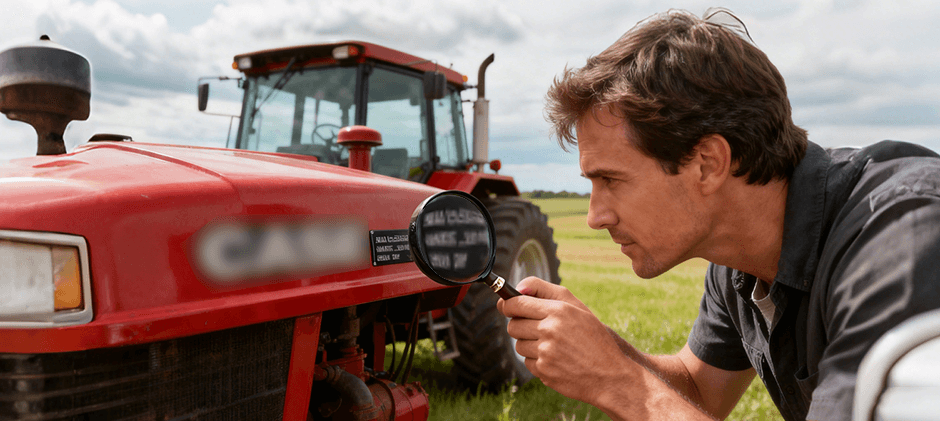
CASE Serial Number Lookup
When you perform a Case serial number lookup, the system translates those stamped digits into a meaningful record containing:
- Manufacturer code
- Model type
- Configuration code
- Assembly plant
- Year of manufacture
- Sequential production number
This section also explains why many owners see the term Case IH (Case International Harvester) associated with their equipment, even when dealing with construction rather than agricultural models.
Why Case International Harvester (IH) Appears?
The merger of J.I. Case Company and International Harvester in 1985 created the Case IH agricultural brand, alongside Case Construction Equipment for industrial and off-road machinery.
Although Case IH focuses primarily on farm equipment — tractors, combines, sprayers — the technology of identification and numbering systems from that merger influenced all Case-model machinery, including dozers and backhoes.
That means your machine’s VIN or serial data structure often follows a pattern first standardized by Case IH.
Case International Harvester Serial Numbers
Serial numbers for early Case IH machinery follow year-based incremental patterns. For instance, older models such as the Case 430, 580 Super D, or 8950 Magnum Tractor carry serial sequences beginning with plant codes that denote manufacturing decades (e.g., prefixes like JJE, JJF, or JJA).
The pattern can help determine production eras:
| Prefix | Typical Model Range | Era |
|---|---|---|
| JJE | CX and Maxxum Series | Late 1990s–2000s |
| JJF | 5100–5200 Series | Early 1990s |
| JJA | Magnum Series | Late 1980s–1990s |
| HFJ | JX Series Compact Tractors | Early 2000s |
When restoring or refurbishing legacy models, identifying the serial prefix is crucial to sourcing the compatible transmission kits, fuel injectors, and axle components.
Example: A Case Model 5120 with a JJF1000001 serial prefix indicates a 1990–1991 production range.
Case IH Engine Serial Number
Your engine serial number (ESN) offers a separate layer of information — it’s especially useful for engine rebuilds, injector replacement, or performance diagnosis.
Typically, you’ll find it stamped vertically on the right-hand side of the block or inscribed on a metal nameplate bolted near the injection pump.
A Case IH engine serial number usually includes:
- Engine Family / Series Code (first few characters).
- Plant Code – tells you where the engine was built.
- Production Year / Batch Code.
- Unique Serial Identifier.
For example, an engine labeled F5BF412C*A12345 could mean:
- F5BF – Fiat Powertrain engine type
- 412C – Cylinder configuration
- A – Plant designation
- 12345 – Unit sequence
Decoding this ensures accurate ordering when matching fuel injectors, oil seals, or turbo kits for machines like the CASE SR270 skid steer or CX350D excavator.
If you’re replacing damaged engine components, explore the wide range of Case parts on FridayParts. Their aftermarket components are made to rigorous standards and are available for both older and current Case off-road models.
Case IH Vehicle Identification Number (VIN) or PIN
Every modern Case IH or Case Construction vehicle is equipped with a VIN (Vehicle Identification Number), also known as a PIN (Product Identification Number).
This 17-character alphanumeric code provides a snapshot of your machine’s design DNA — including its model line, production series, and configuration.
Common VIN locations include:
- On the chassis frame, near the transmission crossmember.
- Embossed on the right-hand frame rail below the cab entry step.
- On the cab plate near the operator seat or door jamb.
Like car VINs, each segment of a CASE VIN tells a story:
| Section | Meaning |
|---|---|
| 1–3 | Manufacturer Identifier (CNH / Case IH) |
| 4–8 | Equipment Descriptor (Model, Engine, Machine Type) |
| 9 | Security Check Digit |
| 10 | Production Year |
| 11 | Manufacturing Plant Code |
| 12–17 | Sequential Serial Number |
If the VIN plate is hidden by add-on frames (especially on older loaders), installers often stamp or restamp it on exposed surfaces, such as the top of the bolster.
VIN Schema for Case IH
While VIN formats evolve slightly across decades, Case IH follows ISO-compliant structures. Below is a simplified example for decoding: YDH214CJP7113456
| Code Segment | Details |
|---|---|
| YDH | Manufacturer: CNH / Case IH |
| 214C | Product Line: CX240 Excavator |
| J | Plant Code: Japan factory |
| P | Production Year: 2023 |
| 7113456 | Sequential Number |
This format not only improves tracking and warranty support but also ensures that when you order a replacement hydraulic coupler or wiper arm kit, suppliers can trace exact model compatibility.
If your VIN doesn’t match a public record or seems incomplete, contact official CASE support or consult trusted aftermarket suppliers like FridayParts, who can validate serial structure before dispatching parts.
FAQs: Case Serial Number Lookup
1. Can I find my serial number online?
Only through authorized CASE databases or verified dealers. Some third-party tools may assist, but confirm authenticity to avoid misinformation.
2. What if my VIN or plate is missing?
Provide engine and transmission model details to cross-check your serial identity. Dealers or parts suppliers often maintain production records to help you recover it.
3. How does the serial number affect aftermarket part purchasing?
Every CASE build year can have design variations — even between identical models. Matching serial data ensures correct fitment, hydraulic compatibility, and avoids downtime.
4. Are serial numbers the same for Case IH and Case Construction?
No, but their VIN logic shares a similar foundation due to the CNH Industrial parent brand structure.
Conclusion
Mastering your Case serial number lookup means faster diagnostics, fewer repair delays, and longer equipment life. The more accurately you identify your machinery, the better you can maintain it with suitable parts and upgrades. Whether it’s engine rebuilds, hydraulic replacements, or cab components — your CASE deserves precision, and FridayParts helps you achieve exactly that.
