

Need the fuse box location on a Kubota fast? Start with the equipment type. The dash or operator station is common on most tractors. BX models tend to have it lower, near the seat or battery. RTVs often place it under the seat or behind a cover. Excavators keep it in a side electrical compartment. This guide shows the most likely areas first, what the panel looks like, and how to narrow the search quickly.
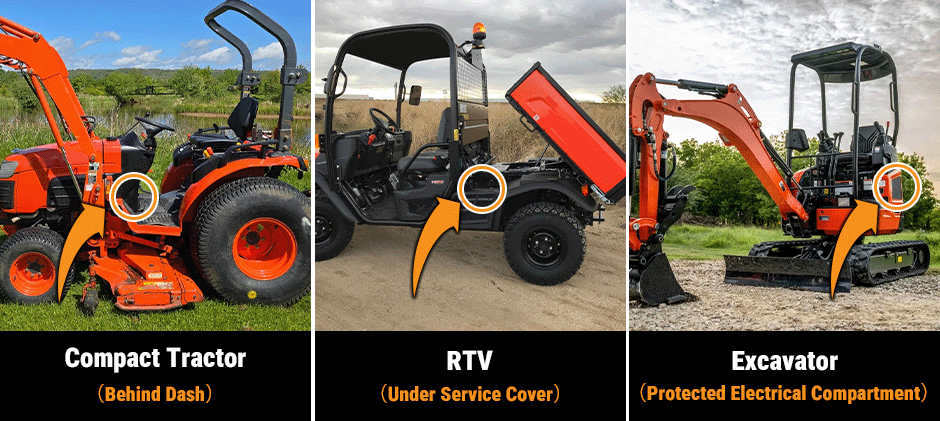
Fuse Box Location by Kubota Equipment Type
The fuse box location on Kubota equipment depends first on the machine type. Tractors, RTVs, and excavators do not use the same access layout. If the machine is a tractor, the next step is to narrow it down by series such as BX, B, L, or M.
| Equipment Type | Tractor Series or Model Group | Common Fuse Box Area | First Place To Check |
|---|---|---|---|
| Tractor | BX Series | Lower operator area, battery side, or side cover | Seat base and side access panel |
| Tractor | B Series | Behind the dash or lower instrument panel | Steering support area |
| Tractor | L Series | Dash support, lower control area, or side panel | Under-dash section |
| Tractor | M Series | Main control panel or protected cab section | Operator control area |
| Utility Vehicle | RTV models | Under seat or interior service cover | Seat base and side cover |
| Construction Equipment | Excavator models | Side electrical compartment or sealed fuse box | Service compartment near main harness |
On many tractors, the dash area is still the best first check. On RTVs and excavators, the panel is more often placed in a protected compartment.
Where To Look by Equipment Type?
The fuse box location becomes easier to find once the machine family is clear. Start with the control area on tractors. Start with the seat base or protected service section on RTVs and excavators.
Tractors
On many Kubota tractors, the fuse box is near the main control and wiring area. Check behind the dash first. Then check below the instrument panel and around the steering support. This layout is common on many B Series and L Series tractors. If the panel is not visible, look for a small plastic cover near the ignition switch, gauge cluster, or lower dash trim.
On BX Series tractors, the layout is tighter. The panel may sit lower than expected. It is often closer to the seat base, battery area, or side engine cover than to the upper dash. That is why the fuse box location on BX models should not be assumed to match that of a larger tractor.
On M Series and some cab tractors, the panel may be in the main operator control section or inside a protected cab area. Extra circuits for lights, fans, or other cab functions can shift the panel away from the lower dash section used on smaller tractors.
Use this order on tractors:
- Behind The Dash – A common first check on B Series and L Series tractors.
- Below The Instrument Panel – Often close to the steering column or ignition switch.
- Near the Main Wiring Junction – Look for grouped harnesses and relays.
- Inside A Protective Cover – Some fuse blocks are hidden behind a small plastic lid.
- Near the Battery Side on BX Models – This is a useful checkpoint on smaller tractors with tighter layouts.
If the panel is not visible right away, follow the main wiring path from the control area. In many cases, that leads to the correct service zone.
RTVs
On Kubota RTVs, the fuse box usually follows a utility vehicle layout rather than a tractor layout. Check the seat base first. Then check behind an interior access cover or side service panel.
Common RTV fuse box areas include:
- under the seat
- behind an interior cover
- near the battery compartment
- beside the main wiring junction
- near relay sections in the operator area
A compact cover is common here. The panel may not be exposed until that cover is removed.
Excavators
On Kubota excavators, the fuse box is usually placed in a more protected section. Side electrical compartments are common. Sealed electrical boxes are also common.
This layout helps protect the panel from dirt, moisture, and vibration. It also moves the fuse box location farther from the open operator area than on a small tractor.
Common excavator fuse box areas include:
- side electrical compartment
- sealed relay and fuse box
- service panel near the battery
- main harness junction area
- compartment near the disconnect switch
If the operator area does not show an obvious fuse cover, move to the side service compartment that holds the main electrical wiring. In that section, the fuse box is often grouped with other protected components.
What Does the Fuse Box Look Like and How To Find It Faster?
The fuse box is usually a small plastic fuse block with several blade fuses grouped together. Many Kubota machines have a black cover. Some covers also show a simple fuse chart.
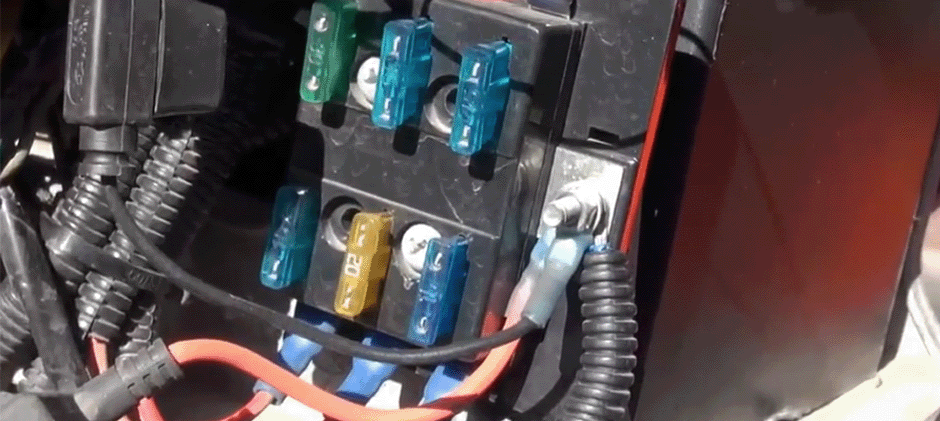
Look for these signs first:
- colored blade fuses
- printed amp ratings such as 10A, 15A, 20A, or 30A
- relay sockets nearby
- a molded plastic cover
- one harness splitting into smaller wires
- labels for lights, ignition, meter, starter, or accessory circuits
The cover can save time. Many Kubota fuse box covers show:
- fuse numbers
- amp values
- circuit names
- relay positions
- simple line diagrams
If a plastic box has no blade fuses, no fuse chart, and no printed ratings, it may be another electrical unit rather than the main panel. Some machines also use a separate inline fuse or main fuse near the primary block. That is normal.
A clear search order works better than trial and error.
- Identify The Equipment Type – Decide whether the machine is a tractor, RTV, or excavator.
- Narrow Tractors by Series – If it is a tractor, check whether it is a BX, B, L, or M model.
- Check the Main Control Area – On many tractors, this means the dash and lower instrument section.
- Look For A Small Cover – Fuse blocks are often protected by a removable plastic lid.
- Follow The Wiring Harness – If the fuse box is not visible, trace the harness from the ignition switch or battery toward the nearest protected junction.
- Check The Side Compartment on RTVs and Excavators – These machines often move the panel away from the dash area.
This method works because the fuse box location is usually close to the protected wiring section, not randomly placed elsewhere on the machine.
Common Mistakes
The most common mistake is using the wrong layout as a starting point. A BX tractor does not always follow the same fuse box path as a B or L Series tractor. An RTV does not use the same access pattern as a tractor. An excavator often places the panel deeper inside a service compartment.
Avoid these mistakes:
- checking only behind the dash on every model
- ignoring the seat base on BX tractors and RTVs
- opening deep engine covers first
- confusing an inline fuse holder with the main panel
- using one series answer for another machine type
Final Words
The right fuse box location is usually easier to find once the machine type is clear. Many Kubota tractors place it around the dash, while BX models and larger non-tractor equipment often use a lower or more protected access point. If replacement parts are needed, FridayParts offers aftermarket parts, high-quality products at affordable prices, a vast inventory, and wide compatibility for many heavy equipment brands.
