

To bench test a starter, simply secure it in a vise, connect it to a fully charged 12V battery using jumper cables, and trigger the solenoid to see if the gear extends and spins forcefully. In this guide, we will walk you through exactly how to bench test a starter step-by-step.
What Is a Starter Bench Test and When Do You Need One?
A bench test is an easy way to check a starter. You take the starter off the engine and hook it straight to a battery on your workbench. This separates the starter from all the rest of your machine’s electrical parts. That way, you can rule out other problems such as bad ignition switches, corroded battery wires or faulty safety switches.
Do this test only after you know your battery is fully charged and working well, but the engine still won’t turn over. Before you pull the starter out, use a multimeter to check your battery voltage. A good battery reads about 12.6 volts. If your battery is good and the terminals are clean and tight, but you still hear fast clicking, one heavy clunk, or slow, weak cranking when you turn the key — it’s time to take the starter out and bench test it.
Running this direct test shows you if internal parts like the armature or brushes are broken. It also keeps you from buying a new starter when the real problem is just a bad ground wire on your tractor frame.
Tools You Need to Bench Test a Starter
Before we begin, we need to gather a few basic tools. Having the right equipment ensures the test is safe and accurate.
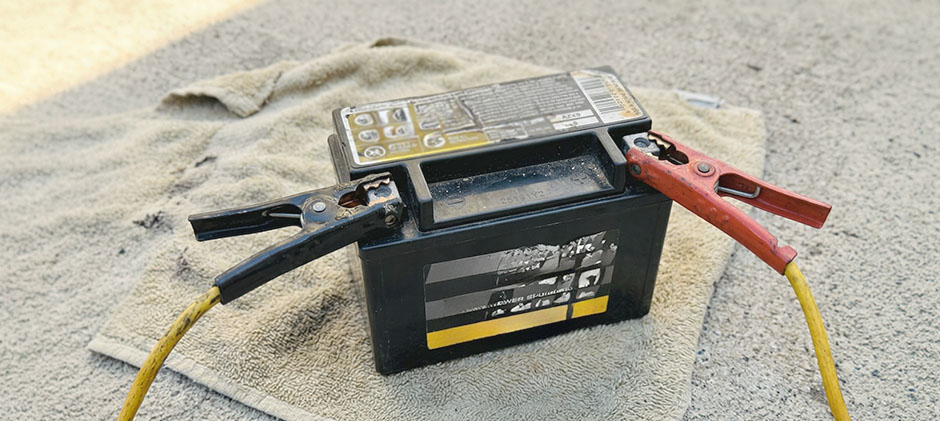
- A fully charged 12V battery: This acts as our reliable power source. Do not use a weak battery, as it will give false test results.
- Heavy-duty jumper cables: We need thick cables to handle the high electrical current required to spin the motor.
- A bench vise: This is crucial for safety. The motor generates a lot of torque and will jump violently if not secured.
- A multimeter: We use this to check our battery voltage and verify power flow.
- Safety glasses and gloves: Sparks are very common during this test, so eye and hand protection is mandatory.
- A small jumper wire: This is needed to trigger the solenoid terminal during the test.
How to Bench Test a Starter Step by Step?
This basic test checks the main spinning function of the motor.
- Clamp the starter securely in your bench vise. Do not clamp it too tight on fragile plastic parts or thin metal housings, but make sure it is held firmly by the solid mounting flange.
- Set up ground connection. Take the black negative jumper cable and attach one end to the negative post of your fully charged battery. Attach the other end of the black cable directly to the metal housing or the mounting ear of the starter. This metal-to-metal contact provides a solid ground path.
- Connect the power. Take the red positive jumper cable and attach one end to the positive post of the battery. Carefully take the other end of the red cable and touch it to the large main power terminal on the starter. This is usually the thickest threaded post on the unit.
Touch the clamp to the terminal, and the motor should spin right away. A small spark may pop up when they make contact — that’s totally normal.
- If it spins fast and smoothly, the internal windings and brushes are good.
- If nothing happens, or it turns really slow, the starter’s internal parts are worn out.
How to Test the Starter Solenoid and Bendix Gear?
Spinning is only half the test. To crank the engine, the starter solenoid has to push the Bendix gear out so it locks onto the flywheel. If the gear won’t pop out, the motor just spins freely. You’ll hear a whir, but the engine never turns.
We need to trigger the solenoid to check both jobs at once. Leave your ground cable clipped to the starter’s metal housing. Keep the main red power cable on the starter’s big battery terminal.
take your small jumper wire. Touch one end to the positive clip of your jumper set, which is already connected to that large terminal. Touch the other end to the small trigger post on the solenoid. This post is usually marked “S”, and that’s where the ignition switch wire hooks up normally. When you send power to this small post, two things need to happen together:
- You hear a firm, loud click from the solenoid.
- The Bendix gear shoots out quickly, and the motor spins fast.
If the gear pops out but the motor doesn’t spin, burned contacts inside the solenoid prevent power from reaching the motor. If the motor spins but the gear stays tucked in, broken mechanical parts inside the solenoid or a stuck gear on the shaft cause the problem. You might be able to free a jammed gear by hand, but a good starter should push that gear out smoothly every time you power it up.
How to Tell If a Starter Is Good or Bad?
Once you finish testing, check your results to find out what’s wrong. Here’s an easy guide to tell if your starter works or has failed.
What a good starter does:
- Spins fast and strong: It hits full speed right away, no lag.
- Gear moves smoothly: The Bendix gear pops out firmly and pulls back fast once power cuts off.
- Works consistently: It acts the same every time you apply power during the test.
Signs of a bad starter:
- Nothing at all: When you apply power and there’s total silence, its internal wiring is fully broken.
- Just one click, no spin: The solenoid tries to activate, but the motor is seized or its internal contacts are burned.
- Slow, weak spin: Worn brushes, a bad armature or internal shorts draw too much current and cause this sluggish cranking.
- Grinding sound: Metal-on-metal scraping means the internal bearings are ruined.
- Gear won’t pop out: The motor spins, but the Bendix gear stays tucked in. It can never catch the flywheel to start your machine.
If you see any of these bad signs, don’t reuse this starter. You need to replace it.
Summary
Knowing how to bench test a starter keeps you from wasting time swapping out the wrong parts. Test the starter on its own, check that it spins and pushes out the Bendix gear, and you’ll know exactly what’s causing your starting problem. When you need a new starter, FridayParts is your go-to source for reliable aftermarket replacement parts.
