

Checking the hydraulic fluid level on a Kubota tractor is straightforward: park on level ground, turn off the engine, and locate the dipstick or sight glass, which is usually at the rear of the machine. Keep reading. This guide covers more operation details and common mistakes to watch out for.
Where Is the Hydraulic Fluid Reservoir?
Before we can check the fluid, we first need to know where to look. The location of the hydraulic fluid reservoir and its checking mechanism can differ slightly across the wide range of Kubota tractor models. However, they are generally found in one of a few common areas.
- On many compact and sub-compact Kubota models, you will find the access point at the rear of the tractor, often near the three-point hitch assembly. It might be a dipstick that looks similar to an engine oil dipstick or a fill cap that has a dipstick attached to its underside.
- On other models, especially those with a cab or a more complex frame, the check point might be a sight glass. This is a small, circular glass window built into the side of the transmission or hydraulic case. You can often find it by looking at the side of the rear axle housing, sometimes just below the operator’s seat.
- You may need to look on both the left and right sides of the tractor, as the placement varies. If you are having trouble locating it, your owner’s manual is the best resource for a precise diagram showing its location for your specific model.
How to Check the Hydraulic Fluid Level on a Kubota Tractor?
There are two primary methods for checking the fluid, depending on whether your tractor uses a dipstick or a sight glass. We will cover both in detail. Regardless of the method, always start by following the safety preparations outlined in the next section.
Method 1: Checking with a Sight Glass
Many modern Kubota tractors are equipped with a sight glass, which makes checking the fluid level incredibly simple.

- Locate the Sight Glass: As mentioned, the sight glass is typically a small, round window on the side of the rear axle or transmission housing. It may have a red circle or dot in the center, or two lines indicating the high and low marks.
- Read the Level: With the tractor parked on level ground and turned off, simply look at the glass.
- If you see the oil level resting between the two marks, or if you see a “bubble” or red dot floating in the center of the glass, your fluid level is correct.
- If the glass is completely empty and you see no oil, your level is too low and you must add fluid.
- If the glass is completely full with no bubble visible, your fluid level might be too high. This is less common but can cause issues with fluid expansion when it heats up.
- Consider Your Attachments: Here is a pro tip that solves a very common problem. If you connect a hydraulic attachment, like a log splitter or a hydraulic top link, that attachment’s cylinders will require a large volume of fluid to operate. When you first connect it and cycle it, it will draw fluid from the tractor’s reservoir, causing the level in the sight glass to drop. After connecting a new attachment, always run the tractor and cycle the attachment’s hydraulics a few times, then shut down and re-check the sight glass. You will likely need to top off the fluid to bring it back to the correct level.
Method 2: Checking with a Dipstick
If your tractor doesn’t have a sight glass, it’ll come with a dipstick instead, and checking the hydraulic and transmission fluid is basically the same as checking your engine oil.
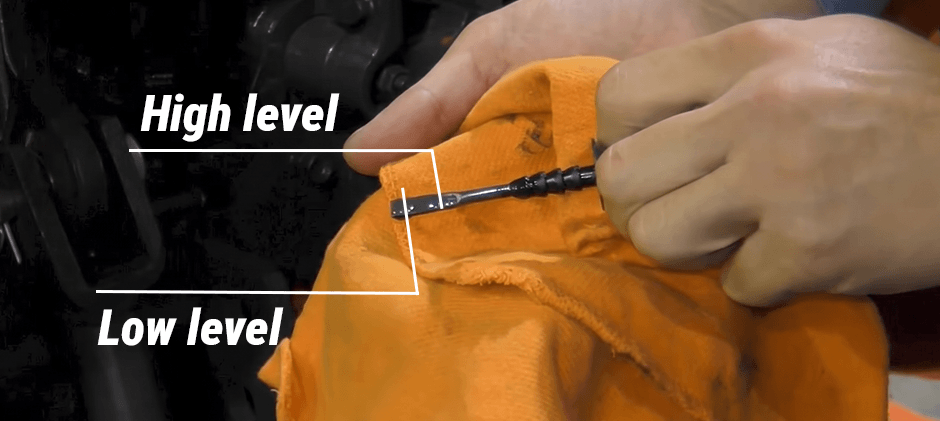
- First, find the dipstick. It’s almost always at the rear of the tractor. It has a large cap, usually orange or yellow, either a screw-on type or a T-handle.
- Before you touch it, wipe off all dirt and debris around the cap with a clean rag. This step is really important. If dirt falls into the hydraulic system, it can cause serious damage.
- Next, take out the dipstick and wipe it completely clean. Push it all the way back in until it sits firmly. If it’s a screw-in dipstick, tighten it all the way down. Then pull it out again to check the fluid level.
- Check the markings on the end of the dipstick. You’ll either see a cross-hatched safe zone or two lines marked H for high and L for low. Hydraulic fluid is clear, so it can be hard to spot — tilt the dipstick toward the light to see it clearly. Your fluid level just needs to stay inside that marked safe range. You don’t have to fill it right up to the H line. Anywhere in the hatched area is fine. If the level is below the L line, you need to add more fluid right away.
Important Tips for Checking Hydraulic Fluid
To ensure you get an accurate reading and perform the check safely, always follow these important tips.
- Park on Level Ground: Even a small slope will shift the fluid and give you a wrong reading. A flat garage floor or paved driveway works best.
- Turn Off the Engine and Let it Cool: Hydraulic fluid expands when hot, so checking it warm will make the level look higher than it really is. A cold check gives you the most accurate result, and it also keeps you from burning yourself on hot parts.
- Wear Protective Gear: It keeps your hands clean and protected.
- Use the Correct Fluid: This cannot be overstated. Check your owner’s manual. Most Kubota tractors need Super UDT2 trans-hydraulic fluid. Don’t just grab cheap generic hydraulic fluid unless it clearly meets Kubota’s specs. Saving a little money on the wrong fluid will ruin your seals and cost you way more in repairs later.
Understanding Hydraulic Fluid
A lot of people just think hydraulic oil is “another regular oil,” but it’s actually the lifeblood of your tractor’s power system. It does way more than just lubricate parts.
- Moves power around your machine. When you pull a lever to lift your loader or move an attachment, the hydraulic pump pushes this fluid under pressure, and that’s what does all the heavy lifting. If your fluid level is too low, the pump sucks in air instead of oil. Air compresses easily, so your loader and attachments start feeling weak, spongy, and slow. That’s usually the first sign something’s wrong.
- Cool your hydraulic and transmission parts. These components get extremely hot while working. The hydraulic fluid circulates through the system, picks up heat, and releases it through the tractor’s housing. When you’re low on fluid, the system can’t cool itself properly. This causes overheating, which wears out seals, pumps, and valves fast — and can lead to permanent damage.
- Has special additives built in. They stop rust and corrosion inside your lines, prevent foaming (foam causes the same weak performance as low fluid), and protect gears and moving parts from wear.
Using the wrong fluid or letting the level drop too low will cause serious, expensive damage to your tractor’s key components.
Conclusion
Checking your hydraulic fluid on a routine basis is one of the simplest and most useful maintenance jobs for your Kubota tractor. If you find worn seals, broken hoses or other faulty parts during your inspection, FridayParts can help you out. We carry a huge selection of reliable, budget‑friendly aftermarket parts that fit many different models.
