

The outer tie rod end usually goes before the inner one. It’s the one out in the open, copping all the mud, water, and rocks. The inner end sits tucked away under a rubber boot, so it doesn’t take nearly the same punishment. This guide helps you work out which one is causing your steering trouble—so you’re not guessing and changing the wrong part.
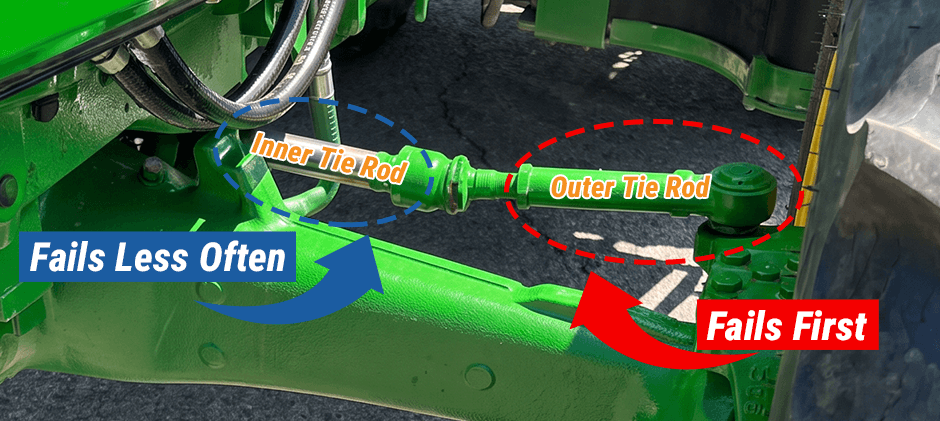
Why the Outer Tie Rod End Wears Out First?
The inner tie rod takes motion from the steering rack and passes it to the outer tie rod. The outer tie rod takes that motion and turns the steering knuckle, which points the wheel. Both ends are ball joints that allow movement, but the outer one is exposed to the elements, while the inner one sits protected under a rubber boot.
The outer rod’s boot gets torn by rocks and debris. Once that happens, grease leaks out. Dirt and water get in. The joint wears out fast. The inner tie rod sits inside a bellows boot near the steering rack. It is protected from direct hits, so it lasts longer. That is the basic reason the outer rod fails first.
| Component | Where It Sits | How It Fails |
|---|---|---|
| Outer tie rod | Between inner rod and steering knuckle | Boot tears, joint wears from debris and moisture |
| Inner tie rod | Inside bellows boot near steering rack | Boot tears and dirt enters, or high-hour wear |
If you feel play in the steering, start by checking the outer tie rod end since it is the most common steering replacement part in this area. Only move to the inner tie rod after you have ruled out the outer one.
What Happens When Each One Wears Out?
A bad outer tie rod wears out your front tires fast. One tire can cost hundreds of dollars to replace. That is just the tire. The real problem is safety. If the outer joint separates, you lose steering control on that wheel.
A bad inner tie rod often means replacing the boot too. That adds time and parts cost. If you ignore a worn inner rod, the damage spreads to the steering rack. That repair costs much more than a tie rod. Catching the problem early saves you money and downtime. The symptoms in the next section will help you figure out which part is worn.
How to Check for Wear – Step by Step
Get the front wheels off the ground. Use a jack and stands. Make sure the machine is stable. Never work under a machine supported only by a jack.
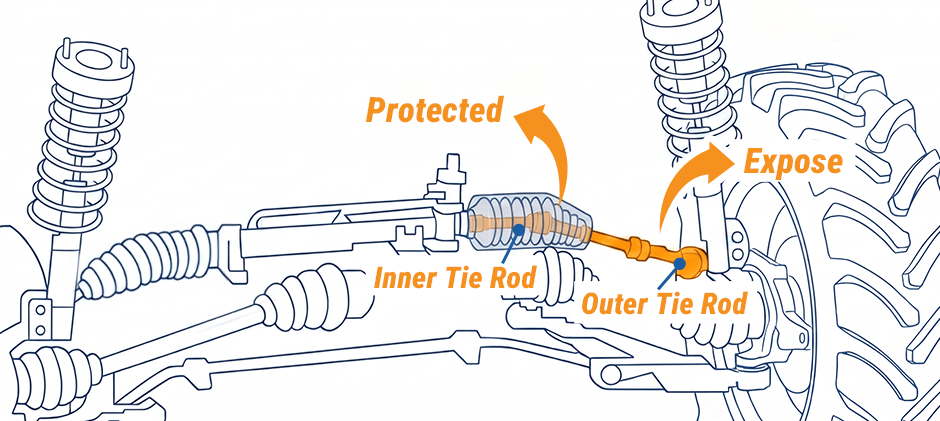
Step 1: The 3-and-9 O’Clock Test
Grip the tire at the 3 o’clock and 9 o’clock positions. Push with one hand and pull with the other. Rock the tire side to side. Do this firmly.
If you feel slack, look at the outer tie rod while you rock the tire.
- If you see the joint moving up and down or side to side, the outer tie rod is worn.
- Watch the ball stud. If it moves in and out of the socket, that is play.
Step 2: Check the Inner Tie Rod
Reach behind the wheel and grab the inner tie rod through the bellows boot. Squeeze the boot and feel the joint inside. Have someone rock the tire at 3 and 9 while you hold the inner joint.
- If you feel clunking or movement at the inner joint, but the outer joint is tight, the inner tie rod is bad.
- If you feel play in both, replace both.
- If the rack moves side to side inside the housing, you may have a steering rack issue.
Step 3: Visual Inspection
Check the boots on both joints of the tie rod. Look for tears, cracks, or grease leaking out.
- Outer boot torn and joint feels loose → Replace the outer tie rod end.
- Inner boot torn and joint has play → Replace the inner tie rod.
- Boot torn but no play yet → Replace the boot. You can save the joint and protect the steering rack from future damage.
Check the grease too. If it is black or gritty, dirt has already gotten inside. Even if the joint does not feel loose yet, it will fail soon.
Symptoms That Tell You Which One Is Bad
| Symptom | More Likely Culprit |
|---|---|
| Clunking noise when driving over rough ground | Outer tie rod |
| Machine wanders left and right on a straight path | Outer tie rod |
| Steering wheel feels loose with a dead spot in the center | Outer tie rod |
| Uneven tire wear on inside or outside edge of front tires | Outer tie rod |
| Shimmy or shake in steering wheel at certain speeds | Inner tie rod |
| Vague steering feel with no clunking over bumps | Inner tie rod |
| Play felt when pushing tire side to side, but outer joint looks tight | Inner tie rod |
A quick rule of thumb: Clunking over bumps points to the outer tie rod. Vague steering or shimmy at speed without clunking points to the inner tie rod.
What to Do After You Find the Worn Part?
Once you know which joint has play, replace it. Follow these guidelines:
- Replace both sides. Steering parts wear together. If one outer tie rod is bad, the other is not far behind. Do both at the same time. Same for inner tie rods.
- Count the turns. When removing an inner tie rod, count the turns to unscrew it from the rack. Install the new one with the same number. This keeps your toe setting close.
- Use a tie rod tool. A pipe wrench can damage the rack. Get the right tool.
- Get a wheel alignment. You must do this after replacing any tie rod. Skipping alignment causes uneven tire wear and poor handling.
- Replace the boot too. A new joint with an old torn boot will fail quickly. Protect your new joint with a fresh tie rod boot or steering rack boot.
- Torque it right. Use a torque wrench. Over-tightening or under-tightening is dangerous. Look up the specs for your machine.
Final Thoughts
The outer tie rod fails first in most cases because its boot takes the most damage from rocks and debris. The inner tie rod lasts longer since it sits protected. To find the problem, use the 3-and-9 test to check for play, and watch the boots for tears. Once you identify the worn part, replace it promptly—and do both sides so the steering feels even. After the job, get a wheel alignment; skipping this step causes uneven tire wear and poor handling. When it is time to replace worn steering parts, FridayParts supplies aftermarket components built for tough conditions. We stock a wide range of tie rods for many machine types. Check our selection and find the right parts for your machine.
