

The John Deere 310 is one of the most common backhoe models on the market, and also one of the most confusing. The same model number has been used for five decades on machines that share little beyond the badge—from the early 52 hp units to today’s 100 hp P-Tier. Before ordering parts or comparing specs, you need to know which 310 you are dealing with. This guide covers the key differences across generations and shows you how to identify the right parts for your machine.
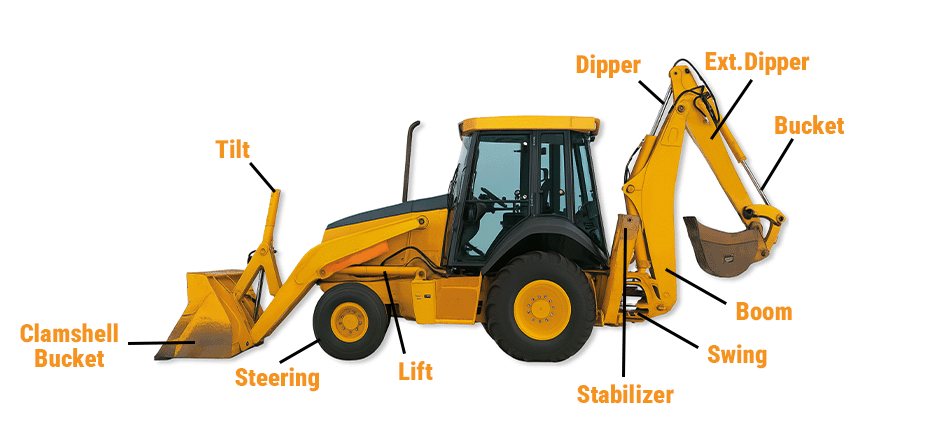
Key John Deere 310 Backhoe Specs
The most useful way to read John Deere 310 backhoe specs is not as isolated numbers, but as clues to how the machine will actually work. Engine power affects how confidently the machine handles repeated digging and loader cycles. Operating weight changes stability and transport planning. Digging depth indicates how well the machine suits trenching work. Transmission type affects ease of operation, especially when the machine spends the day moving between forward and reverse.
Engine and Power
Power is one of the first specs most buyers check because it directly shapes jobsite performance. Maintaining that power over time depends on regular service of engine components such as fuel systems.
An early John Deere 310 was around 52 hp, while the 310 G-Tier sits in the 69 hp class and the 310 P-Tier reaches 100 hp. That spread matters. Older machines can still handle farm work, light trenching, and property maintenance, but later models are better suited to repeated loader work and longer production days.
| Model | Engine | Net Power | What It Means in Use |
|---|---|---|---|
| Early John Deere 310 | diesel engine | about 52 hp | suitable for lighter work and simpler ownership |
| 310 G-Tier | Yanmar 3.3L | about 69 hp class | a newer value-focused machine with enough power for mixed-use work |
| 310 P-Tier | John Deere FT4 engine | 100 hp | stronger fit for demanding trenching and higher daily output |
Operating Weight
Operating weight affects machine balance, digging feel, and hauling requirements. Lighter machines can be easier to transport, but heavier machines often feel more planted during loader work and trenching. That is why weight should be read together with the kind of work the machine will do.
| Model | Operating Weight | What It Means in Use |
|---|---|---|
| Early John Deere 310 | about 12,750 lb | lighter and simpler, often suitable for farm and property tasks |
| 310 G-Tier | about 13,907 to 15,527 lb | heavier platform with better stability than older machines |
| 310 P-Tier | about 15,221 lb | modern operating range with a more production-oriented feel |
For buyers working on soft ground, transport-limited jobs, or small sites, operating weight can be just as important as horsepower.
Digging Depth
Digging depth helps show whether the machine fits utility trenching, drainage work, and general excavation. Even a small difference can affect how often the operator needs to reposition.
| Model | Digging Depth | What It Means in Use |
|---|---|---|
| Early John Deere 310 | about 181 in | workable for general trenching and lighter excavation |
| 310 G-Tier | 13 ft 8 in | suitable for many common utility and site-prep tasks |
| 310 P-Tier | 14 ft 1 in | slightly better reach for repeated trenching work |
For contractors, this spec is not just about maximum reach. It also influences efficiency in real trench layouts where repositioning costs time.
Transmission Type
Transmission choice changes the way a backhoe feels throughout the day. A straightforward setup may appeal to value-focused buyers, while a more advanced transmission can improve rhythm and productivity when the machine constantly shifts between digging, loading, and moving.
| Model | Transmission | What It Means in Use |
|---|---|---|
| Early John Deere 310 | power reverser | older but familiar setup when kept in good condition |
| 310 G-Tier | 4-speed manual synchromesh | simpler and more budget-focused |
| 310 P-Tier | PowerShift | easier operation for repeated forward-reverse work |
For some buyers, the transmission matters almost as much as the engine. It changes how the machine feels and how much you get done in a shift.
John Deere 310 Backhoe Model Evolution
The John Deere 310 name didn’t change, but the machines did—a lot. Knowing what changed helps you sort through used listings and keeps you from ordering the wrong parts.
Early John Deere 310
The early 310 came out in 1971 with about 52 hp. It was straightforward and mechanically basic. That’s still part of the appeal. Some people prefer an older 310 for lighter work because it doesn’t have all the emissions gear that newer machines do.
Later 310 Variants
Models like the 310L, 310L EP, and 310SL fall in the middle of the 310 timeline. A lot of used buyers run into these. They represent the step between older utility-style backhoes and more modern contractor machines. Better cabs, more productivity, and overall improvements came with these.
310 G-Tier
The 310 G-Tier is the value option. It’s got a Yanmar 3.3L engine, a manual transmission, and about 69 hp. It costs less, keeps it simple, and works well for rental fleets, municipalities, smaller contractors, and anyone who wants a newer machine without paying for the top power tier.
310 P-Tier
The 310 P-Tier is the one you buy when production matters. More power, a PowerShift transmission, and a Final Tier 4 engine set it apart. If you’re doing heavier work and want smooth operation and stronger performance, this is the one. The price tag is higher, but so is the output.
John Deere 310 G-Tier vs 310 P-Tier
The John Deere 310 G-Tier vs 310 P-Tier comparison is one of the most useful buying decisions in the current lineup. These two machines serve different priorities even though they share the same 310 family name.
| Category | 310 G-Tier | 310 P-Tier |
|---|---|---|
| Power | about 69 hp class | 100 hp |
| Transmission | 4-speed manual synchromesh | PowerShift |
| Hydraulics | 32.8 gpm axial piston pump | about 28 gpm gear pump |
| Operator expectations | straightforward and value-oriented | smoother, more production-focused feel |
| Ideal buyer profile | rental fleet, mixed-use owner, budget-conscious contractor | contractor needing stronger output and a faster daily pace |
| Buying logic | lower entry cost | stronger performance |
The G-Tier is the simpler choice. It is well suited to buyers who care about cost control, straightforward ownership, and a machine that can cover general-purpose work without aiming for the top end of the performance range.
The P-Tier is the stronger choice for buyers who expect the machine to stay busy in trenching, loader cycles, and active construction work. Its added horsepower and PowerShift transmission make it easier to justify when productivity matters more than entry price.
How the 310 Performs in Real-World Work
The John Deere 310 remains popular because it can cover several types of work with one machine.
- Trenching and utility work: both newer models are practical, but the P-Tier is better suited to repeated digging cycles and longer workdays. The G-Tier is often enough for lighter trenching and municipal or mixed-use jobs.
- Loader work and material handling: the 310’s versatility is one of its strongest advantages. It can dig, move spoil, carry aggregate, and clean up around the site without needing a separate loader.
- Farm and property maintenance: an older 310 may still be a smart buy if the machine is sound. In that setting, simplicity and repairability can matter more than modern output.
- Rental fleet applications: the G-Tier makes sense because it combines a newer platform with a lower acquisition cost and a more straightforward setup.
- Muddy or variable ground conditions: weight, tire condition, and operator judgment all matter. A heavier machine may feel more stable, but site conditions still determine traction and mobility.
In practical terms, the G-Tier leans toward simple durability and budget-focused ownership, while the P-Tier leans toward productivity, stronger power, and more demanding contractor use.
Common Wear Points and Parts Lookup
A used John Deere 310 can look acceptable in photos and still require major repair work. That is why wear inspection matters just as much as reading the spec sheet.
Key areas to inspect include:
- hydraulic leaks at hoses, cylinders, couplers, and valve areas
- boom, dipper, and bucket pin and bushing wear
- transmission engagement quality
- front axle and MFWD condition
- brake response
- steering play
- engine cold-start behavior and smoke
- cooling system condition
- bucket and loader arm cracks or weld repairs
These areas tell you how the machine was used, how well it was maintained, and where repair costs may appear first.
Parts Lookup Table
When doing a John Deere 310 backhoe parts lookup, always match the part to the exact model and serial number range. That step is especially important on the 310 line because the badge covers multiple generations with meaningful mechanical differences.
Final Thoughts
The John Deere 310 remains a useful and recognizable backhoe line because it serves very different kinds of buyers, from owners of older utility machines to contractors comparing today’s G-Tier and P-Tier. The key is to read the specs in context, understand where each model fits, and inspect wear areas carefully before buying or ordering parts. For John Deere 310 parts that fit right the first time, FridayParts carries a range of aftermarket components with verified compatibility for G-Tier, P-Tier, and earlier models.
