

The fuse box on John Deere compact track loaders (such as the 331G and 333G) is located inside the cab behind the left and right side plastic panels, while John Deere tractor fuse boxes (like the 5103) are usually found directly below the dashboard steering console. We have provided the exact John Deere fuse box diagram layouts. Get your machine back to work.
John Deere Fuse Box Location
Finding the fuse panel is the first step in fixing any electrical problem. Depending on the type of machine you are operating, the engineers place these panels in different spots to protect them from dust, moisture, and physical damage.
- For compact track loaders, if you are sitting inside the cab of a modern loader, you actually have a fuse panel on both sides of the interior. You will need to remove the protective plastic covers to reveal the fuses.
- For tractors, the design is slightly different. The main electrical panel is usually located near the operator’s station, often below the dashboard or steering console. To access this area, you typically need to remove four cap screws and lower the protective cover.
John Deere Compact Track Loader Fuse Box Diagrams
When you’re working on your compact track loader, a good John Deere fuse box diagram really comes in handy. These machines have complicated electrics that run both the drive system and your hydraulic attachments.
John Deere 333G Fuse Box Diagram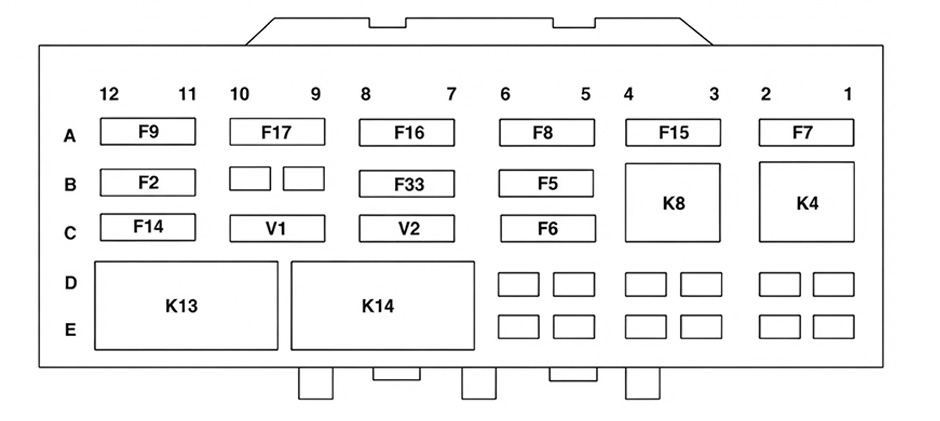
The fuse panel on the 333G uses a grid‑style setup. It’s not just a plain list. Rows are marked A, B, C, D, E and columns go from 1 to 12. This grid makes it easy to find exactly which fuse or relay you need. You’ve got smaller rectangular spots for regular fuses, all starting with “F” — like F9, F17, F16, F8, F15, F7. Then there are bigger square slots marked “K”: K8, K4, K13, K14. Those are relays. Relays work like heavy‑duty switches for high‑current stuff such as your starter or big hydraulic pumps.
Quick example: if your work lights cut out all of a sudden, check slot F6 on the grid. That’s the 25‑amp fuse for the lights.
John Deere 331G Fuse Box Diagram
The 331G shares a very similar electrical architecture with the 333G. Because these machines belong to the same generation and share many attachments, their internal wiring follows the same logic. If your quick-attach system fails on a 331G, you should immediately check the side panels inside the cab. The grid system will guide you to the correct 30-amp fuse. We highly recommend keeping a printed copy of this grid layout inside your cab. When you are out in the field and lose hydraulic control or lighting, matching the “F” and “K” codes on the plastic cover to the actual slots will help you restore power in minutes rather than hours.
John Deere Tractor Fuse Box Diagrams
Tractors generally have a more straightforward electrical layout compared to loaders. The diagrams focus heavily on lighting, basic engine functions, and simple accessories.
John Deere 5103 Fuse Box Diagram
The 5103 tractor uses a highly organized, rectangular panel layout. When you look at the cover, you will see a clear map of what each slot controls. The diagram clearly separates the circuits into different categories.
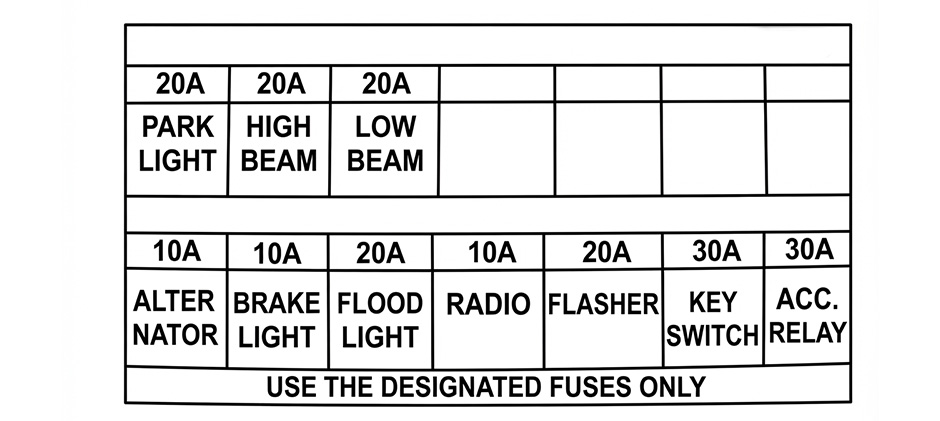
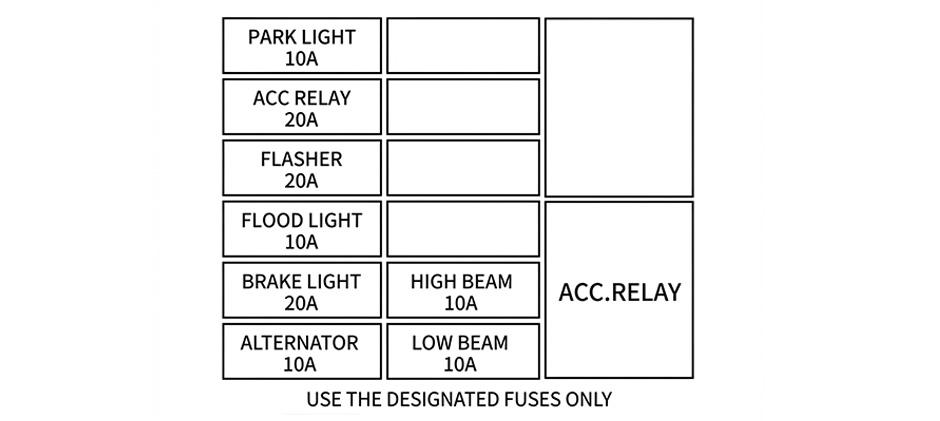
You will find specific slots for the Park Light, High Beam, Low Beam, Alternator, Brake Light, Flood Light, Radio, Flasher, Key Switch, and Acc Relay (Accessory Relay). Each of these functions has a specific amperage requirement to keep the wires from overheating. For instance, the Key Switch requires a heavy-duty 30-amp fuse, while the Radio only needs a 10-amp fuse.
To make replacement easier and safer, the manufacturer uses a strict color-coding system for the fuses on these tractors:
- 10 Amp fuses are Red
- 20 Amp fuses are Yellow
- 30 Amp fuses are Green
“Always use the designated fuses only. Never replace an original fuse with a higher-rated one, or machine damage may occur.”
If you put a green 30-amp fuse into a slot meant for a red 10-amp radio fuse, the electrical load will not break the fuse. Instead, the wires behind the dashboard will overheat, melt, and potentially start a fire.
How to Read a John Deere Fuse Box Diagram?
Reading a John Deere fuse box diagram correctly is a basic skill every operator should learn. The diagram acts as a map between the physical slots on the panel and the electrical components on your machine.
First, locate the legend or the printed label. On tractors, this label is often printed directly on the inside of the plastic cover you just removed. It will list the name of the circuit (like “Alternator” or “Flood Light”) right next to the required amperage (like “10A” or “20A”). On loaders, you will likely see the grid system we mentioned earlier. You must match the row letter and column number to find the right slot. The manual will tell you that “F” stands for fuse and “K” stands for relay.
Always pay attention to blank spaces on the diagram. Sometimes, a panel will have empty slots. These are usually reserved for optional factory upgrades that your specific machine might not have. Do not put a fuse in an empty slot unless you are actively installing a new electrical accessory that requires that specific circuit.
How to Check and Replace a John Deere Fuse?
Whenever something stops working, test the circuit first to check whether your fuse is blown. Start by shutting down the engine and pulling the key out of the ignition. That cuts power to the main circuits so you won’t get shocked accidentally.
Then use your diagram to find the right fuse slot. Grab some needle‑nose pliers or a plastic fuse puller and carefully take the fuse out. Check the bent metal wire inside the colored plastic housing. If that wire is snapped, melted or blackened, your fuse is bad and you need a new one.
Sometimes the break is hard to spot with your eyes. Grab a digital multimeter and switch it over to continuity mode (the beep setting). Touch one probe to each little metal tab on top of the fuse. A beep means the fuse is still good. No beep, and it’s blown out.
When you put the new fuse in, press it solidly into the slot until it sits flush against the panel. Pop the key back in and test the system. If the brand‑new fuse blows right away after you turn the key, stop immediately. You’ve got a short somewhere or badly damaged wiring on the machine. Don’t just keep throwing new fuses in — trace out the wiring or get a pro mechanic to fix it; swapping fuses alone won’t fix the real issue.
Summary
Knowing where the electrical panel is and how to read a John Deere fuse box diagram can help you handle unexpected electrical problems with confidence. FridayParts offers affordable John Deere aftermarket parts to help keep your equipment running smoothly.
