

If you are looking up John Deere S100 riding lawn mower specs and maintenance, the main things to know are fairly simple. The S100 comes with a 17.5 HP single-cylinder gas engine, a hydrostatic transmission, and a 42-inch cutting deck. For most owners, the real maintenance focus is not complicated either. Filters, spark plug, battery, blades, and belts are usually the first items to inspect when the mower starts showing changes in performance. This guide covers the core specs first, then the routine maintenance points and related John Deere S100 parts that are most commonly checked in regular use.
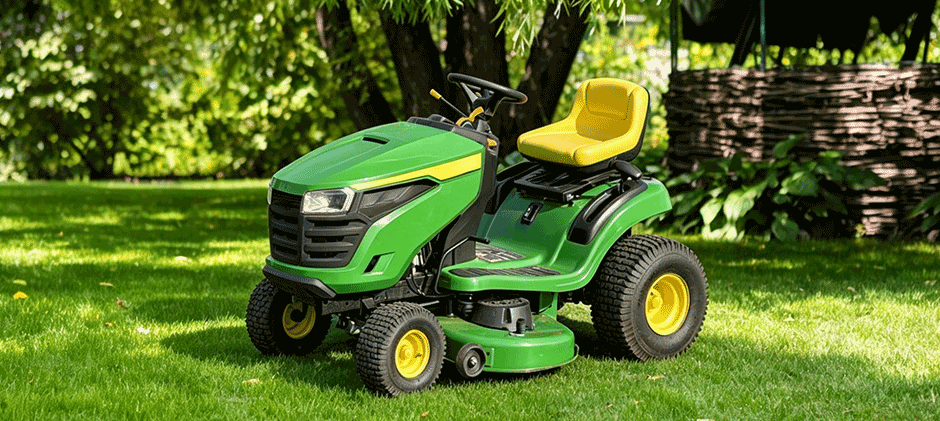
John Deere S100 Overview
The John Deere S100 is a residential riding lawn mower built for routine yard work. Its setup is straightforward: a 42-inch deck, hydrostatic drive, and simple foot-pedal control. That combination makes it a practical option for homeowners who want a mower that is easy to run and easy to maintain.
Here is a quick overview:
- 17.5 HP single-cylinder gasoline engine
- About 500 cc displacement
- Hydrostatic transmission
- 42-inch cutting deck
- About a 1-inch to 4-inch cutting height range
- 2.4-gallon fuel tank
On paper, the machine is simple. In practice, that is a good thing. It means the most common issues can be narrowed down quickly, especially when you start with basic maintenance items instead of assuming a major problem.
Engine, Transmission, and Performance Specs
The S100 uses a 17.5 HP single-cylinder gasoline engine with a displacement of around 500 cc. That is a typical setup for a residential riding mower in this class and gives the machine enough power for regular mowing conditions.
It also uses a hydrostatic transmission. For everyday mowing, this matters more than it may seem. Speed changes are smoother, forward and reverse control feels easier, and the mower is generally less awkward to handle around turns and obstacles than a gear-driven setup.
| Spec | Details | Why It Matters |
|---|---|---|
| Engine power | 17.5 HP | Enough for routine residential mowing |
| Engine type | Single-cylinder gas | Simple layout with straightforward service needs |
| Engine size | About 500 cc | Helps explain the mower’s general power range |
| Transmission | Hydrostatic | Smoother speed control during mowing |
| Fuel tank | 2.4 gal | Reasonable capacity for standard mowing sessions |
| Top speed | Up to 5.5 mph | Fits typical lawn tractor use |
Specs tell you what the mower is built to do, but they do not guarantee how it will perform after a season or two of use. A machine with the right power and deck size can still feel weak if the airflow is restricted, the spark plug is worn, or routine oil service has been pushed off too long.
Cutting Deck and Build Specs
A lot of real-world mower complaints start at the deck, not at the engine. The John Deere S100 uses a 42-inch cutting deck with a two-blade setup, plus a cutting height range of about 1 inch to 4 inches. That is enough adjustment for most residential lawns and seasonal mowing conditions.
| Item | Details | Service Relevance |
|---|---|---|
| Deck width | 42 in. | Affects mowing coverage and time |
| Blade setup | Two blades | Directly tied to cut quality |
| Cutting height | About 1 in. to 4 in. | Helps match mowing height to lawn conditions |
| Wash port | Included | Makes deck cleaning easier |
| Frame | Welded steel | Supports normal residential use |
| Front axle | Cast iron | Adds durability to the front end |
The deck is where cut quality is won or lost. If the grass starts to look torn, the discharge weakens, or the finish becomes uneven, the condition of the blades and belt should be checked before anything else. Buildup under the deck can also reduce airflow more than many owners realize.
The frame and front axle matter for overall durability, but in day-to-day mowing, the deck system has a much bigger effect on what you actually see in the lawn.
Routine Maintenance Schedule
John Deere S100 riding lawn mower maintenance is mostly about consistency. It does not require anything complicated, but small service items can create noticeable problems when ignored for too long.
Basic schedule
| Time | What to Check | Why It Matters |
|---|---|---|
| Before each use | Engine oil, fuel level, loose parts, deck area | Helps catch small issues before mowing |
| After mowing | Grass buildup, blade area, belt area, and uneven cut signs | Keeps airflow and cut quality from getting worse |
| Periodic service | Filters, spark plug, battery, oil service, blade wear | Supports reliable starting and steady operation |
Before each use
A quick walk-around is usually enough. Check engine oil, fuel level, and the area around the deck. If grass is packed underneath or if hardware looks loose, it is better to catch it early than mow through it and create a bigger issue.
This is also a good time to notice how the mower starts. Slow cranking, hesitation, or a rough start often points to the battery or ignition system before the problem becomes more obvious.
After mowing
After mowing, clear off grass buildup and look over the blade and belt area. This matters even more after cutting wet or heavy grass. A dirty deck does not just hold debris — it can affect airflow and make the next cut look worse.
Unusual vibration should not be ignored either. In many cases, it is an early sign that something in the deck system needs attention.
Periodic service
At service intervals, the focus usually shifts to the most common wear items: engine oil, the air filter, the oil filter, spark plug, battery, blades, and belts.
A practical checklist looks like this:
- Change engine oil on schedule
- Inspect or replace the air filter if it is dirty or restricted
- Inspect or replace the oil filter during oil service
- Check the spark plug if the starting quality changes
- Check battery charge and cable condition
- Inspect blades for wear or damage
- Inspect the deck belt for wear, cracking, or slippage
For most owners, this is where the biggest difference is made. A mower often feels unreliable because routine service items were delayed, not because something major suddenly failed.
Related John Deere S100 Parts
Not every wear item on the S100 is something you’d source aftermarket — filters, blades, and spark plugs are usually easy to pick up locally. Where aftermarket parts do help is in two areas that dealers often mark up heavily: the ignition/starting circuit and the PTO / deck drive system. These are also the parts that tend to fail after a few seasons of use rather than at routine service intervals.
Starting & Ignition Circuit
When an S100 cranks slowly, starts intermittently, or won’t turn over with a good battery, the issue is often in the ignition switch wiring — not the switch itself. Corroded terminals and worn harness connectors are the two most common causes.
|
Part Name
|
Part Number
|
Function
|
Related Link
|
|---|---|---|---|
|
Ignition Switch Wire Harness Connector Kit
|
M90206
|
Connects the ignition switch to the starting circuit; fixes intermittent start and no-crank issues
|
https://www.fridayparts.com/ignition-switch-wire-harness-connector-kit-430-223-for-stens |
|
Ignition Switch Connector Terminal (2 Pcs)
|
M90206 | Replaces corroded or damaged terminal pins in the ignition harness | https://www.fridayparts.com/elec-connector-terminal-m90206-for-john-deere-loader-320d-323d-326d-328d-328e-329d-329e |
PTO & Deck Drive System
Cut quality issues on the S100 often trace back to the deck drive rather than the blades themselves. If the blades spin up slowly, the belt squeals when the PTO engages, or the deck loses power under load, the PTO cable and idler pulley are the two parts to check first.
|
Part Name
|
Part Number
|
Function
|
Related Link
|
|---|---|---|---|
|
PTO Control Cable
|
GY22387
|
Engages and disengages the mower deck; replace when the PTO lever feels stiff, or the deck won’t engage cleanly
|
https://www.fridayparts.com/pto-control-cable-gy22387-for-john-deere-107s-d100-d105-d110-d120-d125-d130-e100-e110-e120-e130-l100-l105-l107-l110-l111-l118-s100-s110-s120-s220-x105-x106-x107-x125-x145 |
|
Flat Idler Pulley (2 Pcs)
|
GY22172
|
Maintains deck belt tension; replace when squealing, slipping, or pulley wobble appears
|
https://www.fridayparts.com/2-pieces-flat-idler-pulley-gy22172-for-briggs-stratton-engine-441577-445577-44m777-john-deere-tractor-s100-s160-x105-x110-x140 |
Final Thoughts
The John Deere S100 is a straightforward riding mower: 17.5 HP, hydrostatic drive, and a 42-inch deck. That simplicity is part of its appeal, but it also means routine service has a direct effect on how the machine performs. Keeping up with filters, spark plugs, battery, blades, and belts goes a long way toward maintaining cut quality and reliable starting.
If replacement parts are needed, always match them to the correct model and serial number before ordering. For out-of-warranty maintenance, FridayParts stocks aftermarket filters, blades, belts, and other common wear items for the S100 and the wider 100 Series.
