

For a fast John Deere tire pressure chart reference: riding mowers are 12 to 14 PSI front, 8 to 10 PSI rear. Gators are around 20 to 22 PSI. Tractors are different—the right PSI depends on tire size, load, ballast, and attachments. Getting this right affects more than tire wear. It can change ride quality, traction, steering, and even cut height. The guide below breaks down the practical PSI ranges and shows what to check before adding air.
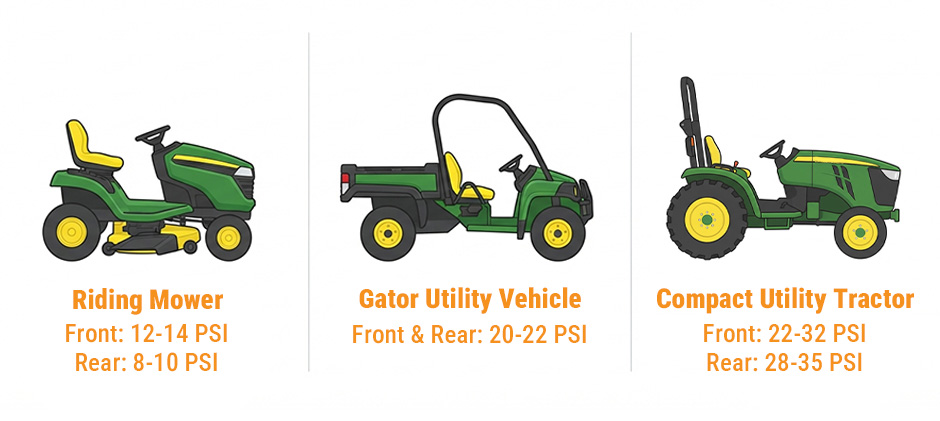
John Deere Tire Pressure Chart
For quick checks, match the machine type first. Then confirm the exact tire size and working load before adding air.
| Equipment Type | Front PSI | Rear PSI | What To Know |
|---|---|---|---|
| Riding Lawn Mowers | 12 to 14 | 8 to 10 | Common range for many lawn tractor setups |
| S100 Series Lawn Tractors | 14 | 10 | Typical for S100, S110, S120, S130, S140 |
| Zero Turn Mowers | 13 | 10 | Common on many John Deere ZTrak setups |
| Garden Tractors | 16 | 12 | Seen on larger lawn and garden models |
| Compact Utility Tractors | 22 to 32 | 28 to 35 | Check tire size, ballast, and loader use |
| Utility Tractors | 30 to 40 | 32 to 35 | Use the tire inflation chart for the exact setup |
| Row Crop Tractors | 35 to 45 | 30 to 40 | Load and road speed matter |
| Gator Utility Vehicles | 20 to 22 | 20 to 22 | Many models stay in the same front and rear range |
| Commercial Front Mowers | 20 | 16 | Verify by model and tire fitment |
If the machine has replacement wheels or aftermarket tires and wheels, confirm the size on the sidewall before using any chart. A common mower size such as 15×6-6 or 20×10-8 does not guarantee the same pressure across all tire brands and ply ratings.
Mower And Gator PSI
For most lawn equipment, the John Deere tire pressure chart is simple enough to use without digging through a long service manual.
Riding Mowers
A practical starting point is:
- Front tires: 12 to 14 PSI
- Rear tires: 8 to 10 PSI
For many S100 Series machines, the usual setting is:
- Front tires: 14 PSI
- Rear tires: 10 PSI
Typical tire sizes in this group include 15×6-6 in front and 20×8-8 or 20×10-8 in the rear, depending on model. The pressure itself still matters more than the size when cut quality is the problem. A mower with one low rear tire can cut unevenly even when the deck is adjusted correctly.
Zero Turn Mowers
Many John Deere zero turns stay near:
- Front tires: 13 PSI
- Rear tires: 10 PSI
This matters because small pressure changes show up quickly on zero turns. You may notice:
- A cut that is lower on one side
- More scuffing on soft turf
- Poor tracking on slopes
- Faster edge wear
If you are already checking deck parts, blades, or mower front wheels, it makes sense to check tire pressure at the same time.
Gator Utility Vehicles
Many Gator setups run around 20 to 22 PSI front and rear, but there are exceptions. Some Gator models use low-pressure flotation tires. Tire inflation pressure and ground footprint pressure are not the same thing, so it is important not to confuse those numbers.
If a Gator is carrying tools, feed, fencing, or spray equipment, check the tire sidewall and model information before raising pressure to the top of a general range.
Tractor Tire Pressure By Tire Size And Load
Tractor tire pressure is not one fixed number. The correct setting changes with tire size, tread pattern, ply rating, ballast, and mounted equipment. For that reason, a John Deere tire pressure chart is more useful when it is read by tire specification and load condition, not by a single PSI target.
The examples below show how much inflation pressure can change across common tractor tire setups.
| Tire Position | Tire Size | Tread | Ply Rating | Light Load PSI | Heavy Load PSI |
|---|---|---|---|---|---|
| Front | 7.50-16 | F2 | 6 | 24 | 44 |
| Front | 9.5-24 | R1 | 6 | 12 | 30 |
| Front | 9.5-16 | R3 | 6 | 12 | 30 |
| Front | 12.5/80-18 | R4 | 10 | 15 | 45 |
| Rear | 14.9-28 | R1 | 6 | 12 | 20 |
| Rear | 16.9-28 | R1 | 6 | 12 | 18 |
| Rear | 16.9-24 | R4 | 6 | 12 | 18 |
| Rear | 420/85R30 | R1 | 6 | 12 | 23 |
| Rear | 21.5L-16 | R3 | 6 | 12 | 12 |
Some factory charts also list fixed standard inflation values for certain tire sizes. For example:
- 13.6-28, R1, 6PR: 17.4 PSI
- 380/70R28, R1: 30 PSI
- 420/85D24, R4: 24.7 PSI
- 44×18.00-20, R3, 4PR: 20.3 PSI
- 360/80R28, R1: 46.4 PSI
Before adding air, check these points:
Read The Sidewall
Confirm the exact tire size, ply rating, and tread type.
Match The Load
A tractor carrying ballast or a heavy mounted implement may need more pressure than the same tractor used without added weight.
Check Front And Rear Separately
Front tire pressure and rear tire pressure often differ, especially on 4WD machines.
Recheck After Tire Changes
New tractor tire assemblies may use a different construction even when the listed size looks similar.
How To Check Tire Pressure?
A lot of pressure trouble is not from the chart. It comes from checking at the wrong time or using the wrong method.
Check Tires Cold
Measure pressure before mowing, hauling, or field work. A warm tire can read higher than its true cold PSI.
Keep The Same Axle Even
Left and right tires on the same axle should match unless the manual calls for something different. On mowers, even a small difference can show up in the cut. On tractors and Gators, it can affect steering feel and straight-line tracking.
Watch For Signs Of Wrong PSI
Look for these clues before the tire wears out:
- Center wear means pressure may be too high
- Edge wear can point to low pressure
- Squat under load can mean the rear tires need more support
- Steering drift often starts with an uneven front pair
- Harsh ride can come from overinflation
- Poor traction may come from either too much or too little PSI, depending on the surface
Adjust When The Job Changes
Tire pressure should change when the work changes. A mower used only for flat lawn care does not need to be set the same as one pulling a loaded cart. A compact tractor mowing pasture is not set the same as a machine carrying a loader bucket full of gravel. If you swap implements often, keeping a log with PSI settings can save time.
If you are servicing hubs, spindles, or front axle parts such as axle seals, it is a good time to inspect the tires for cracks, bead leaks, and sidewall damage too.
How To Read John Deere Tire Sizes?
A John Deere tire pressure chart makes more sense once the sidewall numbers are clear.
Common mower tire sizes:
- 15×6-6
- 20×8-8
- 20×10-8
For 20×10-8:
- 20 is the overall tire diameter in inches
- 10 is the tire width in inches
- 8 is the rim diameter in inches
Common tractor tire sizes:
- 7.50-16
- 9.5-24
- 13.6-28
- 16.9-28
For 13.6-28:
- 13.6 is the tire width in inches
- 28 is the rim diameter in inches
This tells you fitment, but not the final PSI by itself. Tire build, tread type, and working load still decide the correct pressure.
Final Words
The best results come from using the chart as a starting point, then matching PSI to the actual tire setup and daily workload. A few minutes with a gauge can help prevent uneven wear and poor handling. If it is time to replace tires, wheels, or supporting parts, FridayParts offers high-quality aftermarket parts at affordable prices, with wide fitment and a large stock for many heavy equipment brands.
