

A clicking hot stall does not always mean a Kubota fuel shutoff solenoid failure. On the L3400, the seat switch, safety interlocks, relays, and fuses frequently trigger the same shutdown pattern. The solenoid clicks because it lost power, not because it broke. The distinction between solenoid failure and upstream circuit problems is determined by voltage testing at the connector during the fault.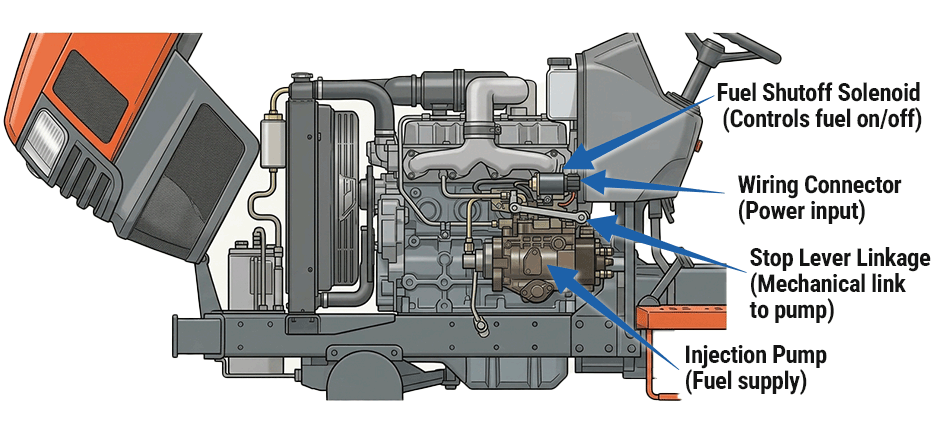
What Does a Kubota Fuel Shutoff Solenoid Do?
The fuel shutoff solenoid keeps the engine in the run position when the correct control circuit is energized. When that circuit is interrupted, the stop mechanism returns to shutdown, and the engine dies. That is why a solenoid can click at the exact moment of failure and still be working normally.
Common Kubota Fuel Shutoff Solenoid Symptoms
Use the symptoms below to narrow down whether the problem is the solenoid or its control circuit.
| Symptom | More Likely Direction | What to Check Next |
|---|---|---|
| Click at shutdown | Solenoid or control circuit | Check voltage at the connector |
| Restarts after cooling | Either | Repeat tests hot |
| Pedal, clutch, PTO, or seat input changes the symptom | Safety/interlock circuit | Check switches, relay, timer |
| Fuel filter replacement does not help | Electrical side more likely | Trace shutdown circuit |
| Direct power test is weak or unstable | Solenoid more likely | Check coil and plunger |
| Voltage disappears at shutdown | Upstream control fault | Trace feed and relay path |
| Solenoid works correctly with proper direct testing | Control circuit more likely | Check fuse, wiring, timer, interlocks |
| Engine will not shut off with key | Solenoid or linkage problem | Inspect stop mechanism |
Fuel restriction can also cause stalling, especially with a clogged filter, blocked vent, or air leak. However, a sudden shutdown with a click makes the electrical shutdown circuit worth checking.
Solenoid vs. Safety Switch: How to Tell the Difference
This is the distinction that matters most in real troubleshooting.
| If You See This | More Likely Cause |
|---|---|
| Solenoid is weak or dead even with correct direct testing | Solenoid |
| Proper voltage stays present, but the engine still dies | Solenoid or linkage |
| Voltage drops out at shutdown | Relay, timer, switch, fuse, or wiring upstream |
| Seat, clutch, PTO, or HST input changes the symptom | Safety/interlock logic |
| Tractor restarts after cooling and repeats the same pattern | Heat-sensitive solenoid or electrical fault |
| Solenoid clicks normally but will not stay in run | Hold circuit or upstream control issue |
If power disappears first, the solenoid may still be fine. If power stays present and the solenoid still drops out, then the solenoid itself becomes a stronger suspect.
How to Troubleshoot a Kubota Fuel Shutoff Solenoid?
Good troubleshooting starts with one question: Is the solenoid losing power, or is the solenoid failing while power is still present? Work through the system in order instead of replacing parts based on the click alone.
Step 1: Confirm the Shutdown Pattern
Start by writing down exactly how the tractor fails. The pattern often tells you whether the problem acts more like fuel starvation or more like an electrical shutdown.
Check these points:
- How long does the tractor run before it dies
- Whether shutdown is sudden or gradual
- Whether there is a click
- Whether it restarts immediately or only after cooling
- Whether clutch, seat, PTO, or HST input changes the symptom
A fuel restriction often causes fading power, sputtering, or weak response before the engine quits. An electrical cutoff usually feels sharper and more immediate.
Step 2: Check Fuel Basics
Before testing the shutdown circuit, rule out the basic fuel causes:
- Fuel filter condition
- Tank vent
- Water or debris in fuel
- Air leaks at fuel lines
- Sediment bowl, if equipped
If these checks are already done and the engine still dies suddenly with a click, move to the electrical shutdown circuit.
Step 3: Check Solenoid Movement
The click matters because it tells you the shutdown mechanism is moving or trying to move.
Turn the key on and off and listen. If possible, watch the solenoid, stop lever, or linkage while another person cycles the key or operates the pedals. Repeat the test when the tractor is hot and close to failure.
Look for:
- Sharp click with key on
- Sharp click with key off
- Linkage or stop-lever movement when the engine dies
- Slower or weaker action when hot
If the solenoid clicks or the stop lever moves right when the engine stalls, the shutdown mechanism is being activated. The next job is to find out what activated it.
Step 4: Test Voltage
This is often the most useful test in the whole process. Use a multimeter or test light and check voltage at the solenoid connector:
- With key on
- During cranking
- While running
- At the moment the fault appears, if possible
You want to know whether the hold side of the circuit loses voltage when the engine dies. If voltage disappears first, the problem is upstream. If voltage remains correct but the solenoid drops out, then the solenoid or linkage becomes more suspicious.
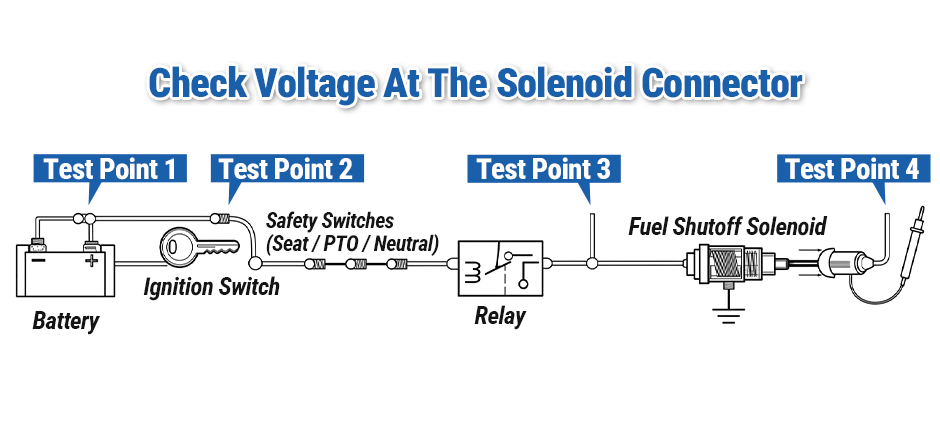
At the same time, inspect the rest of the path: harness connector, ground connection, key switch feed, fuse panel, stop relay, and wiring near heat and vibration points. Installing fresh relays, connectors, and fuses during routine inspection helps keep the electrical circuit reliable.
A cracked fuse can mislead you here. It may look fine and even test normal with no load, but open up under heat or vibration.
Step 5: Test the Solenoid According to Service Procedure
A direct test can help separate a bad solenoid from a bad control circuit. Using a quality solenoid valve ensures reliable engine shutdown when the circuit is functioning correctly.
Some tractors use:
- Pull-in and hold-in windings
- Timer-based stop logic
- Different wire counts and terminal functions
- Energized-to-run or timed-shutdown configurations
That means you should not assume every Kubota solenoid can be safely tested by simply applying battery voltage.
Before direct testing, confirm:
- Whether the solenoid is a one-wire, two-wire, or three-wire type
- Which terminal is pull-in
- Which terminal is hold-in
- Whether a timer or controller is involved
- What the service information allows
General rule:
- Pull-in windings are for short-duration actuation
- Hold-in windings are for sustained operation
- Applying battery voltage to the wrong terminal for too long can damage the solenoid
Step 6: Check the Safety/Interlock Circuit
This is the step many people skip, and it is often where the real problem is.
On tractors like the Kubota L3400, the seat switch usually does not act like a simple direct on-off switch for the fuel solenoid. Instead, it feeds the operator-presence and interlock logic. That logic may then act through a relay, timer, or related shutdown path that eventually removes the run signal.
Check these related items together:
- Seat switch
- PTO switch
- HST interlock input
- Neutral input
- Clutch-related interlock input
- Stop relay
- OPC timer or delay-control circuit
- Wiring and connectors between those parts
The exact shutdown logic can vary by model and production configuration, so the tractor’s wiring diagram or service manual should be used whenever possible.
Kubota L3400 Case: Why Did It Shut Off After 30 Minutes?
This L3400 case is useful because it looked like a classic fuel shutoff solenoid problem at first.
The pattern was:
- The tractor runs for about 30 minutes
- Engine dies with a click
- Pushing the clutch can save idle
- Pressing the forward HST pedal kills it again
- Letting it cool for about an hour brings it back
- Fuel filter replacement, tank cleaning, and air purge do not solve it
At first glance, those symptoms seem to point straight at the solenoid:
- Hot shutdown
- Click at failure
- Restart after cooldown
But two details pointed somewhere else:
- The clutch could save idle
- The forward HST pedal would trigger shutdown again
That kind of behavior fits safety or interlock logic better than simple fuel starvation. It also does not necessarily mean the clutch switch itself is bad. What it shows is that changing the operator-control conditions changes whether shutdown occurs.
On an L3400, that makes the upstream safety circuit, relay path, and timer logic much more important suspects than the click alone would suggest.
Why the Seat Switch Was the Real Problem?
This is the key lesson from the case. The final repair was the replacement of the seat switch, and the tractor then ran another 5 to 6 hours without repeating the shutdown. But the seat switch should still be described correctly in relation to the solenoid.
The most accurate fault chain is this:
- Seat switch or seat-related input becomes unstable
- Safety/interlock logic reacts
- A relay or control circuit interrupts the run signal
- Solenoid loses hold power
- Stop mechanism returns
- Engine shuts down
So the better conclusion is not that the seat switch directly cuts power to the solenoid. The better conclusion is that the seat switch, or the interlock circuit it controlled, indirectly triggered a shutdown upstream. The solenoid then did exactly what it was designed to do.
That distinction matters because it changes how you diagnose the tractor. If you assume the seat switch directly controls the solenoid, you may miss the real failure point in the relay, timer, fuse, connector, or wiring between them.
A bad seat switch can absolutely look like a bad solenoid, especially when the tractor dies hot, clicks, and then restarts after cooling. But the reason is indirect. The solenoid is often just the final device in the chain.
When to Replace the Fuel Shutoff Solenoid?
Move the solenoid back near the top of the suspect list if you find signs like these:
- Weak or no response with correct direct testing
- Failure to hold even when correct voltage remains present
- Mechanical sticking in the plunger or linkage
- Erratic action that gets worse with heat
- Repeat failure after interlocks, relay, timer, fuse, and wiring have been ruled out
- The engine will not shut off correctly with the key
Those symptoms point more directly to the solenoid assembly or the stop linkage near the injection-pump control.
Conclusion
A clicking shutdown is a circuit signal, not a component verdict. Verify fuel basics first. Then check whether the solenoid hold circuit retains voltage at the moment of failure. In L3400 applications, seat switches, relays, fuses, PTO interlocks, and OPC timers produce symptoms indistinguishable from solenoid failure. Systematic circuit tracing, guided by the model-specific wiring diagram, prevents unnecessary parts replacement. Replace the solenoid only after the entire control path tests clear. When replacement becomes necessary, FridayParts supplies quality stop solenoids compatible with Kubota and other major brands at competitive prices, helping you complete the repair without overspending.
