

Understanding the difference between OAT vs HOAT coolant is essential for protecting your Cummins 6.7L engine from corrosion and costly cooling system repairs. Both coolant types can go into your Cummins. But can we mix? Is there anything to note? Let’s move on to explore more!
What Is OAT Coolant?
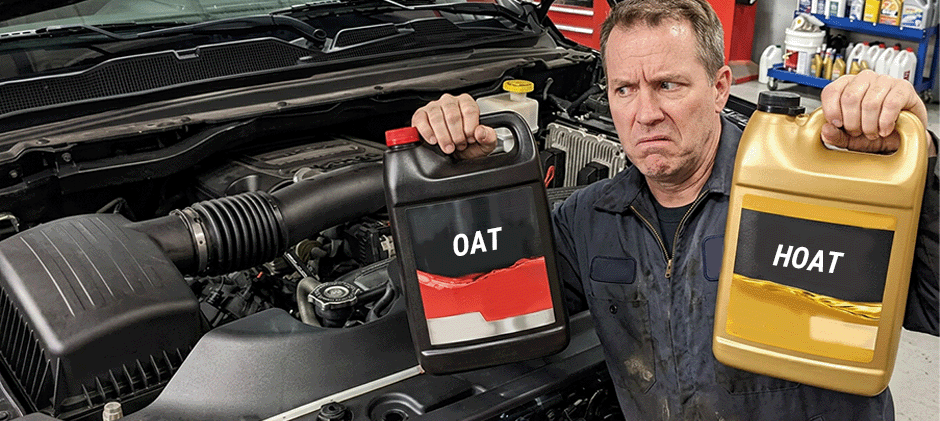
OAT coolants don’t contain silicates or phosphates like IAT coolants. It uses organic additives like carboxylate-based organic acids. These additives don’t coat the entire system like the ones in IAT coolants do. Instead, they target the corrosion sites specifically and feature less accumulation of deposits in the system. Another advantage of OAT is that the organic additives don’t deplete as fast as silicates and phosphates, ensuring the OAT coolant can last up to 10 years.
OAT coolants have plenty of advantages, but they don’t have the same anti-corrosion properties as IAT coolant. So, this type of coolant is not necessarily ideal for older engines or some heavy-duty vehicles. In addition to GM vehicles, you’ll also find OAT coolant in some VW, Saab, Ford, Chrysler, Fiat, and Jeep models.
What Is HOAT Coolant?
HOAT, or hybrid OAT coolant, uses a mix of OAT and IAT technologies to provide greater protection against corrosion. This type of coolant mixes in a little bit of phosphate and/or silicate additives. Some only add phosphate or silicates. Basically, they are a hybrid version of OAT and IAT and are HOAT sub-types called P-HOAT or P-OAT and Si-OAT, respectively. They can last a long time, with changes typically recommended at 5 years, though some can go as long as 10 years. Despite this, you should check even long-lasting coolant from time to time for level and discoloration. Brown coolant indicates you’re overdue for a flush, and it can be a sign of other issues, too.
What vehicles take HOAT coolant? You can find HOAT in some Chrysler and Ford models. Some Asian manufacturers like Toyota, Honda, Subaru, Hyundai, Kia and Nissan frequently use P-HOAT coolants and some European models like VW, BMW and Mercedes-Benz often use blue or purple Si-OAT.
OAT vs HOAT Coolant
The table below shows clearly the difference between OAT and HOAT Coolant.
| Attribute | OAT Coolant | HOAT Coolant |
|---|---|---|
| Technologies | Organic Acid Technology (OAT) | Hybrid Organic Acid Technology (HOAT) |
| Additive Type | Organic acids | Hybrid blend of organic and inorganic inhibitors, such as silicates, phosphates… |
| Typical Color | Orange, purple, pink, red, dark green | Yellow, blue, turquoise, pink, purple |
| Benefits |
|
|
| Ideal for | Newer engines and daily drivers | Modern aluminium-intensive engines |
| Service Interval | Long-life service, often described as up to ten years or about 150,000 miles | Long-life service, often described as about five to ten years or about 150,000 miles |
How To Choose 6.7 Cummins Engine Coolant?
In the maintenance of your 6.7 Cummins engines, it’s critical to choose the right coolant. Here are four aspects that you should pay attention to during the selection.
Formula type
There are quite a few tricks to the coolant formulas. As certified by Cummins, the NOAT (Organic acid-free technology), such as Fleetguard ES Compleat, can be perfectly adapted to your Cummins engine. The HOAT coolants may contain phosphates that can cause damage to aluminum water pumps. Two other formulas must also be avoided: silicate formulas and nitrite formulas. The former are prone to causing precipitation and the latter can lead to DPF poisoning. See How to Clean the DPF on A Cummins here.
Freezing/Boiling Point
The freezing point and boiling point of the coolant are directly related to your Cummins engine’s survival ability in extreme environments. Generally, a 50% ethylene glycol concentration is the equilibrium point that can achieve a freezing point of -37 ℃ and a boiling point of 129℃. However, you may need to adjust the coolant concentration according to the actual altitude where you drive your vehicle.
Additive Package (DCA)
DCA4 corrosion inhibitor is the “golden partner” of coolant and its concentration must be maintained at 1.2-1.8 units per gallon. You can easily grasp the concentration of DCA4 with a test strip. Remember not to use coolant that contains a boron formula, because it can have a chemical reaction with your cylinder liner coating and then cause damage to your Cummins 6.7 engine.
Compatibility Certification
The CES 14603 standard is a mandatory requirement of the Cummins engineering specification. Always look for the CES 14603 label when selecting coolant for your Cummins. Coolants labeled as “universal” may seem convenient, but they can cause electrolytic corrosion of sensors. Using incompatible coolant will gradually torment your Cummins engines.
What Coolant Goes into Your Cummins 6.7?
For Cummins 6.7L engines of different years, the factory-used coolants are different.
2013+ Cummins 6.7L Engine
For the Cummins 6.7 engines produced after 2013, it uses OAT coolant. Remember to avoid those with nitrite!!! Typical coolant is Mopar purple 10-year coolant that meets the MS-12106 standard or official Fleetguard ES Compleat OAT red coolant. Please note the engine of these years are not allowed to add HOAT directly, as it can destroy the long anti-corrosion protection of the original OAT coolant.
2007.5-2012 Cummins 6.7L Engine
For Cummins 6.7L engines produced before 2012, they use HOAT coolant, usually yellow or amber. Typical products are Mopar 5-year HOAT coolant or Valvoline Zerex G-05. If your vehicle has an engine from these years and didn’t go through a complete flush, the remnants are likely HOAT and you should add HOAT coolant when it’s time to refill.
Can I Mix OAT and HOAT Coolant in Cummins 6.7?
It’s not recommended to mix OAT and HOAT for your Cummins 6.7 engine despite the same coolant color. Mixing coolant colors typically does not cause immediate engine failure, but it contaminates the cooling system and reduces effectiveness. Potential problems are as follows:
- Reduced heat transfer efficiency
- Sludge or gel formation
- Corrosion of engine components
- Water pump impeller damage
- Heater core blockages
- Overheating under load or extreme temperatures
If you’ve unfortunately mixed two coolants, you can use the manufacturer-specified coolant for a complete cooling system flush and refill. A coolant flush is a quick solution to ensure long-term reliability in both hot and cold conditions. See How to Flush Your Cooling System here.
Final Words
Choosing 6.7 Cummins coolant type is essential for the service life of your engine. Always consult your owner’s manual for specific coolant type and coolant concentration ratio. Don’t mix coolant colors and directly change your coolant blindly. FridayParts does not provide coolant, but you can explore more knowledge of your engine cooling system through our blogs and a vast selection of quality cooling system parts and engine spare parts to get your vehicle running at its optimal performance.
