

Many drivers describe P2118 Toyota as a “dead pedal” problem—the engine idles normally, but pressing the accelerator has little or no effect because the electronic throttle system is no longer responding.
What Does the P2118 Code Mean on a Toyota?
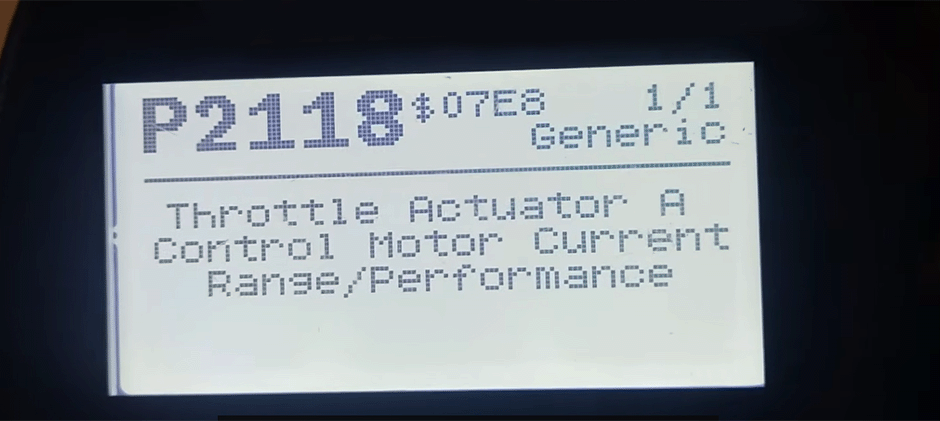
P2118 stands for “Throttle Actuator Control Motor Current Range/Performance.” It means the Engine Control Module (ECM) has detected a problem with the electrical current going to the electronic throttle motor. Instead of using a traditional throttle cable, modern Toyota vehicles use an Electronic Throttle Control System (ETCS). When you press the accelerator pedal, the ECM tells the throttle body motor how far to open the throttle plate to control airflow into the engine.
If the ECM sees that the throttle motor is drawing too much or too little current, it sets the P2118 code. This can happen because of a power supply problem, damaged wiring, a sticking throttle body, or a fault inside the throttle motor. The main parts involved include:
- Accelerator Pedal Position Sensor (APPS): Detects how far you press the accelerator pedal and sends that information to the ECM.
- Throttle Body Motor: Opens and closes the throttle plate based on commands from the ECM.
- Throttle Position Sensor (TPS): Reports the actual throttle plate position back to the ECM.
- ECM/PCM: Processes the pedal input and controls the throttle body motor.
Common Symptoms of a P2118 Code
If your Toyota has P2118, driving it can be tough and risky. The throttle system malfunctions, so the engine limits power to avoid damage. Typical warning signs you’ll notice:
- Limp Mode: Power gets restricted, and your car takes forever to speed up
- Poor Throttle Response: Press down on the accelerator, but the engine barely reacts
- Loss of Power: Hard to pick up speed, especially merging onto highways or climbing hills
- Check Engine Light: The Check Engine Light comes on, and a scan tool shows the P2118 code.
- TRAC or VSC Warning Light: On certain Toyotas, these systems rely on the electronic throttle, so they trigger alerts too.
Main Causes of P2118 Toyota Error
We break down all possible triggers for this code into three clear groups to make troubleshooting straightforward.
Electrical Supply Issues
- The ETCS throttle motor needs steady power from its separate +BM circuit. If the ETCS fuse or EFI No.1 fuse blows, the motor won’t get enough power to work right. This is the main reason.
- Corroded battery terminals or weak ground connections also cut power flow to the motor. The current reading drops outside the normal range, and the code triggers.
Mechanical & Build-Up Issues
Dirty throttle bodies are the usual reason for P2118 on RAV4s. Oil fumes and carbon gunk build up around the throttle plate over time, making it stiff and hard to move. The ECM pushes extra current to the motor to fight that mechanical drag. Once the power draw goes over the factory limit, the ECM logs P2118 to stop the wiring from overheating.
Sensor & Module Failures
These issues don’t happen as often, but they still mess up the whole throttle system.
- A bad accelerator pedal position sensor sends inconsistent signals that throw off the car’s current tracking system.
- On Corollas, we sometimes see internal ECM damage — the computer can no longer read the throttle motor’s current feedback correctly.
How to Diagnose the Toyota P2118 Code?
Follow these steps to diagnose the problem.
Step 1: The Fuse Check
Start by checking the ETCS fuse and the EFI No.1 fuse in the engine compartment fuse box. Don’t assume a fuse is good just because it looks fine—use a multimeter or a test light to verify it. If a fuse is blown, inspect the wiring for a short before replacing it.
Step 2: Live Data & +BM Voltage
Connect the scan tool and pull up the ECM live data. Locate the +BM voltage parameter to check it.
| Circuit Parameter | Expected Value | Fault Condition | Diagnostic Conclusion |
|---|---|---|---|
| +BM Voltage | 11.0V – 14.5V | < 4.0V | Power supply loss (Fuse/Wiring) |
| Motor Current | 1.0A – 3.0A (Idle) | > 10.0A | Mechanical binding or Short |
| Ref Voltage | 4.9V – 5.1V | 0V | Internal ECM/Sensor short |
Step 3: Wiring & Connector Inspection
On some Toyota models, wiring problems are a more common cause of P2118 than a failed throttle body.
If the +BM voltage is low, unplug the 6-pin connector at the throttle body. Look for any corrosion (“green crusties”) or pins that have backed out of the plug.
If the ETCS fuse is good but the throttle body still isn’t getting power, the wiring between the ECM and the throttle body may be damaged. With the multimeter, check that the throttle body is receiving battery voltage and the proper 5V reference signal. Low voltage or high resistance in the wiring can also trigger a P2118 code.
Step 4: Inspect and Clean the Throttle Body
Turn the ignition off, then manually move the throttle plate to feel if it sticks or catches. If it’s stiff or jerky, grab the proper throttle body cleaner.
Spray the cleaner on a rag or toothbrush—don’t spray it straight into the motor assembly. Scrub all carbon gunk off the throttle plate and the inner bore.
Idle Relearn Step
You need to reset the ECM’s idle memory after cleaning. Disconnect the negative battery cable and leave it off for 15 minutes. Hook the battery back up, start the engine, turn off all accessories, and let it idle for another 15 minutes. The computer will relearn the smooth idle position with the clean throttle body.
Model-Specific Problem
- Toyota Camry: Before swapping any expensive parts on certain Camrys, check the battery, charging system, ETCS fuse and throttle body first. Low system voltage often messes up throttle control.
- Toyota RAV4: Lots of real repair records show wiring faults on RAV4s with the 2AR-FE engine. Check the harness close to the air intake for fraying or loose connections.
- Toyota Corolla: Start by checking the 10A ETCS fuse on Corollas. You’ll need to run the throttle relearn process after cleaning or installing a new throttle body. High-mileage Corollas commonly suffer from carbon buildup, too.
Conclusion
The P2118 code is more of a “signal issue” than a full mechanical failure. It usually means the throttle system isn’t getting the right power or signals to work properly.
Before replacing an expensive throttle body, it’s important to check the basics first—like fuses, wiring, and the +BM voltage supply. Also, make sure the throttle plate moves freely and isn’t sticking due to carbon buildup. If a replacement is needed, quality aftermarket Toyota parts from FridayParts can help.
