

The numbers on your sidewall only tell part of the story. A tractor tire size chart shows whether a tire will fit your rim, carry the load, and match the front axle. Get that wrong, and you risk driveline damage that costs far more than a new set of tires. This guide walks you through reading sizes, converting bias to radial, measuring worn tires, and checking front-to-rear ratio before you buy.
How To Read A Tractor Tire Size Chart?
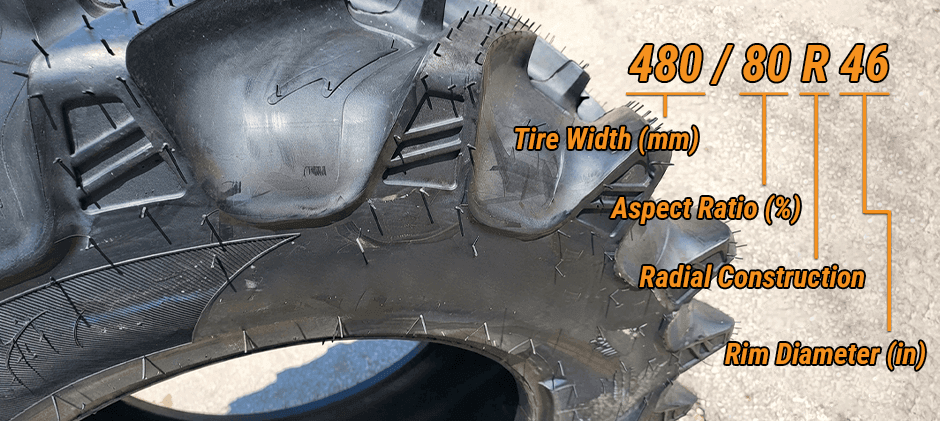
The first step is reading the sidewall correctly. Most tractor tires use either a standard inch format or a metric format. Both appear simple, but each number has a job.
| Size Format | Example | Meaning |
|---|---|---|
| Standard bias | 16.9-30 | 16.9-inch width, 30-inch rim, bias construction |
| Standard radial | 18.4R38 | 18.4-inch width, 38-inch rim, radial construction |
| Metric radial | 380/70R24 | 380 mm width, 70 aspect ratio, radial, 24-inch rim |
| Flotation style | 27×8.5-15 | 27-inch overall diameter, 8.5-inch width, 15-inch rim |
What The Markings Tell You
Width
The first number shows tire width. It may be in inches or millimeters.
Aspect Ratio
On metric tires, the second number is sidewall height as a percentage of width.
Example: 380/70R24 means sidewall height is 70 percent of 380 mm.
Construction
R means radial, – means bias, B means bias-belted
Rim Diameter
The last number is the wheel diameter in inches.
Load Index
This shows how much weight the tire can carry at its rated pressure and speed.
Speed Index
This shows the maximum rated speed at the listed load.
Tread Code
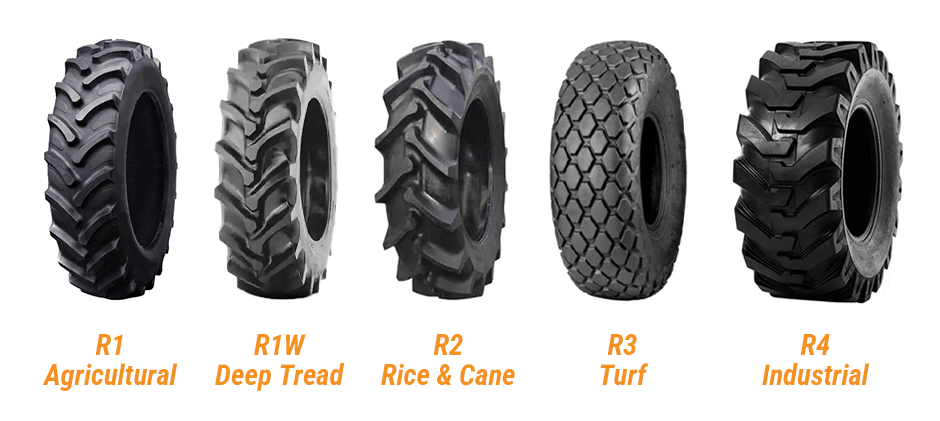
Common codes include R1, R1W, R2, R3, and R4.
This is where many people stop. But a tractor tire size chart is not only about reading the sidewall. It is also about checking whether that tire actually fits your machine, your work, and your axle ratio.
Finding Your Size By Rim Diameter
When you shop by size, most catalogs sort tractor tires by one of three methods:
- By full sidewall size
- By rim diameter
- By conversion between bias and radial sizes
That is why searches for tractor tire size chart in inches, metric tire conversion, and front tractor tire size chart often overlap.
Common Rim Diameters Seen On Farm Tires
Rear and implement tires are often grouped by rim diameter such as:
- 24 inch
- 28 inch
- 30 inch
- 34 inch
- 38 inch
- 42 inch
- 46 inch
- 48 inch
- 50 inch
- 54 inch
This helps when you know the wheel size but not the full tire spec. For smaller turf, mower, or compact equipment, charts may instead start with overall diameter, width, and rim size such as 11×4.00-5 or 4.10×3.50-4.
Quick Size Reference Table
| What You Know | What To Check Next |
|---|---|
| Rim diameter only | Approved widths and overall diameter |
| Old inch size | Radial conversion and rolling circumference |
| Metric size | Inch equivalent and aspect ratio |
| Front tire size | Rear pair and rolling lead |
| Tire height | Fender and axle clearance |
When you replace tires at the same time as hubs, steering joints, or axle hardware, matching sizes early can save time. It also helps to have dependable tractor replacement parts ready if wheel-end service is part of the job.
Tractor Tire Size Conversion Guide
A conversion chart is useful, but it is not final proof of fit. It gives you a close replacement path, especially when moving from an older bias size to a newer radial.
Common Bias To Radial Examples
| Bias Size | Radial Size |
|---|---|
| 11.2×20 | 280/85R20 |
| 12.4×20 | 320/85R20 |
| 11.2×24 | 280/85R24 |
| 12.4×24 | 320/85R24 |
| 13.6×24 | 340/85R24 |
| 14.9×24 | 380/85R24 |
| 16.9×24 | 420/85R24 |
| 12.4×28 | 320/85R28 |
| 14.9×28 | 380/85R28 |
| 16.9×28 | 420/85R28 |
| 18.4×38 | 460/85R38 |
| 20.8×38 | 520/85R38 |
| 18.4×42 | 460/85R42 |
| 20.8×42 | 520/85R42 |
These are widely used equivalency points. Still, two cautions matter:
- A conversion chart shows the nearest size, not always the exact rolling match
- The same nominal size can vary by brand, tread, and casing design
Simple Metric Conversion Rules
For a metric size such as 480/80R46:
- 480 = width in mm
- 80 = sidewall height as a percent of width
- R = radial
- 46 = rim diameter in inches
To estimate width in inches:
480 ÷ 25.4 ≈ 18.9
So a 480 mm tire is roughly 18.9 inches wide.
This helps with a metric tire size chart, but you still need the manufacturer’s rolling circumference and load table before final selection.
Why Front And Rear Tires Must Match?
This is the part many short guides barely cover. Yet for real off-road machinery use, it is one of the most important checks.
On MFWD or FWD tractors, front and rear tires must keep the correct rolling circumference ratio. If the ratio is wrong, the front axle can pull too hard or too little. That creates driveline strain, scrub, hard steering, and early tire wear.
What To Keep In Mind?
- On MFWD and FWD tractors, front and rear tires must maintain proper rolling relationship
- On articulated 4WD tractors, front and rear tire diameter should match if you change one axle
- A tire from a different brand can have a different rolling circumference even with the same labeled size
For some tractors, the target front wheel lead falls within a narrow range:
- About 1.5 to 4 percent for some IVT transmission setups
- About 1 to 6 percent for some PowrQuad Plus and AutoQuad Plus setups
A sample lead formula is:
Front Lead (%) = (RCF / RCR × AR − 1) × 100
Where:
- FL = front wheel lead
- RCF = rolling circumference of front tire
- AR = front axle to rear axle speed ratio
- RCR = rolling circumference of rear tire
That is why a front tractor tire size chart should never be used alone on MFWD machines. You need the rear tire data too. If you are also servicing axles, quality front axle parts and drive system parts can help keep the new tire setup working as intended.
Measuring Width And Overall Diameter
Sometimes the sidewall is weathered, painted over, or damaged. Then you need to measure the tire by hand.
How To Measure It?
Before measuring:
- Take the weight off the tire
- Inflate it to rated pressure
- Park on level ground
Then measure:
Section Width
Measure at the widest point of the sidewall, not the tread.
Overall Diameter
Wrap a string around the centerline of the tire to get circumference. Divide that number by 3.14 to estimate diameter.
This gives you the two numbers needed to compare against a tractor tire size height chart or catalog listing.
Why Used-Tire Measurements Need Care?
A worn tire does not measure like a new tire. Tread wear lowers overall diameter, and flex changes with age and inflation. So your tape measure gets you close, not perfect.
That is also why it is smart to confirm:
- load capacity
- speed index
- approved rim width
- rolling circumference
- static loaded radius if required
If your machine uses ballast, a tractor tire inner tube size chart may matter as well, especially with tube-type rims or fluid fill planning. Pairing the right tire and tube with reliable wheel and rim parts keeps the setup simpler during service.
Choosing The Right Tread Code
A tire size alone does not tell you whether the tire suits your work. Tread type, load index, and inflation pressure matter just as much.
Common Tread Codes
| Tread Code | Typical Use |
|---|---|
| R1 | General field traction |
| R1W | Deeper tread for wet soil |
| R2 | Rice and cane conditions |
| R3 | Turf and low ground disturbance |
| R4 | Industrial and mixed surfaces |
Load And Speed Matter Too
A few useful reference points:
- A load index of 125 equals 3,640 lb
- A speed symbol of A8 means 25 mph
Always match tire pressure to:
- load
- speed
- road time
- field conditions
That is where central tire inflation systems and pressure calculators can be helpful on larger machines. A low-pressure setup may improve footprint and reduce compaction, but only if the tire is rated for it.
Quick Buying Checklist
Before you order, confirm these points:
- Tire size on the sidewall
- Rim diameter and approved rim width
- Radial or bias construction
- Load index
- Speed index
- Tread style
- Rolling circumference
- Front and rear compatibility
- Clearance at fenders and steering stops
When the machine works on rough ground, matching the tire package with durable steering and suspension components can also help the whole system wear more evenly.
Final Words
The right tractor tire size chart does more than decode a sidewall. It confirms rim width, load index, and front-to-rear rolling match. Check those before you buy to avoid the mistakes most owners make. When you need supporting parts, FridayParts stocks aftermarket components for many tractor models. Tires and parts that fit right keep your equipment working longer.
