

The P0087 trouble code means one thing: your engine is being starved of fuel, which stands for fuel system pressure too low, indicating that the high-pressure fuel system isn’t getting the pressure it needs to run properly. This leads to significant power loss, stalling, and potential engine damage if ignored. This guide will walk you through what causes this common fault and how to fix it.
P0087 means the engine control module is seeing fuel rail pressure that is too low for the commanded target. If you searched P0087, you’re probably dealing with low power, stalling, hard starts, or limp mode—often right after a filter change, fuel issue, or heavy load. This guide explains what the P0087 code really indicates, what usually causes it on off-road diesel equipment, and how to diagnose it step by step without guessing.
Clear statement: P0087 is a “pressure can’t keep up” problem, not a “replace one part” problem.
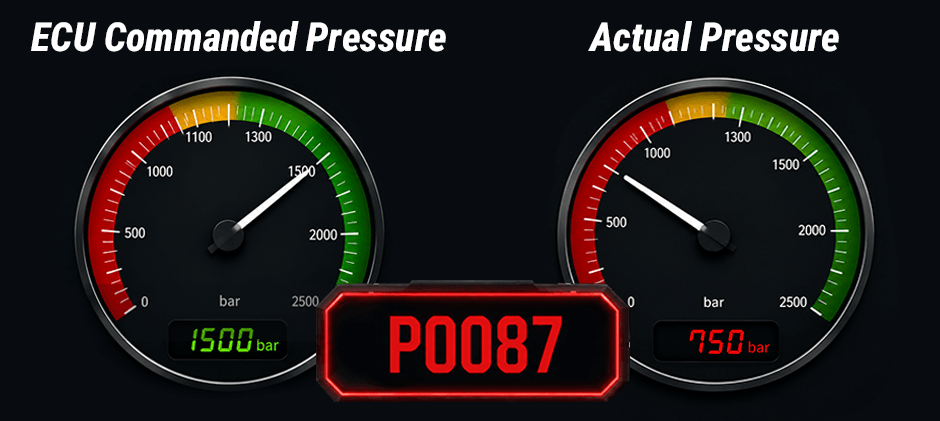
What is the P0087 Code?
P0087 is “Fuel Rail/System Pressure Too Low.” The ECU/ECM compares desired rail pressure to actual rail pressure, and it sets P0087 when actual pressure stays below spec long enough under certain conditions.
P0087 usually shows up on common-rail diesel systems. Many loaders, excavators, skid steers, telehandlers, and tractors use a low-pressure supply side feeding a high-pressure pump that builds rail pressure for the injectors.
When Does the P0087 Code Typically Appear?
P0087 often happens under load or during acceleration. Low rail pressure is easiest to trigger when the engine demands more fuel than the system can deliver.
P0087 can also happen right after maintenance. A slightly restricted filter, a small air leak, or a not-fully-primed system can drop supply pressure and starve the high-pressure pump.
7 Common Symptoms of a P0087 Code
P0087 typically feels like fuel starvation. Look for these symptoms:
- Loss Of Power (especially climbing, pushing, or digging)
- Limp Mode or reduced RPM
- Hard Starting or extended cranking
- Stalling at idle or when throttling up
- Surging (power comes and goes)
- Smoke Changes (sometimes less smoke because fueling is limited)
- Other Fuel Pressure Codes alongside P0087 (sensor/performance codes)
Clear statement: If it restarts after sitting, think of restriction, air-in-fuel, or a weak supply pump.
Why You Shouldn’t Ignore a P0087 Code?
P0087 is risky because low rail pressure can damage expensive components over time. A starving high-pressure pump may run hotter and wear faster, and poor fueling control can increase misfires and rough operation.
P0087 is also a productivity killer. Even if the machine “still runs,” it may be derated and burn more time per cycle.
Top 10 Causes of the P0087 Code
P0087 is caused by insufficient fuel delivery or uncontrolled fuel loss. The most common causes of off-road machinery include:
- Clogged Fuel Filter (primary or secondary)
- Restricted Tank Vent or Cap (vacuum in tank)
- Plugged Tank Pickup Screen or debris in the tank
- Air in Fuel (loose clamps, cracked line, bad seals, bad primer)
- Weak Lift Pump / Transfer Pump
- Low Supply Pressure to the high-pressure pump
- Faulty Fuel Metering Valve (IMV/SCV) on the HP pump
- Fuel Pressure Regulator / Relief Valve Leaking (dumping pressure)
- Excessive Injector Return Flow (internal leakage)
- Rail Pressure Sensor or Wiring Fault (bad signal creates wrong control)
Quote to remember: “Low rail pressure is either not enough in or too much leaking out.”
P0087 on Off-Road Machines vs. Trucks
P0087 can appear even when the machine isn’t a true OBD-II. Off-road equipment may display P-codes on its own monitor, or you may see a manufacturer code that maps to “rail pressure too low.”
P0087 diagnosis still follows the same physics. You still have a supply side, a high-pressure generation side, and a feedback loop (sensor + control valve).
How to Diagnose P0087? A Step-by-Step Guide
Step 1: Perform Basic Fuel and Filter Checks
The fastest first check is fuel level, fuel quality, and filter condition. Low fuel, gelled fuel, water contamination, or a collapsed/dirty filter can trigger P0087 quickly.
Step 2: Inspect the Fuel Tank Vent
A restricted vent can starve the system by pulling a vacuum in the tank. Loosen the cap briefly and see whether the symptom changes (follow site safety rules and avoid contamination).
Step 3: Search for Air Leaks in the Fuel System
Air leaks are common after filter service or hose disturbance. Look for wet fittings, cracked hoses, loose clamps, and damaged O-rings; then prime correctly and re-check.
Clear statement: If it runs better right after priming and worse later, suspect an air leak or weak lift pump.
Step 4: Measure Fuel Supply Pressure
Supply pressure must be right before you blame the high-pressure pump. If you have a spec and a gauge port, measure low-side pressure/flow; otherwise, use service-tool data if available.
Step 5: Analyze Scan Tool Data
Compare “Commanded Rail Pressure” vs “Actual Rail Pressure.” If commanded rises and actual can’t follow, you likely have restriction, air, weak supply, or leakage.
Step 6: Test the Rail Pressure Sensor and Wiring
Bad sensor signals can mimic real pressure loss. Inspect the connector, pins, corrosion, harness rub-through, and reference voltage/ground before replacing parts.
Step 7: Check for Excessive Injector Return Flow
High injector return can dump rail pressure under load. A return-flow test (procedure varies by engine) can reveal one injector leaking internally.
Step 8: Evaluate the High-Pressure Pump and Metering Valve
The HP pump/IMV/SCV becomes suspect after supply-side checks pass. If supply pressure is correct, no air is present, filters are clean, and returns are normal, focus on the metering valve, relief/regulator, or pump wear.
P0087 Safety: What Not to Do?
Do not loosen high-pressure fuel lines to “see if fuel is there.” Common-rail diesel fuel can be at extremely high pressure and can cause severe injury.
Safety quote: “Never crack a rail line on a running common-rail system.”
Do not keep pushing the machine hard in limp mode. If rail pressure is repeatedly low, you can turn a small restriction into a bigger repair.
6 Common Fixes for the P0087 Code
Most P0087 fixes start with basic fuel supply health. These are common, practical wins:
- Replace Clogged Fuel Filters (and drain water separators)
- Prime And Bleed Correctly after filter work
- Fix Air Leaks (seals, clamps, cracked hoses)
- Clean The Tank, Pickup / Replace Dirty Fuel
- Replace A Weak Lift Pump if the supply pressure/flow is low
- Address Return Leaks (injector or regulator/relief issues) after testing
Clear statement: A new filter that isn’t sealed or primed can still cause P0087.
When to Call a Professional Technician?
Call for help when the machine won’t build rail pressure or stalls repeatedly. If you can’t reach target rail pressure at idle, if you see metal in fuel, or if multiple fuel-system codes appear together, professional diagnostics can prevent expensive repeat failures.
Final Thoughts
A P0087 code is a serious warning that your machine’s fuel system needs immediate attention. By starting with the most common and simple fixes, like replacing clogged filters, you can often solve the problem quickly and affordably. Ignoring the issue can lead to more expensive damage to your high-pressure pump and injectors.
Whether you need a simple fix or a major component, FridayParts has the reliable parts to get the job done. From high-grade Fuel Filters designed for tough conditions to dependable Fuel Pumps and precise Fuel Injectors, we have what you need to clear that P0087 code and restore your machine’s power.
