

Based on Q4 2025 trends and ABC’s preliminary 2026 forecasts to fleet owners across North America. We have reviewed countless OEM repair quotes this month where the baseline for a standard hydraulic overhaul has surged by 25% nearly overnight. This isn’t a statistical anomaly; it is the physical manifestation of the 6.2% input price jump that hammered the sector in early 2026. The analysis of the latest Horton Group data confirms that we have entered a “year of no return.” If you are attempting to navigate this market using 2025 cost baselines for your heavy equipment parts or equipment downtime cost projections, you aren’t just behind. You are functionally insolvent. Today, smart fleet owners know that proactive construction equipment maintenance is no longer an operational expense—it is a financial survival strategy.
1. The Inflation Death Spiral — Why “Waiting it Out” is Not a Strategy
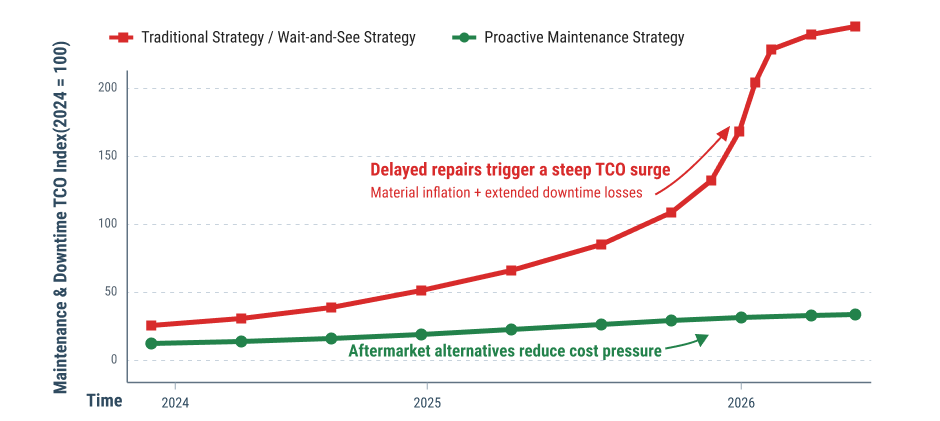
For decades, contractors have treated inflation as a temporary storm to be weathered by delaying capital expenditures. In 2026, that “wait and see” approach has become a financial death spiral.
According to the Associated Builders and Contractors’ Construction Input Prices Report (Q1 2026), the 6.2% rise in input prices during the first four months of 2026 alone exceeded the cumulative increases of the previous three years combined.”Failing to bring in the needed workers will worsen labor shortages, especially in certain occupations and regions, placing further upward pressure on labor costs,” warns Anirban Basu, ABC Chief Economist.
You cannot afford to ignore this fact. Delaying a structural repair today to “save” cash actually exposes your firm to a market where structural steel costs are rising at 12.5% annually. In this environment, the cheapest time to fix a machine was yesterday; the second cheapest time is right now.
Delaying maintenance doesn’t save money. Instead, it merely locks you into a higher future price point for materials that show no signs of cooling. If there is one rule that defines 2026, it is this: reactive construction equipment maintenance is a luxury you can no longer afford.
2. The Tariff Trap — The Invisible 25% Tax on Your Hydraulics
Furthermore, Section 301 tariff pass-throughs are throttling the 2026 market and tightening supply chain barriers. The analysis of the Horton Group findings indicates that it isn’t just steel and copper under fire; the “invisible tax” now extends to aluminum, softwood lumber, and timber. As a result, it affects every component from the boom to the cab. The current baseline for critical materials has shifted to:
- Copper: $5.76/lb (up 32%)
- Structural Steel: Up 12.5% (impacting frames and heavy structures)
- Aluminum: Under sustained tariff pressure
- Cement: Up 7.7%
- Softwood Lumber and Timber: Facing volatile fluctuating duties. To maintain hydraulic system maintenance and fleet readiness, you must recognize that sticking exclusively to OEM parts often means paying a 5% to 25% “brand name tax” plus the tariff penalty. Smart operators are treating the move toward high-quality heavy machinery aftermarket solutions as “financial engineering.” By utilizing alternative replacement parts that meet identical structural standards, you can bypass OEM markups. Consequently, you preserve the margin necessary for megaproject delivery. Moreover, integrating aftermarket components into your construction equipment maintenance program allows you to stretch your budget further without compromising machine performance.
3. The Talent Gap — Why Machine Reliability is Your Only Operator Retention Plan
We’ve observed that the most catastrophic cost of 2026 isn’t a part—it’s a person. We are currently facing a net shortage of 349,000 workers across the industry.
This labor scarcity is most acute in the leadership layer of California Megaprojects, such as the High-Speed Rail and BART Silicon Valley Phase II. According to data from The Birmingham Group, senior leadership on these overlapping megaproject schedules—Project Executives and VPs of Operations—now command total compensation between $200,000 and $300,000+.
When a machine fails due to deferred diesel engine maintenance costs, you aren’t just losing the machine’s productivity. You are also burning the payroll of high-value human capital who are sitting idle. In a world where a Project Executive costs $300,000 a year, equipment downtime cost is no longer a shop-level line item—it is a fatal erosion of your most expensive asset.
Therefore, reliable equipment is your best retention strategy; proven operators will flee a fleet that manages constant, preventable failures. That is why disciplined construction equipment maintenance directly impacts your ability to attract and retain top talent—operators want machines that start every morning and stay running.
4. Life Cycle Cost (LCC) Restructuring — The “Aftermarket Pivot”
The survivalists of 2026 are embracing what Pragma Market Research defines as a “disciplined transformation.” We are witnessing a fundamental shift from “Asset Ownership” to “Asset Utilization.” The heavy equipment market scales from a $154.95 billion valuation toward $ 227.19 billion by 2031. Meanwhile, the traditional “buy new and trade in” cycle has become prohibitively expensive. This transformation is driven by the “Three A’s” of modern machinery:
- Automation: Transitioning to autonomous hauling systems to solve the operator shortage.
- Augmentation: Using AR-assisted maintenance to help less experienced technicians perform complex repairs.
- Alternative Fuels: Moving toward hydrogen combustion for ultra-heavy machinery and Tier 5 compliance(EPA emissions standards).
With an industry CAGR(Compound Annual Growth Rate) of 5.7%, the shift to professional aftermarket parts is the only way to reset your cost baseline against the 34% total material increase seen since 2020. This is not about “cutting corners”. Instead, it is about sophisticated Life Cycle Cost restructuring. Ultimately, it allows you to maintain the high torque and uptime required for the current infrastructure “Super-Cycle” without the crippling capital expenditure of new OEM fleets. Ultimately, the most successful contractors will treat construction equipment maintenance as a strategic lever—not a cost center—and use it to protect both their margins and their machine availability.
Three-Step Action Checklist:
We recommend that you review your equipment maintenance practices as follows to assess whether your maintenance costs are reasonable.
- Step 1: Audit your current parts procurement mix (OEM vs aftermarket ratio)
- Step 2: Calculate total cost of ownership (TCO) for critical systems over 5 years
- Step 3: Pilot certified aftermarket alternatives on non-critical fleets first
Conclusion
We are entering an era where cost discipline will define the divide between the profitable and the insolvent, not just bid volume. The global market scales toward that $227.19 billion peak. Therefore, your ability to bypass the “brand name tax” while maintaining machine integrity will determine your survival. In a market where the cost of a steel structure has risen 12.5% in a single year, and a net shortage of 349,000 workers persists, you must ask yourself: Can you afford the “brand name tax” on your spare parts? Or is it time to start banking that margin for your next megaproject bid?
Further Reading
How Contractors & Fleet Owners Navigate Construction Equipment Challenges
