

A full bucket puts the load, the loader frame, and much of the tractor’s weight on the front axle, leaving the rear tires light. A 3-point ballast box addresses that by hanging weight behind the rear axle, and most models carry a 2-inch receiver so you can still move a light trailer without pulling the box off. What follows covers hitch categories and pin sizes, how to work out what your tractor can really lift, which fill material gets you to the weight you need, and what changes when you tow from the receiver. The number that decides all of it is not printed on the box.
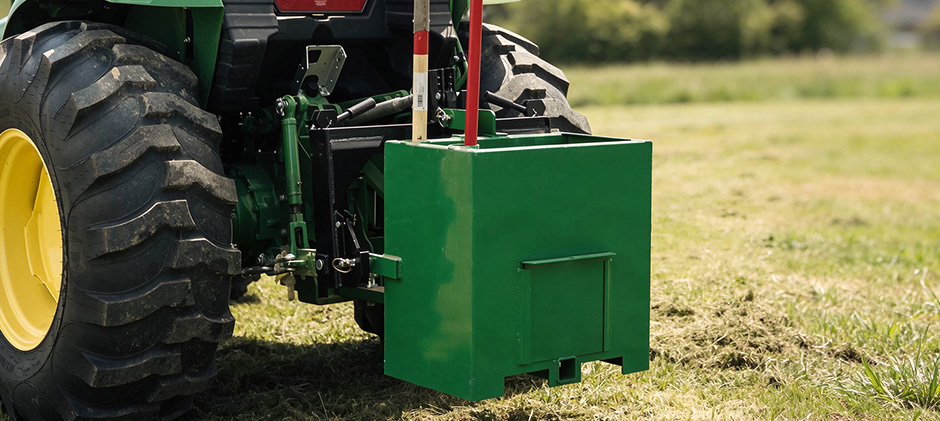
What a 3-Point Ballast Box Does?
Why loader work needs rear weight
A front loader shifts the tractor’s balance point forward. With the bucket full, the front axle carries the material, the loader frame, and much of the tractor’s own weight, while the rear tires get lighter. Traction and braking suffer with them.
Rear ballast pushes the balance point back toward the middle. Many compact tractor manuals list a minimum amount of rear ballast for loader use, so look up that figure for your model first.
- Keeps the rear tires planted for traction and braking
- Takes strain off the front axle, spindles, and wheel bearings
- Lowers the chance of the rear end lifting when the bucket is raised
- Keeps the tractor steadier on slopes while carrying a load
Years of loader work without enough ballast wear out the front end early. Play in the steering or uneven tire wear is the usual sign, and spindles, bushings, and bearings are what put it right.
How the built-in receiver saves a swap
Most ballast boxes sold today have a 2 x 2 inch receiver on the back. Without one, every towing job means lowering the box, unpinning it, mounting a separate hitch, then reversing the whole process later.
With a receiver box, the weight stays on, and a ball mount slides straight in. A yard trailer or a small log cart can move between loader jobs. Keep in mind that a 3-point hitch moves up and down, so towing from it has limits.
How to Choose the Right Ballast Box?
A box that does not match your hitch, or is too heavy for your lift arms, will not do the job however well it is built.
Match your hitch category
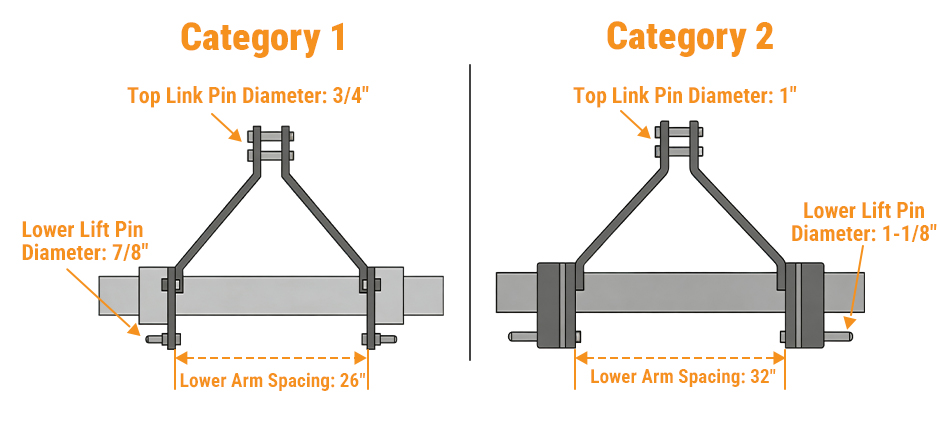
Most compact and subcompact tractors use a Category 1 hitch, while larger utility tractors usually have Category 2. The pin sizes differ, so a box made for one category will not pin up correctly on the other.
| Feature | Category 1 | Category 2 |
|---|---|---|
| Lower lift pin diameter | 7/8 in | 1-1/8 in |
| Top link pin diameter | 3/4 in | 1 in |
| Typical tractor size | About 20 to 45 hp | About 40 to 100 hp |
Check your lift capacity first
An 800 lb rating tells you what the box can hold. It says nothing about what your tractor can lift. An empty steel box weighs about 130 lb, so a full 800 lb load brings the total close to 930 lb.
Rear lift capacity is usually measured at a set distance behind the lift points, often 24 inches. The center of a ballast box can sit near or past that point, so your real margin may be smaller than the spec sheet suggests.
The check is arithmetic, plus one slow test lift:
- Find the rear lift capacity in your operator’s manual and note where it is measured.
- Add the empty box weight to the fill weight you plan to use.
- Keep the total below your lift capacity with some room to spare.
- Lift the first time slowly and listen for the relief valve or any strain.
If the hitch now struggles with loads it used to lift easily, check the fluid level and filter. A new filter or seal is often what restores lost lift.
Compare these specs before buying
Most boxes look alike in photos, and the small details decide how easy one is to live with every day.
| Spec | Common range | What to look for |
|---|---|---|
| Weight capacity | 800 to 1,000 lb | Matched to your lift capacity |
| Volume | 3.2 to 6.2 cu ft | More volume if you plan to use sand or gravel |
| Steel | 11-gauge is common | Thick walls and solid welds at the pin plates |
| Receiver | 2 x 2 in | Pin hole that fits your hitch pin |
| Door | Sliding front door | Lets you add or empty ballast without lifting the lid |
| Extras | Fork pockets, tool holders | Fork pockets make moving the box much easier |
| Hardware | Lower pins and top link pin | Included pins save a trip to the store |
Quick hitch and iMatch fit
A quick hitch lets you back up and hook an implement without climbing down to line up every pin. John Deere’s iMatch follows the ASAE Category 1 quick hitch standard, and most other brands sell hitches built to the same standard.
Every implement on a quick hitch needs a bushing set, and your ballast box is no exception. The lower bushings go over the lift pins so the hooks can lock around them. On iMatch, these measure about 1.43 inches across.
Before buying, check that the box is listed as quick hitch compatible, and that its lower pin spread and top pin height match your hitch frame. If your setup needs a refresh, browse our aftermarket 3-point hitch parts for bushings, lift arm ends, and stabilizers.
What to Fill Your Ballast Box With?
Your fill material decides how heavy the box gets, and light materials fill the space well before they reach the rated capacity.
Weights below are for a 4.6 cubic foot box filled to the top. They are estimates, since moisture and how tightly the material packs move the numbers around.
| Fill material | Approx. weight per cu ft | Full box weight |
|---|---|---|
| Dry sand | About 100 lb | About 460 lb |
| Gravel | About 95 to 105 lb | About 440 to 480 lb |
| Wet sand | About 120 lb | About 550 lb |
| Concrete | About 145 to 150 lb | About 670 to 690 lb |
| Steel weights or scrap | Much higher | Can reach 800 lb quickly |
Concrete packs the most weight into the space for the cost. Poured straight into the box, it becomes permanent, so casting it into smaller blocks lets you add or remove weight later.
Steel weights or scrap give you the most weight in the least space. They cost more, and you can stack them to hit an exact target.
Whatever you use, keep the top covered and check for drain holes so water does not pool inside.
Towing from the Ballast Box Receiver?
Safety checks before you hook up
A 3-point hitch pivots and is held up by hydraulic pressure, which makes it different from a fixed drawbar. Trailer tongue weight also adds to the load already hanging on the lift arms.
Go through this each time:
- Tighten sway chains or stabilizers so the box cannot swing side to side.
- Set the hitch height so the trailer sits level, then lock the position control.
- Count the trailer’s tongue weight against your lift capacity along with the box.
- Keep towing to light trailers and use the drawbar for heavy loads.
- Inspect the lower pins and top link pin for wear and make sure the clips are in place.
- Never tow from the top link.
Many boxes do not list a towing rating. If yours does not, ask the seller before pulling anything heavy. Worn pins are the common weak spot, and they are a cheap thing to replace.
Other ways to skip the hitch swap
| Option | Adds rear ballast | Lets you tow | Best for |
|---|---|---|---|
| Ballast box with receiver | Yes | Light trailers | Loader work mixed with light towing |
| 3-point receiver adapter | No | Light trailers | Towing when you do not need ballast |
| Quick hitch | Only with a ballast implement | Depends on implement | Frequent implement changes |
| Loaded rear tires or wheel weights | Yes, often not enough alone for loader work | Leaves the drawbar free | Keeping the 3-point open for other tools |
Final Words
A 3-point ballast box should match your hitch category, stay inside your lift capacity, and hold enough dense fill to balance the loader. If you tow from the receiver, keep the load light and check the pins every time. FridayParts stocks aftermarket parts for the hitch, the hydraulics, and the front end.
