

The 3-point hitch is what makes tractors so versatile. But picking the right implement for your tractor isn’t always easy, you need to check hitch categories, pin sizes and horsepower ratings. This guide coves hitch categories and 3-point hitch dimensions to help you get a good fit.
3-Point Hitch Categories
The first step in understanding the 3-point system is knowing the categories. The American Society of Agricultural and Biological Engineers (ASABE) established these standards to ensure implements and tractors from different manufacturers can work together. The categories are based primarily on the tractor’s drawbar horsepower (HP).
- Category 0 (Cat 0): Designed for the smallest machines, like garden tractors, with less than 20 horsepower.
- Category 1 (Cat 1): This is the most common category for sub-compact and compact utility tractors, typically in the 20 to 45 horsepower range.
- Category 2 (Cat 2): For larger utility tractors, usually between 40 and 100 horsepower. These hitches are built with heavier steel and larger pins to handle more demanding implements.
- Category 3 (Cat 3): Found on high-horsepower farm tractors (80 to 225 HP) used for large-scale agricultural work.
- Category 4 (Cat 4): The largest and most robust category, reserved for the most powerful agricultural tractors (180+ HP) pulling massive implements.
For most off-road machinery owners working on property maintenance, landscaping, or small farms, the focus will almost always be on Category 1 and Category 2 hitches.
Three-Point Hitch Components
Before we dive into dimensions, let’s identify the parts of the system. A 3-point hitch creates a rigid, stable triangle between the tractor and the implement, allowing you to lift, lower, and control it with precision.
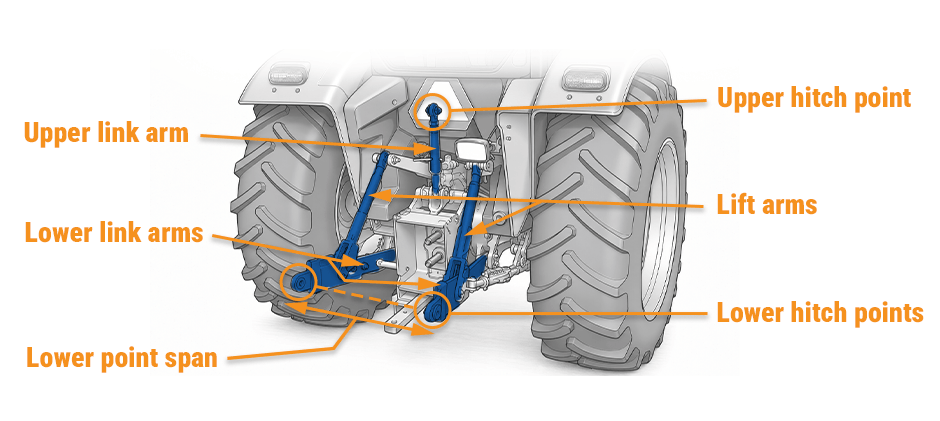
- Upper and Lower Link Arms: These are the three arms that form the connection. There is one upper link arm (often called the top link) and two lower link arms. They are the primary points of attachment.
- Lift Arms: These are connected to the tractor’s hydraulic system and the lower link arms. When you operate the hydraulic lever, the lift arms raise and lower the entire hitch and the attached implement.
- Hitch Points: These are the corresponding connection points on the implement itself—one on top and two on the bottom—where the link arms attach with pins.
- Lower Point Span: This refers to the distance between the two lower hitch points, a critical dimension for compatibility.
Understanding how these parts work together is the foundation for attaching and using implements safely and effectively.
3-Point Hitch Dimensions
This is where the details matter most. While the category gives you a general idea, the specific 3-point hitch dimensions determine whether an implement will physically fit your tractor. The most important measurements are the diameter of the hitch pins and the spacing of the lower link arms.
A smooth connection depends on the pins on the implement fitting perfectly into the ball ends on the tractor’s link arms.
Category 1 (Cat 1) 3-Point Hitch Dimensions
- Top Link Pin Diameter: 3/4 inch (19 mm)
- Lower Link Pin Diameter: 7/8 inch (22.4 mm)
- Lower Link Spacing: 28 inches (718 mm)
Category 2 (Cat 2) 3-Point Hitch Dimensions
- Top Link Pin Diameter: 1 inch (25.5 mm)
- Lower Link Pin Diameter: 1 1/8 inches (28.7 mm)
- Lower Link Spacing: 34 inches (870 mm)
As you can see, the pins and spacing for a Cat 2 hitch are substantially larger and wider to handle greater forces. This transition from one category to the next is a crucial point that trips up many operators.
“The golden rule is simple: the implement’s pin size and spacing must match the tractor’s hitch category. Using bushings to adapt a smaller implement to a larger tractor is common, but trying to force a large, heavy implement onto a small tractor is a recipe for failure.”
Quick-Hitch Systems
For operators who frequently swap between a box blade, a mower, and a tiller, constantly wrestling with three separate connection pins can be time-consuming and strenuous. This is where a quick-hitch system becomes a massive time and labor saver.
A quick-hitch is a heavy-duty triangular frame that attaches to your tractor’s three link arms one time. After that, it acts as a universal adapter. You can simply back the tractor up to a compatible implement, use the hydraulics to lift the hitch, and it will automatically lock onto the implement’s pins without you ever having to leave your seat.
There are a few types of systems you will encounter:
- Universal Standard Systems: Many implement manufacturers build their equipment to be “quick-hitch compatible” according to the ASAE S278 standard. This means they have a consistent A-frame geometry that works with most standard quick-hitches on the market for both Cat 1 and Cat 2.
- Adapter-Style Systems: These kits convert your tractor’s standard lower link arms into hook-style receivers. This allows you to snap on nearly any standard implement without needing it to be specifically designed for a full quick-hitch frame.
- Proprietary Systems: Some major tractor manufacturers have their own proprietary quick-hitch designs. While effective, they often require you to buy a specific adapter for every single implement you own, which can add significant cost and limit your choices.
Cat 1 vs. Cat 2: Which Do You Actually Need?
This is one of the most important questions when buying implements. The answer almost always comes down to your tractor’s PTO horsepower.
The rule of thumb is clear:
- If your tractor’s PTO horsepower is under 40 HP, you should be shopping exclusively for Category 1 implements.
- The 40 to 50 HP range is the crossover zone. Many tractors in this class come with Cat 1 hitches but have enough power and lift for certain Cat 2 jobs. Some attachments have adjustable convertible pins for both categories, and certain tractors can get convertible link ends installed.
- If your tractor is over 50 PTO HP, you should be looking at Category 2 implements.
However, the difference is far more than just pin size. A Category 2 implement is not just bigger; it’s built for higher stress.
It usually weighs 30–50% more than a Cat 1 version. It also has a heavier gearbox built for higher horsepower, so your tractor needs enough hydraulic lifting power to raise it. Hooking a 1,000-pound Cat 2 box blade to a 35 HP tractor, even with adapter bushings, is risky. It can badly damage the tractor’s hydraulics or frame.
The Most Common Mistake
A common mistake we see is owners of sub-compact tractors (usually 25 HP or less) trying to use regular Category 1 attachments. Though the pins may match Cat 1 size, these attachments are built for bigger compact utility tractors.
When you hook one up to a smaller sub-compact tractor, the fit won’t work right. The lift arms sit too low, the top link tilts at a very sharp angle, and the attachment frame may scrape the ground. Often, the tractor’s hydraulics don’t have enough travel to lift the attachment high enough to use.
Always confirm whether an attachment works with sub-compact tractors. Many trusted brands make a separate line of lighter, smaller attachments built to fit sub-compact tractors perfectly for safe, proper operation.
Conclusion
Picking the right 3-point hitch implement isn’t just about getting work finished. It also keeps you safe, boosts efficiency, and protects your tractor gear. Once you understand hitch categories, parts and key measurements, you can make smart buying choices. FridayParts supplies budget-friendly transmission and hydraulic parts to keep your tractor working reliably.
