

5W40 vs 15W40 protect a hot diesel about equally. The grade in front of the W is where they differ, and it buys about ten degrees more cold headroom. A machine worked through hard winters wants 5W-40; one that runs above freezing does fine on the cheaper 15W-40. The rest of the page gives you the test temperatures behind each grade, what the W and the 40 measure, how much of the price gap is base oil, and how to read your manual’s chart. The catch sits in the second half of the label, where the price gap stops mattering.
Quick Answer
In the 5W40 vs 15W40 comparison, both grades carry the same 40, so the hot film is the same, and the higher price is not buying extra protection. What the extra money buys is cold flow and a better base oil.
| Feature | 5W-40 | 15W-40 |
|---|---|---|
| Cold start rating | Tested down to about -30°C / -22°F | Tested down to about -20°C / -4°F |
| Thickness when hot, 100°C | Same SAE 40 range | Same SAE 40 range |
| Usual base oil | Synthetic or synthetic blend | Mostly conventional mineral oil |
| Price | Higher | Lower |
| Best for | Cold winters, short runs, frequent starts | Warm climates, steady heavy work, older engines |
If your machine works through hard winters, 5W-40 gives better protection. If it runs mostly above freezing, 15W-40 does the job for less money.
How to Read the Oil Numbers?
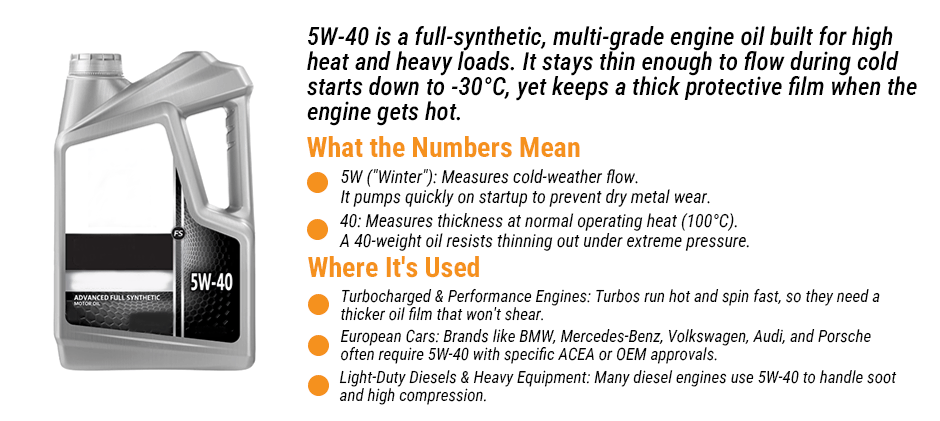
A label like 15W-40 is an SAE viscosity grade. To understand 5W40 vs 15W40, viscosity is how thick the oil is and how easily it flows, and each half of the grade describes a different condition.
What the W means
The W stands for winter, not weight. The number in front of it describes cold behavior: a lower number means the oil still flows at lower temperatures. So 5W passes its cold tests at temperatures where 15W fails them, which means easier cranking and faster oil flow on a cold start.
What the second number means
The number after the W is the thickness at operating temperature, around 100°C / 212°F. Both grades carry a 40 there, which puts them in the same band of 12.5 to under 16.3 mm²/s. Once your diesel is warm and working, the two oils hold about the same film on the bearings, cam, and cylinder walls.
High-temperature shear rating
Oils also go through a high-temperature, high-shear test called HTHS, which measures how thick the oil stays under load in tight spots such as the bearings. SAE requires at least 3.5 mPa·s from a 5W-40, and at least 3.7 mPa·s from a 15W-40, and plenty of 5W-40 diesel oils test well above the minimum.
Cold Starts and Engine Wear
Most engine wear happens in the first seconds after a cold start. The oil is still sitting in the pan, and the pump has to lift it and push it to every moving part. Thick oil moves slowly, so those parts run nearly unprotected until it arrives.
SAE checks this with two low-temperature tests: cold cranking (CCS), which asks whether the starter can turn the engine over, and pumping (MRV), which asks whether the pump can pull the oil up and move it through the engine.
| Test | 5W-40 limit | 15W-40 limit |
|---|---|---|
| Cold cranking, max | 6,600 mPa·s at -30°C | 7,000 mPa·s at -20°C |
| Pumping, max | 60,000 mPa·s at -35°C | 60,000 mPa·s at -25°C |
| Typical pour point | About -40°C or lower | About -27°C to -33°C |
The limits look close until you read the temperatures. At -25°C, a 15W-40 is at its pumping limit; a 5W-40 at the same temperature still flows with room to spare.
What you notice on a cold morning
With 15W-40 in deep cold, expect slow, labored cranking, more strain on the starter and batteries, low oil pressure for the first few seconds, and extra wear on the cam, lifters, and turbo bearings. A block heater helps a lot if you stay with 15W-40 through winter, and fresh batteries with a healthy starter make cold starts easier, whichever oil you run.
Base Oils, Additives and Certifications
The way an oil reaches its grade explains much of the price gap, and it also decides how well the oil holds up over a long drain interval.
How each oil is made
Most 15W-40 diesel oils start from conventional mineral base oil. Blenders add polymers called viscosity improvers to keep it thick enough when hot. It is an old recipe, and it has protected heavy diesels for decades.
Most 5W-40 oils use synthetic or synthetic blend base stocks, which already flow well cold and stay stable hot, so they need fewer improvers. Heavy loads break those improvers down over time, and the oil thins out, which is called shear loss. Fewer improvers usually means the grade holds longer and the engine builds less sludge.
15W-40 is not a lower grade
A higher price does not make 15W-40 a poor oil. A full synthetic 5W-40 often costs much more than a conventional 15W-40 from the same brand. For a machine working in warm weather on normal drain intervals, 15W-40 is a sound and cost-effective choice.
Check the service rating first
The API service category matters as much as the viscosity. C categories such as CK-4 are for diesel engines, S categories such as SP are for gasoline engines, and many diesel oils carry both, as in CK-4/SN. Some 5W-40 oils on the shelf are blended for European passenger cars and carry only gasoline ratings. Those do not belong in a heavy diesel. Find the C rating your engine manual lists first, then pick the viscosity.
Which Oil Fits Your Machine?
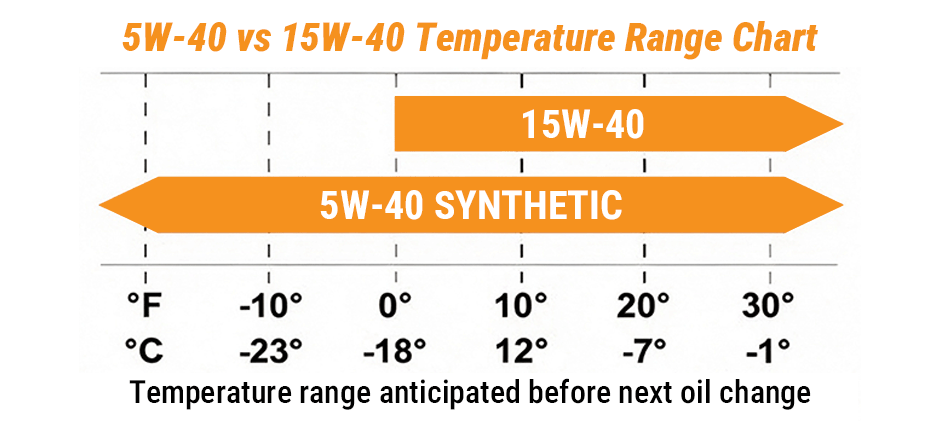
The 5W40 vs 15W40 decision comes down to climate, workload, and what the engine maker allows.
| Your situation | Better choice |
|---|---|
| Winter lows often below -15°C / 5°F | 5W-40 |
| Machine parked outside overnight in cold areas | 5W-40 |
| Short jobs and many starts per day | 5W-40 |
| Long drain intervals or very heavy loads | 5W-40 synthetic |
| Climate mostly above 0°C / 32°F | 15W-40 |
| Older engine that burns a little oil | 15W-40 |
| Large fleet watching oil costs | 15W-40, with 5W-40 for winter units |
Follow the temperature chart
Your operator’s manual has a chart showing which grades work in which temperature range, and most diesel makers list both 5W-40 and 15W-40 with the range for each. Pick from the lowest temperature your machine will see at startup rather than the daytime high.
Can you mix or switch?
Both grades with the same API rating can be mixed for a top-up, and the blend ends up somewhere between the two on cold performance. Switching from 15W-40 to 5W-40 at a normal oil change is fine, and so is switching back. No flush needed.
Change the filter with the oil. A good filter keeps soot and wear metal out of fresh oil, which matters as much as the grade.
Small gas engines are different
Your shop probably also runs mowers, pumps, or small generators, and diesel rules do not apply to those. Most small air-cooled gas engines call for SAE 30 above about 4°C / 40°F, or 10W-30 where temperatures swing more. Some small engine makers advise against 10W-40 because it can raise oil consumption. Use a 40-weight there only if the manual allows it.
Protect the rest of the system
Clean oil cannot fix dirty air or fuel. Dust that gets past a worn filter mixes with the oil and wears the engine fast. Fresh air and fuel filters for heavy equipment let the oil last its full interval and keep the inside of the engine clean.
Final words
Hot protection is the same in both grades. 5W-40 pays off on cold starts and long drain intervals; 15W-40 saves money in warm climates. Go by your manual and by your coldest morning. FridayParts stocks aftermarket filters and engine parts for a wide range of heavy equipment brands.
