

Having cleaned your Briggs & Stratton carburetor, but now the engine is surging, running rough or the throttle won’t snap back? You’ve likely hooked up the governor or throttle return springs to the wrong holes. Missing any one connection can cause your engine to scream at dangerously high RPMs or choke out entirely. In this guide, we’ll show you how to restore your engine’s perfect idle in minutes.
Understanding the Briggs and Stratton Throttle & Governor Spring Diagram
Standard Mechanical Throttle & Governor Spring Diagram
The diagram below is for a classic Briggs & Stratton V-Twin engine (like the Vanguard Series or Intek Series). After you clean your carburetor, the throttle & governor spring is where many guys fail. If your Briggs engine runs rough, you may refer to the diagram.
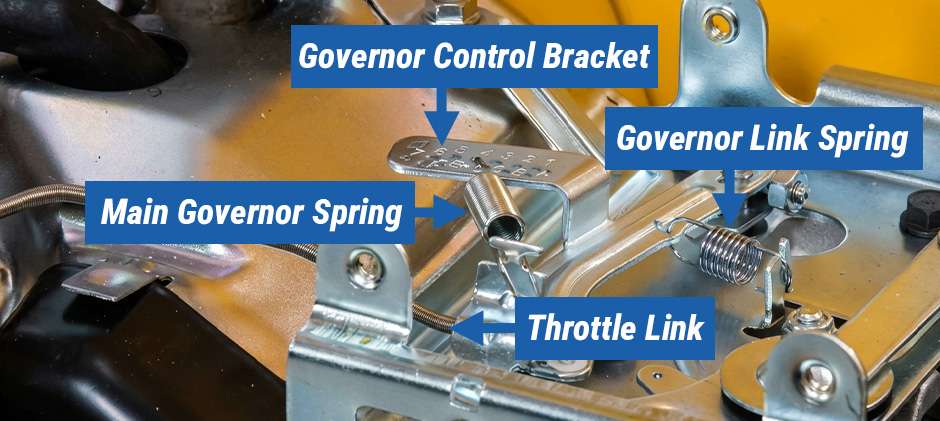
- Governor Control Bracket: A metal plate that anchors the main governor spring to adjust the top no-load RPM.
- Main Governor Spring: A thicker spring connected to the governor arm and governor control bracket. Its primary function is to keep the engine running stably at the set RPM.
- Throttle Link: A solid metal linkage rod connecting the governor arm directly to the carburetor’s throttle plate (or throttle shaft). It physically opens and closes the throttle to regulate fuel-air mixture intake.
- Governor Link Spring: Often the most overlooked spring in the system. It wraps around the throttle link to eliminate mechanical play (slop) between the linkages, which directly prevents engine hunting and surging.
Briggs and Stratton Throttle Spring Diagram
This diagram is extracted from the Briggs Single Cylinder L-Head Repair Manual 270962. It is suitable for Briggs & Stratton Model Series 80000, 91200, 110000, 130000 (like Briggs & Stratton 136200). If your throttle does not spring back with a pull, it is likely due to a broken return spring or an incorrect connection. The throttle return spring is a longer, stretchable spring connected between a fixed metal bracket and the throttle control lever. When you release the throttle, this spring pulls the control lever back to its idle position, ensuring the engine slows down safely.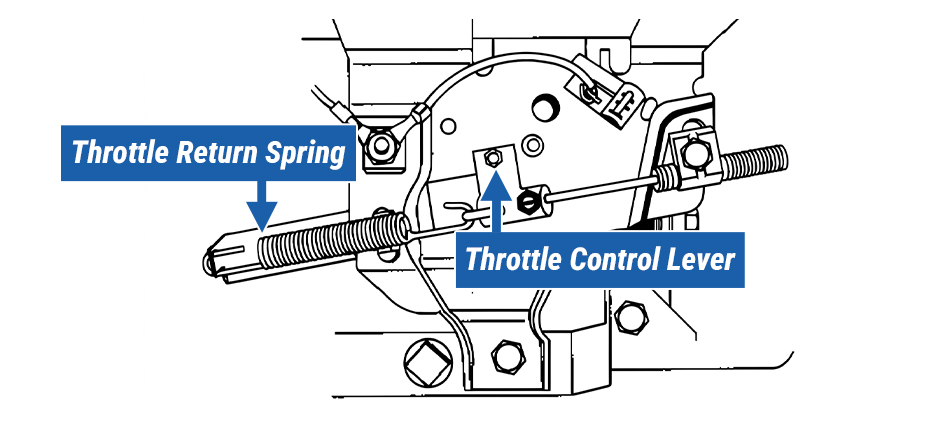
Briggs and Stratton Pneumatic Governor & Choke Linkage Diagram
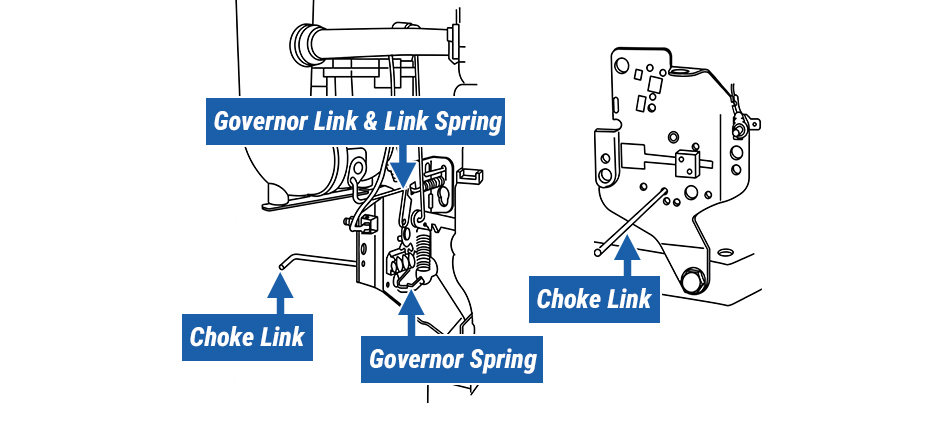
This diagram shows a classic setup for a Briggs pneumatic governor with automatic choke on a 3.5-4.5 HP engine. If you have an interest in the governor and choke linkage setup, you can browse our blogs for the Briggs and Stratton Governor Spring Diagram and Choke Linkage Diagram on our website.
How to Adjust Briggs Pneumatic Governor Systems?
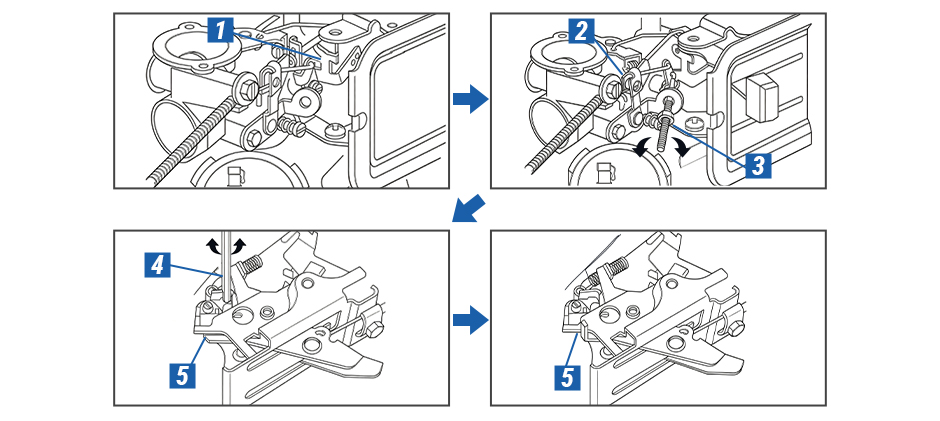
Adjusting the Briggs and Stratton pneumatic governor systems is straightforward with this step-by-step guide. The following diagrams for Model Series 80000 and 90000 show the governor spring connection and how to control the speed by adjusting the spring tension.
Adjust Top No-Load Speed
- Let the engine warm up for 5 minutes. Find the spring anchor tang (1). This is where your governor spring hooks in.
- Set the control lever or remote controls to the fast position with the engine running.
- Adjust the idle speed. Turn the stop nut (3) and idle speed screw (2) to keep the engine running smoothly at a proper RPM. Turn the stop nut clockwise (A) to increase speed, counterclockwise to decrease.
- To set the top speed, do not just pull the spring. Use a tang bending tool (or a specialty tool #19229) to gently bend the metal anchor tang (5) to adjust spring tension.
Adjust Governed Idle
- Let the engine run at normal operating conditions. Place the control lever in the minimum speed position.
- 80000 Series: Hold the throttle lever against the stop and adjust the idle speed screw (2) to obtain 1600 RPM. Release the throttle lever. Then, turn the governed idle stop nut (3) to obtain 1750 RPM.
- 90000 Series, Low Emissions Carburetors, Type Numbers ending in A1-A9 or E1-E9
CAUTION:
- Fixed adjustable control: Before the control lever can be moved to the slow position, the fixed speed tang (5), Figs. 3, 4, must be bent down to move the lever.
- Fixed adjustable control: After setting the governed idle, move the control lever back to the fast-speed position and bend the fast-speed tang up to hold the speed control lever.
Conclusion
Restoring a Briggs & Stratton engine is highly rewarding, but even the best carburetor clean-up is useless without properly installed governor and throttle springs. If your springs are stretched, rusted, or lost during the rebuild, trying to bend or reuse them will only lead to persistent engine surging and unstable RPMs. At FridayParts, you can source a vast selection of replacement springs, linkages or carburetor parts to restore your engine’s peak performance. Explore our extensive catalog for Briggs & Stratton replacement parts today and enjoy reliable performance from your machinery later.
