

Drum mowers and disc mowers dominate the market of hay mowers. You choose the right hay mower depending on your hectares, your tractor, your crop and how much time you can give to maintenance. If you have light work and a tight budget, choose a drum mower; if your operation needs high efficiency on large areas, consider a disc mower. In this guide, we’ll compare both mowers head-to-head on cutting speed, durability, cost and other things you may be interested in. Let’s get started!
What Is A Drum Mower?
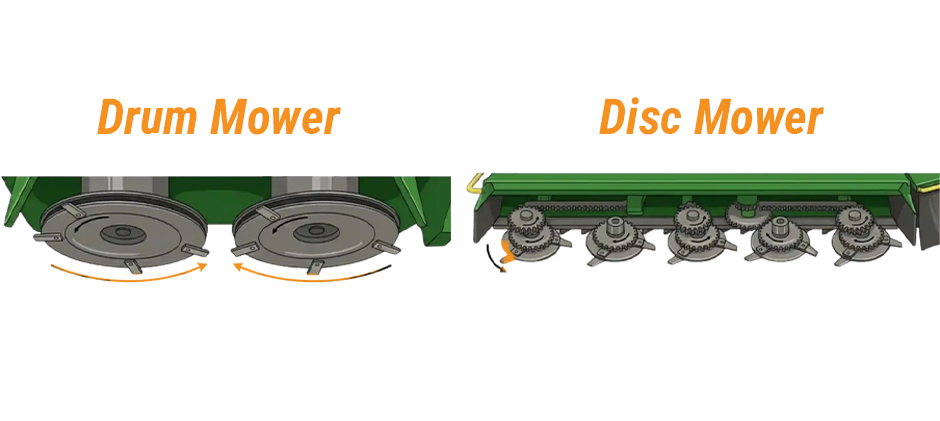
A drum mower is usually equipped with two or three large counter-rotating drums driven by a gearbox above the cutter assembly. You can see 3 to 4 free-swinging blades around the base of each drum. Its working mechanism is to rotate inward toward each other, drawing the cut crop into a windrow between them.
The drum mower controls the cutting height and avoids obstacles by keeping the whole drum assembly sliding along the ground on a “dish” bearing. It features high impact damage tolerance due to its design of drive gears above the cutting plane, making it rare to sustain expensive gearbox failures. The drum mowers windrow naturally, leaving crop in a relatively narrow strip between the drums. This makes it convenient to rake but can slow drying without tedding.
What Is A Disc Mower?
A disc mower mounts 6 to 10 smaller discs depending on cutting width along a horizontal cutter bar. There are 2 free-swinging blades on each disc. These discs are driven from below by gears or a shaft running inside the cutter bar.
The disc mowers can cut at high ground speeds, enabling them to handle thick and lodged crop well and leave a uniform spread or configurable windrow. As for the shortcomings, they are subject to impact damage. Striking a rock or fence post hard can break a disc, damage the cutter bar or destroy the gear case, thus bringing about costly repairs and replacements.
Drum Mower vs Disc Mower
| Mower Type | Cutting Speed & Throughput | Purchasing Price | Operating Cost | Horsepower Requirement |
|---|---|---|---|---|
| Drum Mower | 1. Drum mower (1.8 m)
|
1. Drum mower (1.6–2.4 m)
|
|
1. Drum mower (1.6 m, 2-drum)
2. Drum mower (2.4 m, 3-drum)
|
| Disc Mower | 1. Disc mower (2.4 m)
2. Disc mower (3.2 m+)
|
1. Disc mower (2.0–2.4 m)
2. Disc mower (3.2 m+)
|
|
1. Disc mower (2.0 m)
2. Disc mower (2.4 m)
3. Disc mower (3.2 m)
|
Which One Should I Choose?
Selecting the right hay mower depends on the real field performance. Here are the situations where each one wins:
Choose Drum Mower If:
- You require mid-size operations with 10-40 ha
- You have an older or smaller tractor (35–55 HP) where a disc mower would overload the rear axle
- You work on rocky or unfamiliar fields where impact damage risk on a disc mower is high
- You work under wet or dewy conditions where the heavy drum mass keeps cutting through tough material
- You have tight budgets or hobby operations cutting 1–2 times per year
Choose Disc Mower If:
- You work on large, clean fields with good visibility and few obstacles
- You work on heavy, lodged or wet crop where sickle bars would plug
- You work in premium hay markets where uniform stubble height and high leaf retention drive prices
- Your operations are sized to a 2.4 m+ working width with the tractor to suit
- Your tractor is over 60 PTO HP and your fields are over 30 hectares of relatively clean ground
Maintenance of Drum Mower and Disc Mower
If you own a drum mower, you may need to tension your belt twice a season, replace the blade as required and top up gear oil periodically. If you have a disc mower, your machine may require less frequent attention. But when something goes wrong with your disc mower, your work will be more complex and your replacement parts are more expensive. You need to check cutter bar oil, inspect the disc module, replace the blades and re-torque the knife bolt regularly. Therefore, if you are an operator with little experience in mechanics, a drum mower has the advantage of being almost forgiving. If you’re an operator who keeps up with the inspection schedule, the disc mower is a better choice.
Conclusion
Both drum and disc mowers have a clear niche in hay mowers. You can make your purchasing decision according to your specific needs and the situations where you’ll operate your machine. Regular inspection and maintenance ensure uptime and extend the service life of your hay mowers. At FridayParts, we are dedicated to providing a vast selection of quality mower parts to keep your machine running at its optimal performance.
