

Flail mower selection for a compact tractor comes down to matching power and weight, not brand name. The usual question is whether 19.5 PTO HP from a Kubota LX2610 is enough for a WoodMaxx FM-62H. Based on WoodMaxx’s current official specs, the FM-62H has a 55-inch cutting width and a 20 PTO HP minimum requirement, so the LX2610 sits slightly below the published minimum. In light mowing, it may still be workable, but it is a borderline match rather than a clean spec fit.
One easy point to miss is the model name. FM-62H does not currently mean a 62-inch cutting width. WoodMaxx now lists the FM-62H with a 55-inch cutting width and a 65-inch overall width.
Can a 19.5 PTO HP Kubota LX2610 Run a 55-Inch WoodMaxx FM-62H?
The LX2610’s 19.5 PTO HP is just below WoodMaxx’s 20 PTO HP minimum rating for the FM-62H. In light mowing, the combination may be workable, but it is technically below the manufacturer’s stated power requirement. That matters more in thick grass, wet growth, and brush than it does in light routine mowing.
A simple way to judge it is this:
- The mower may spin at the correct PTO speed without trouble.
- The real limit appears when material gets thicker.
- If travel speed must drop too often, the setup is too close to the edge.
- If most work is routine mowing, some operators may find the setup workable.
This is also where a properly maintained PTO shaft and healthy belt drive systems help. Sharp blades and a smooth drive system reduce wasted power and make a smaller tractor feel better matched.
A useful rule: if the mower fits only on paper, it’s risky. If it fits in real field conditions with power to spare, it’s workable.
What Matters More Than the Sticker HP Range?
Before width or blade type, confirm three basics:
- PTO horsepower
- Category 1 hitch
- 540 RPM PTO
These are the main starting checks, but they are not the only compatibility limits. The listed HP range is useful. It is not the whole story.
When selecting a flail mower for compact tractor, manufacturer HP ranges are useful, but they should not be treated as optional. A general width-to-HP guide can help compare mower sizes, but the mower maker’s stated minimum PTO requirement still matters first. In lighter mowing conditions, some operators may find a borderline setup usable, but that does not change the published minimum rating.
Load changes with grass height, moisture, forward speed, and slope. That is why one owner says a 55-inch mower is fine, while another says it is too much. Both can be right.
How To Match Width and Weight To a Compact Tractor?
Width matters. Weight matters too. Many buyers focus on cutting width first. That is understandable because width is easy to compare. Yet compact tractors often run into weight, lift, and balance issues before raw PTO power becomes the only problem. This is especially true when a mower has an offset design or hydraulic side shift.
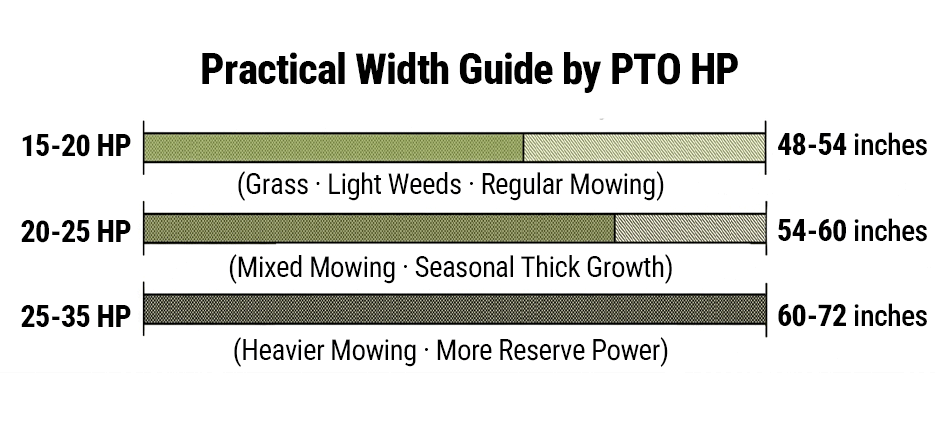
Typical Starting Point by PTO HP
| PTO HP Range | Suggested Flail Width | Best Use |
|---|---|---|
| 15 to 20 PTO HP | 48 to 54 inches | Grass, light weeds, regular mowing |
| 20 to 25 PTO HP | 54 to 60 inches | Mixed mowing, thicker seasonal growth |
| 25 to 35 PTO HP | 60 to 72 inches | Heavier mowing, more reserve power |
These are practical guidelines, not manufacturer ratings. Always check the mower manufacturer’s minimum PTO horsepower, hitch category, and weight requirements before buying.
As a general starting point, a 48- to 54-inch flail mower gives an LX2610 more power margin than the 55-inch FM-62H. The 55-inch FM-62H is closer to the edge because WoodMaxx rates it for 20 to 45 PTO HP, while the LX2610 is rated at 19.5 PTO HP.
Why Oversizing Causes Trouble?
The most common compact tractor mistake is buying too wide or too heavy. That creates several problems at once:
- Lower travel speed in normal mowing
- More strain when grass gets wet or tall
- Reduced front-axle loading when the mower is raised
- Reduced side-to-side stability on slopes
- Harder lifting on the 3-point hitch
- Less comfort when turning or backing
That is why a flail mower for compact tractor matching guide should talk about lift and balance, not just PTO horsepower.
Lift Capacity and Stability Are Real Limits
A heavier mower with hydraulic side shift often sounds attractive because it reaches under fences, along ditches, and on field edges. The tradeoff is extra weight and extra side load.
Watch these points closely:
- 3-point lift capacity at the hitch
- Tractor ballast
- Front axle feel during transport
- Side stability on uneven ground
- Rear overhang with offset engaged
For light mowing on flat ground, a standard rear-mounted flail is often the better value. For ditch bank mowing, slope mowing, and edge work, offset design can save time. Still, the added mass may push a small tractor into a less comfortable range.
Kubota lists the LX2610 with a 3-point lift capacity of 1,676 lb at 24 inches behind the lift point. On paper, that is higher than the FM-62H’s listed mower-and-shaft weight. Even so, lift capacity alone does not determine safety or comfort. Total tractor weight, front-to-rear balance, rear overhang, ballast, slope, offset position, and tire setup still matter. On a lighter compact tractor, a mower in this weight class can noticeably unload the front axle during transport, especially if the tractor is not carrying a loader or other front ballast. That can reduce steering confidence and overall stability even when the 3-point hitch can technically lift the machine. This is a good place to think about long-term service as well. Easy access to rear roller parts, mower bearings, and 3-point hitch parts can make ownership simpler over time.
Y Blades vs Hammer Blades
For a small tractor operating near the mower’s minimum PTO rating, Y blades may be the more practical choice for routine grass mowing because they are generally better suited to grass cutting and often place less cutting resistance on the mower in that kind of work. Hammer blades are better suited to tougher brush and heavier material, but actual power demand depends on material, cutting height, travel speed, and cutting conditions rather than blade weight alone.
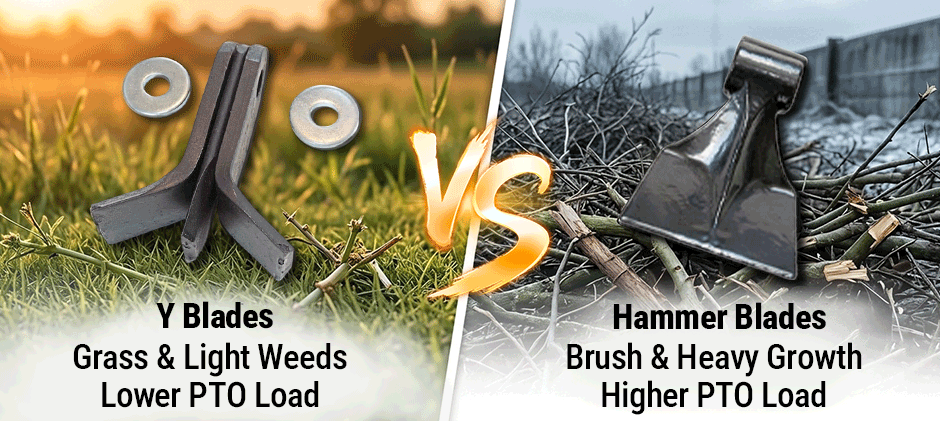
Y blades are a better fit when you want:
- Lower PTO load
- Cleaner grass finish
- Better mowing flow in routine work
- Good mulch results in lighter material
- Often a better choice near a 19.5 PTO HP limit
Hammer blades make more sense when the mower will spend more time in woody growth, rough brush, and heavier clearing where finish quality matters less than impact strength.
When Do Hammer Blades Make More Sense?
Hammer blades still have a place. They are a better fit when the work includes:
- Woody stems
- Rough brush clearing
- Heavy overgrown grass
- Tougher ground conditions
- More impact against coarse material
The tradeoff is mostly about cutting conditions. Hammer blades are tougher in rough material, but they may feel heavier to manage in dense cutting conditions on a smaller tractor.
Quick Blade Comparison
| Blade Type | Typical Load Tendency | Finish Quality | Best Match for 19.5 PTO HP |
|---|---|---|---|
| Reversible Y Blades | Usually easier to manage | Cleaner on grass | Usually better |
| Hammer Blades | Often heavier in tough material | Rougher but tougher | More demanding |
What About Occasional Stones and Small Branches?
Occasional debris does not automatically mean hammer blades are the better choice. If the main job is still mowing, Y blades remain the more balanced option. The smarter question is how often the machine will see rough material.
Use Y blades if:
- Small branches are occasional
- Stones are not a constant problem
- Grass finish matters
- PTO reserve is limited
Move toward hammer blades if:
- Brushwork is routine
- The ground is rough most of the time
- Finish quality is less important
- The tractor has more power in reserve
For upkeep, Y blade sets, hammer blade kits, and blade mounting hardware are worth checking before purchase. Good parts availability often matters more than a small feature difference between brands.
Is Hydraulic Side Shift Worth It on a Small Tractor?
Hydraulic side shift helps with fence lines, ditches, and pond banks, but it mainly affects mower weight, balance, rear overhang, and lift requirements rather than PTO horsepower alone. On a small tractor, that extra rear mass and offset load can change handling noticeably. It also requires compatible tractor hydraulics. A hydraulic side-shift mower such as the WoodMaxx FM-62H needs a rear hydraulic remote to operate the side-shift function. On tractors like the Kubota LX2610, rear remotes may depend on configuration or optional equipment, so that requirement should be confirmed before purchase. If edge work is frequent, a side shift may be worth it. If most mowing is in open fields, a standard rear-mounted flail is often the simpler choice. Before using a hydraulic side-shift mower, check the tractor’s stability and front-end load with the mower raised and offset. Front ballast may be needed depending on the tractor configuration, mower weight, rear overhang, and operating conditions.
A Practical Buying Guide for the LX2610 and Similar Tractors
The Kubota LX2610 and WoodMaxx FM-62H example is useful because it sits near a real decision line. It is not a clean spec match, but it is also not an automatic impossibility in light mowing. That makes it a strong example for compact tractor buyers. That makes it a strong example for anyone evaluating a flail mower for compact tractor.
This Setup Makes Sense If
- The mower will be used mostly for grass
- Light weeds are common
- Heavy brush is occasional
- Slower travel speed is acceptable in dense spots
- Good blade choice is part of the plan
This Setup Makes Less Sense If
- Brush clearing is a main task
- Wet heavy growth is common
- Long workdays under load are expected
- Offset use is frequent on rough ground
- A relaxed power margin is important
Best Practical Match for This Use Case
For the stated use, the most balanced setup is usually:
- 48 to 54 inch working width
- 540 RPM PTO compatibility
- Category 1 hitch fit
- Y blades for regular mowing
- Enough weight margin for stable transport
- Easy access to service parts
For an LX2610, the 55-inch FM-62H is better described as a borderline, compromise setup rather than a preferred match. If the mower is already owned, some operators may find it workable in lighter mowing by slowing travel speed and choosing blades suited to grass work. But if the goal is to buy the most comfortable long-term match, a 48- to 54-inch frame is usually the safer recommendation. The 55-inch FM-62H remains below WoodMaxx’s published minimum PTO requirement for the LX2610.
Common Buying Mistakes To Avoid
- Looking at engine HP instead of PTO HP
- Buying for the rarest heavy task
- Ignoring mower weight
- Overvaluing side shift on a small tractor
- Skipping parts availability checks
- Choosing hammer blades for mostly grass work
Before buying, it helps to check support items such as rear roller parts, replacement flail mower blades, belt drive parts, and driveline parts. Easy service support often decides whether a mower stays practical after the first season.
Final Words
The right flail mower match depends on real mowing conditions, not just the listed HP range. For anyone shopping for a flail mower for compact tractor, power margin, mower weight, and blade choice often matter more than width alone. When it is time to maintain that setup, FridayParts is a reliable aftermarket parts supplier with high-quality products at affordable prices, a vast inventory, and wide compatibility for many heavy equipment brands.
