

This guide shows you how to read a Freightliner VIN and understand what each character means. You can use it to identify important information such as the manufacturer, model, and model year. Keep in mind that Freightliner trucks built before May 1, 2000, use a different VIN format. This guide covers the VIN structure used on most modern Freightliner trucks and FCCC chassis.
Where to Find Your Freightliner VIN?
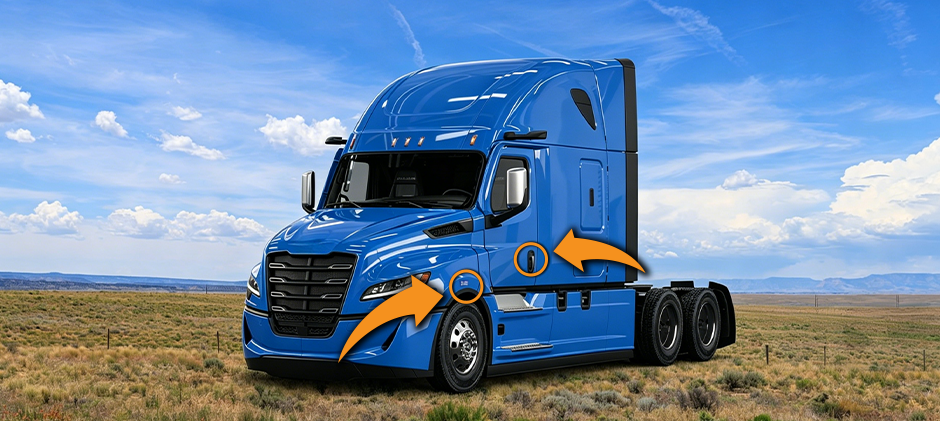
Before you can decode the VIN, you need to find it. On most Freightliner trucks, the VIN can be found in one of the following locations:
- Driver’s Side Door Frame: The VIN label is usually attached to the driver’s side door frame. This is the most common place to find it.
- Left Frame Rail: The VIN may also be stamped into the left frame rail near the front axle.
- Dashboard: On some models, you can see the VIN through the windshield on the driver’s side of the dashboard.
- Mexico-Built Trucks: The VIN is typically located on a label attached to the driver’s door. It may also appear as the “Chassis” number on a data card inside the glove box.
- FCCC Chassis: On Freightliner Custom Chassis Corporation (FCCC) vehicles, the VIN is usually found on a permanently mounted metal plate.
If the VIN plate is dirty or difficult to read, check your vehicle registration, insurance documents, or service records. The VIN listed on these documents should match the one on the vehicle.
How to Read a Freightliner VIN?
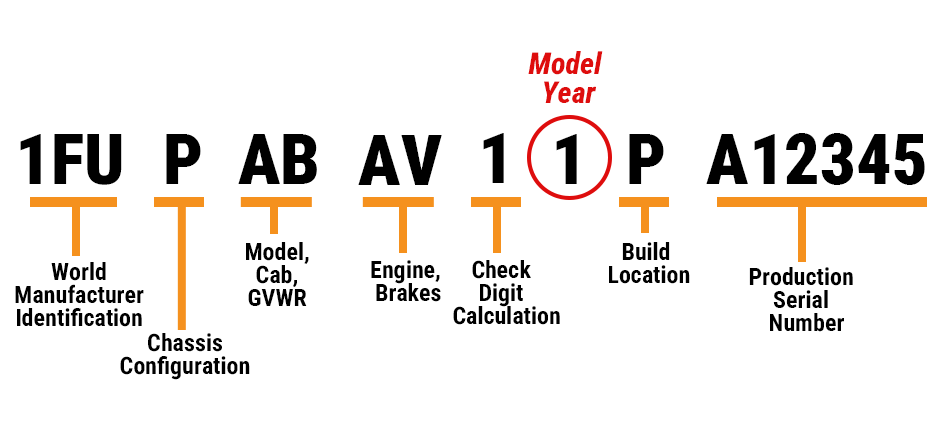
Federal Motor Vehicle Safety Standard 115 dictates the 17-character format. Freightliner updated its coding logic for all vehicles built after April 30, 2000. We rely on the following structure for modern truck identification:
| Position | Description | Meaning |
|---|---|---|
| 1, 2, 3 | WMI | World Manufacturer Identification (e.g., 1FU = Truck-Tractor, 1FV = Incomplete Vehicle) |
| 4 | Chassis Configuration | Identifies axle setup (including axle arrangement and brake configuration) |
| 5, 6 | Model/Cab/GVWR | Decoded as an alpha-alpha or alpha-numeric pair (e.g., “CX” = M2 106 Medium Duty, Class 7) |
| 7, 8 | Engine/Brakes | Identifies specific engine model, fuel type, and brake system |
| 9 | Check Digit | A value calculated via a mathematical formula to verify VIN authenticity and detect cloning or transcription errors |
| 10 | Model Year | Code representing the year of manufacture (e.g., Y=2000, 1=2001) |
| 11 | Build Location | Identifies the specific assembly plant (e.g., L = Cleveland, NC) |
| 12–17 | Serial Number | The unique production sequence for that specific vehicle |
VIN Positions 1, 2, and 3 (World Manufacturer Identification)
| Code | Vehicle Manufacturer | Vehicle Make | Vehicle Type |
|---|---|---|---|
| 1FU | Freightliner, U.S.A. | Freightliner | Truck-Tractor |
| 1FV | Freightliner, U.S.A. | Freightliner | Incomplete Vehicle |
| 3AK | M-B, Mexico | Freightliner | Truck-Tractor |
| 3AL | M-B, Mexico | Freightliner | Incomplete Vehicle |
| RSA | NAI, Saudi Arabia | Freightliner | Incomplete Vehicle |
| RSA | NAI, Saudi Arabia | Freightliner | Truck-Tractor |
VIN Position 10: Freightliner Model Year
| Code | Model Year |
|---|---|
| Y | 2000 |
| 1 | 2001 |
| 2 | 2002 |
| 3 | 2003 |
| 4 | 2004 |
| 5 | 2005 |
| 6 | 2006 |
| 7 | 2007 |
| 8 | 2008 |
| 9 | 2009 |
Positions 7 and 8: Engine and Brake Systems
Positions 7 and 8 are the most critical for fleet maintenance and ordering Freightliner aftermarket parts. These characters identify the fuel type, displacement, and braking configuration. We use these codes to ensure compatibility for internal components:
- Mercedes-Benz (MBE) Engines: Examples include CN, CP, or CR (MBE900, 4.3L) and CV, CW, or CX (MBE4000, 12.0L). These are vital for M2 and legacy highway models.
- Detroit Diesel Engines: Examples include CD, CE, or CF (Detroit Series 60, 11.1L) and DR or DS (Detroit Diesel DD15, 14.8L).
- Cummins Engines: Examples include BG, BH, or BJ (Cummins ISX/Signature, 14.9L) and DT or DU (Cummins ISB, 6.7L).
- Caterpillar Engines: Examples include AD, AE, or AF (Caterpillar 3406, 14.6L) and AK, AL, or AM (Caterpillar 3126/CFE, 7.2L).
- Brake Identification: These positions also specify whether the truck uses Air, Hydraulic, or Air/Hydraulic systems.
Freightliner Custom Chassis Corporation (FCCC) Specifics
Not all Freightliner vehicles are heavy-duty trucks. Freightliner also operates Freightliner Custom Chassis Corporation (FCCC), a division that manufactures chassis for motorhomes, shuttle buses, school buses, and walk-in delivery vans.
If your VIN begins with 4UZ, it typically indicates a Freightliner Custom Chassis vehicle rather than a conventional Freightliner truck such as the Cascadia or M2. Common chassis identified through this decoder include:
- XC Chassis: Rear-engine motor home platforms (including straight-rail, modular, and raised-rail variants).
- MT Series: Walk-in van chassis such as the MT35, MT45, and MT55.
- S2 106: Specialized bus chassis platform.
- Chassis Serial Number: For FCCC vehicles, the last six digits represent the unique chassis serial number, which is distinct from the body builder’s identification.
Why You May Need the Freightliner VIN Check?
Decoding a Freightliner VIN can tell you a lot about the truck and help you make better maintenance and repair decisions.
- Vehicle Class and GVWR: The VIN can help identify the truck’s weight class and Gross Vehicle Weight Rating (GVWR). This information is useful for loading, operation, and compliance requirements.
- Recall Information: You can use the VIN to check for open recalls through the NHTSA database. This helps you find important safety or equipment-related recalls that may affect the truck.
- Finding the Right Parts: The VIN helps you identify the correct engine, chassis, and vehicle specifications. This makes it easier to find compatible replacement parts, such as sensors, air dryers, clutch components, and cooling system parts.
Quality Components with Your VIN Data
Once you’ve decoded the VIN and identified the correct engine and chassis, finding the right parts becomes much easier. The VIN helps you match parts to your truck’s exact specifications and avoid ordering the wrong components. At FridayParts, you can find a wide range of high-quality aftermarket Freightliner parts in one place. Using your VIN helps ensure you get compatible parts for your truck.
