

Most John Deere mowers use a 12V U1 battery with 300–350 CCA. Compact tractors and Gators may need different specs. Before you buy, check voltage, group size, terminal position, tray dimensions, and CCA.
What Battery Does Your John Deere Use?
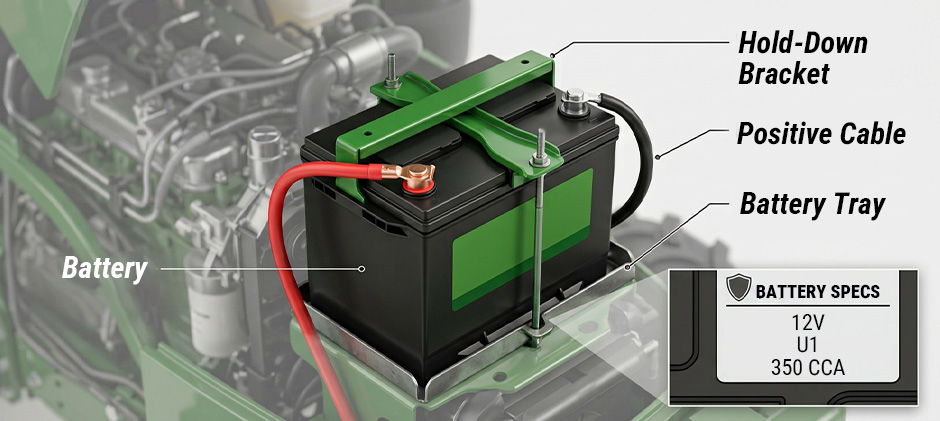
When it comes to identifying the right John Deere battery, the original battery specs tell you more than the machine category alone. Two models may look similar and still use different battery setups. Checking the case size, terminal position, and cranking power before you buy can help you avoid fitment problems and starting issues.
These are the first specifications to verify:
- Voltage – Most John Deere mower and tractor batteries are 12V.
- Group Size – U1 is common for lawn and garden equipment.
- CCA – Cold cranking amps affect starting power, especially in cold weather.
- Ah Rating – Amp-hour capacity affects reserve power.
- Terminal Type – The cable ends must match the battery posts.
- Battery Tray Size – The case must fit the tray and hold-down bracket.
John Deere part TY25221B is a useful example. This is a U1 BCI battery with 12V, 30 Ah, 350 CCA, and lug terminals. It’s used on a variety of John Deere equipment like riding mowers, tractors, zero-turns, and some Gators. That said, you should still check your model for proper fit.
A quick reference is below:
| Spec | What It Means | Why It Matters |
|---|---|---|
| 12V | Battery voltage | Must match the machine’s electrical system |
| U1 Group | Common lawn and garden battery size | Helps confirm tray fit |
| 350 CCA | Starting power in cold conditions | Affects cold starts and larger engines |
| 30 Ah | Battery reserve capacity | Supports cranking and electrical load |
| Lug Post Terminal | Battery post style | Must match the cable connection |
A battery for one John Deere riding mower may share the same group size as another machine but still differ in terminal layout or CCA. For that reason, many owners also inspect nearby battery accessories, connections, and cable condition before ordering a replacement.
Battery fit is only part of the decision. Battery location also matters because it affects access, cable reach, and replacement time.
Where Is the Battery on a John Deere Machine?
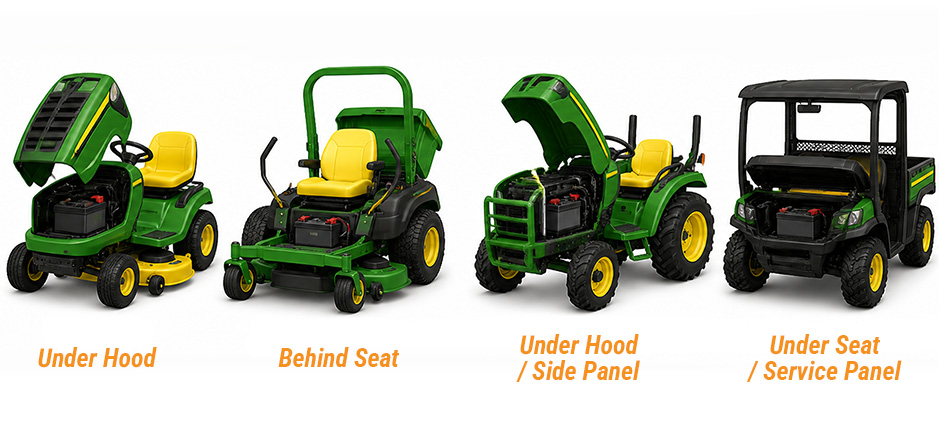
Battery location varies by machine type. On many John Deere machines, the battery is easy to find once the main access panel is opened. On others, it sits below a cover or behind a side panel.
Riding Mowers and Lawn Tractors
Look under the hood for the battery. It’s usually near the front of the engine bay or under the dash. For a John Deere lawn mower battery replacement, start by checking the tray, bracket, and cable length.
Zero-Turn Mowers
The battery is often behind the seat or under a rear access panel. This area is usually easier to reach, but space can still be tight. Before ordering a replacement, check tray dimensions and hold-down hardware.
Compact Tractors
The battery is often under the hood or behind a side engine panel. Nearby engine components and filters can limit access. A quick inspection before removal helps avoid buying the wrong case size or terminal layout.
Gator and XUV Models
The battery is often under the seat or behind a service cover. This is the first place to check if you are trying to find the battery on a John Deere Gator. Utility vehicles also tend to put more stress on batteries because of vibration, repeated stop-and-start use, and longer storage periods.
These checks save time before replacement:
- Find the battery tray first
- Check the cable routing
- Note terminal direction
- Measure the battery case if the label is unclear
- Inspect cable ends and charging components for corrosion
Battery location affects more than access. A battery placed near heat, dirt, or vibration may wear out faster, which helps explain why service life can vary across different machine types.
How to Choose the Right Replacement Battery?
The best replacement matches both fit and power needs. Many battery problems start with a battery that looks close enough but is not an exact match. A battery may appear correct in photos and still create installation or starting issues.
Use this order when choosing a John Deere battery:
- Match the Voltage – A 12V machine needs a 12V battery.
- Confirm the Group Size – U1 is common, but it is not used on every John Deere machine.
- Check the CCA Rating – Larger engines and colder climates may require more cranking power.
- Check the Ah Rating – Higher reserve capacity can help if the machine sits between uses.
- Verify Terminal Position – Cable length and polarity must line up correctly.
- Measure the Tray – The battery must fit the tray and hold-down setup.
- Consider the Work Environment – Vibration, outdoor storage, and frequent short runs all affect battery choice.
This table helps compare common use cases:
| Machine Type | Common Battery Need | What to Check First |
|---|---|---|
| Riding mower | Compact 12V starting battery | U1 size and terminal layout |
| Lawn tractor | 12V garden battery | Tray fit and CCA |
| Zero-turn mower | Good hold under vibration | Bracket fit and cable position |
| Compact tractor | Stronger starting reserve | Exact model fit and power rating |
| Gator or XUV | Stable starts in rough use | Terminal layout and battery access |
Battery type also matters. Flooded lead-acid batteries are common and usually cost less. AGM batteries may be a better choice for machines exposed to more vibration, longer storage, or heavier electrical demand. That can be especially useful for commercial mowing equipment, utility vehicles, and some compact tractors.
Brand choice is another common concern. A John Deere battery is often compared with Interstate, NAPA, EverStart, and other aftermarket options. The comparison usually comes down to a few practical points:
- exact fit
- terminal match
- CCA rating
- production date
- local warranty support
- use pattern
- price
Price matters, but it shouldn’t be the deciding factor. A battery that fails early costs you in downtime and labor. Check the positive battery cable too. If it shows corrosion, stiffness, or insulation damage, replace it while you’re at it.
How Long Does a John Deere Battery Last?
Battery life depends on use, storage, and charging habits. A John Deere battery in hard service may last 3 to 4 years. One in lighter seasonal use with better charging and storage conditions can last 6 years or more.
A simple service-life range looks like this:
- 3 to 4 years in hot weather, rough ground, long idle periods, or weak charging conditions
- 4 to 6 years in normal use with decent maintenance
- 6 years or more when storage and charging are managed well
Several conditions shorten battery life:
- repeated deep discharge
- corroded terminals
- loose cable connections
- long off-season storage without a maintainer
- high vibration
- extreme heat
- undercharging
- frequent short runs
A weak battery often shows clear signs:
- slow cranking
- clicking at start
- dim lights during ignition
- repeated jump starts
- the need for frequent charging
- swelling or leakage
- heavy corrosion around the posts
A battery test is useful before replacement. If voltage drops too fast under load, the battery may be near the end of its service life. If the battery tests well but starting remains weak, the problem may be elsewhere. In that case, the starter, charging system, wiring, and cable connections deserve a closer look.
Many machines do not go from healthy to dead in a single day. The problem often builds slowly through weak charging, corrosion, vibration, or storage loss. Routine checks make it easier to catch those problems before they turn into a no-start situation.
How to Charge and Maintain a John Deere Battery?
Routine care helps a battery last longer, especially on riding mowers, lawn tractors, compact tractors, and Gators that sit for long periods between uses.
Keep the Battery Clean
Clean terminals support better current flow. Dirt and corrosion create resistance, and resistance reduces starting power.
A basic cleaning routine includes:
- Turn the machine off
- Disconnect the cables safely
- Clean the posts and cable ends
- Reinstall the cables tightly
- Check again for corrosion after use
Use a Maintainer During Storage
A maintainer helps prevent slow discharge. Seasonal equipment often loses battery life during storage, not during active work.
A maintainer is especially helpful for:
- seasonal lawn tractors
- backup utility vehicles
- compact tractors with light use
- machines stored outdoors for long periods
Avoid Deep Discharge
Starting batteries are not designed for repeated deep drains. Leaving lights on or ignoring a weak charging system can shorten service life quickly.
Check the Charging System
A fresh battery will not solve a charging problem. If a new battery loses charge too soon, check charging output, cable condition, and fuse connections.
Secure the Battery Properly
A loose battery wears out faster. Vibration can damage internal plates and cable connections, especially on rough ground. The hold-down bracket should be tight, and the tray should stay clean and dry.
These steps help extend battery life:
- Keep terminals clean
- Charge during long storage
- Avoid repeated short run times
- Inspect the hold-down bracket
- Replace worn cables
- Test charging output when starting problems appear
Good maintenance does not take much time, but it can add useful service life and reduce sudden no-start problems when the machine is needed most.
FAQ
What size battery for a John Deere riding mower?
Many models use a 12V U1 battery, often in the 300 to 350 CCA range.
What size battery for a John Deere lawn mower?
Many lawn tractors also use a 12V U1 battery, though the exact fit should still be confirmed before ordering.
What size battery for a John Deere 3032E?
Compact tractors often use a different battery than lawn tractors, so the exact model and serial range should be checked before buying a replacement.
How long does a John Deere battery last?
Many John Deere batteries last about 3 to 6 years, while well-maintained batteries in favorable conditions can last 6 years or more.
Final Words
The right John Deere battery depends on size, terminal layout, battery location, and working conditions. A careful fit check reduces installation problems and helps the machine start more reliably over time. When replacement time comes, it helps to buy from a supplier that offers clear fit information, broad compatibility, and dependable stock. FridayParts offers aftermarket options for many John Deere and heavy equipment applications.
