

If you’re replacing the coolant in your John Deere equipment, you might be wondering whether you have to use John Deere Cool-Gard II or or if a less expensive alternative will do the job. The answer is yes—there are compatible replacements. But not every coolant on the shelf is a good choice. The key is matching the coolant technology and specifications, not just the color or the brand. This guide covers what coolants are compatible with John Deere Cool-Gard and what to look for when choosing a replacement.
What Coolant Does John Deere Cool-Gard Use?
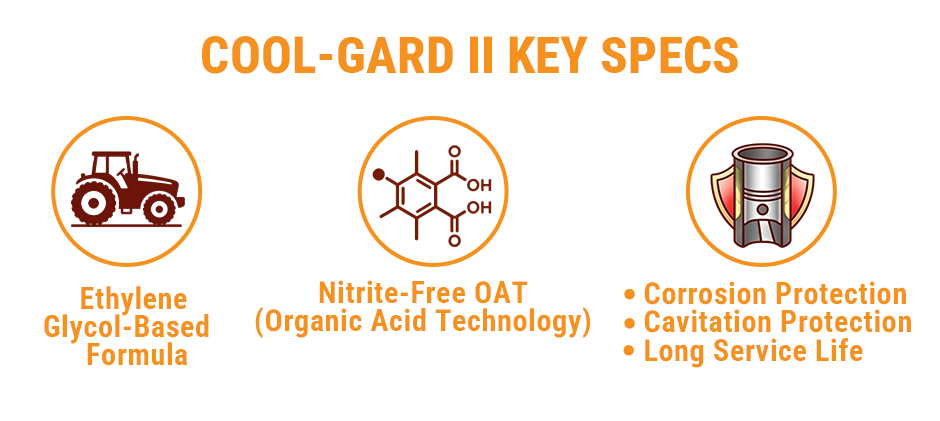
Cool-Gard II is antifreeze made for hardworking diesel engines. It runs on OAT organic acid protection, which doesn’t wear down fast. John Deere rates it to last 6 years or 6,000 hours of use. Key specs:
- Base: Made with ethylene glycol, the common base for heavy-duty coolants
- Technology: Nitrite-free OAT mix, easy to tell by its red/gold strawberry shade
- Purpose: Protect all metal parts from rust, and block liner cavitation — the biggest risk for wet-sleeve diesel engines
What’s cavitation? Engine vibration creates tiny bubbles against the cylinder liner. When these bubbles burst, they chip away small bits of metal. After enough wear, the liner gets holes. Coolant seeps into combustion chambers, and the whole engine fails completely.
What Coolants Are Compatible with John Deere Cool-Gard?
A coolant is compatible with Cool-Gard II if it meets the same performance specifications, regardless of the brand on the bottle. Don’t judge compatibility by coolant color. Always check the label to make sure it passes these three key rules:
- Made for heavy-duty diesel engines: Coolants meant for regular cars don’t have strong enough additives. Diesels run hotter, hold more pressure, and need extra protection that passenger vehicle coolant can’t offer.
- Nitrite-free OAT or P-OAT formula: Your replacement coolant has to use Organic Acid Technology (OAT) or Phosphated Organic Acid Technology (P-OAT). This uses a similar coolant technology to John Deere Cool-Gard II.
- Complies with ASTM D7583: ASTM D7583 is the official test standard for stopping cylinder liner cavitation, built to copy John Deere’s own engine tests. If a coolant label says it meets ASTM D7583, it delivers the cavitation shield your diesel engine needs.
Any coolant that meets all three of these criteria can be considered a Cool-Gard II equivalent.
John Deere Cool-Gard II Equivalents
Based on the specific chemical profiles, here are the top-tier aftermarket fluids that can directly replace John Deere products:
| Original John Deere Product | Chemical Classification | Top Compatible Aftermarket Alternatives |
|---|---|---|
| Cool-Gard (Conventional) | IAT (Inorganic Additive / Classic Green) |
|
| Cool-Gard II (Extended Life) | Non-Nitrited OAT (Strawberry Red/Gold) |
|
Never use RV antifreeze as engine coolant, even if it’s pink or red. It’s made for winterizing RV water systems, not cooling engines. It doesn’t have the additives needed to protect a heavy-duty diesel engine from corrosion, overheating, or cavitation.
How to Safely Change Coolants?
You cannot simply drain the old coolant and pour in the new, especially when switching brands or types. To prevent chemical reactions and ensure the new coolant performs as it should, a full system flush is mandatory.
1. Safety First
Wait until the engine cools down all the way. Put on safety goggles and gloves too; coolant is poisonous if touched or ingested.
2. Drain Every Drop of Old Coolant
Open the radiator drain valve and all drain plugs on the engine block to empty all the old coolant out of the system.
3. Flush the System with Regular Tap Water
Seal all drain openings, then fill the cooling system with tap water. Start the engine and run it for 10 to 15 minutes while turning the heater to its hottest setting. The running water will flow through every part and wash away leftover old coolant residue.
4. Drain and Repeat the Flushing Step
Let the engine cool off again, then drain all the water out. Keep repeating this full flush cycle until the water you drain runs completely clear with no discoloration.
5. Do One Last Flush with Distilled Water
Use distilled water for your final flush step. Tap water contains minerals that can leave scale and buildup inside your cooling system over time, and distilled water gets rid of those leftover minerals. Drain all of this distilled water entirely when finished.
6. Fill the System with Your New Coolant
Close every drain plug and valve tightly. If you purchased concentrated coolant, mix it half-and-half with distilled water before pouring it in. Pre-mixed coolant can go straight into the radiator with no mixing needed.
Bleed Trapped Air Out of the Cooling System
Take off the radiator cap, start the engine, and let it idle. Once the thermostat opens up, the coolant level inside the radiator will drop. Keep adding more coolant until the liquid level stays steady and no air bubbles rise to the top. Put the radiator cap back on, then check and adjust the fluid level in the overflow reservoir.
Conclusion
The right replacement coolant can protect your engine just as well as John Deere Cool-Gard, as long as it meets the proper specifications. Before switching to a different coolant, flush the cooling system thoroughly to help avoid compatibility issues.
Need cooling system parts for your John Deere equipment? FridayParts offers reliable aftermarket radiators, water pumps, thermostats, coolant reservoirs, and more—all at competitive prices.
