

Using a John Deere tractor size chart? Start with your hardest everyday job rather than property size. A small acreage can still justify a larger tractor if you’re handling bales, running a loader, or pulling heavy attachments. Too much tractor, though, burns through money quickly. The chart below lists each John Deere series by power, size, and typical use so you can narrow your options before buying.
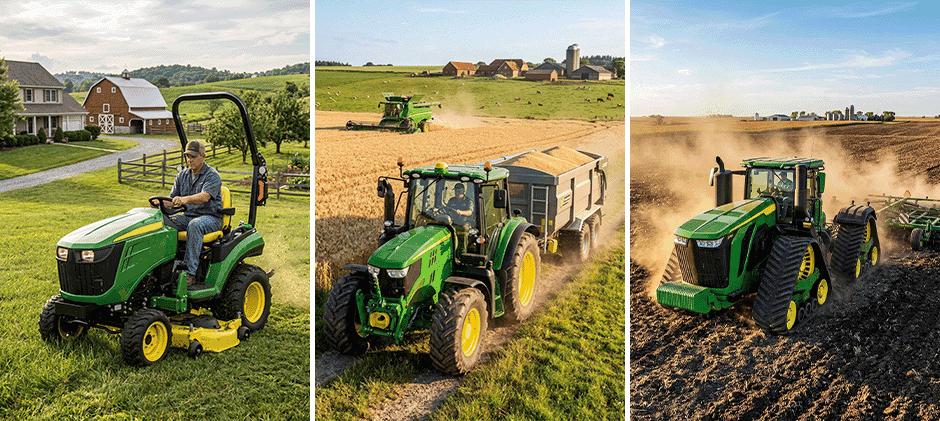
John Deere Tractor Size Chart By Series
This John Deere tractor size chart gives you a quick view of the main tractor groups, their power range, and the kind of work they suit best.
Table 1: Compact Tractors (1–4 Series) — Homeowners and Small Properties
| Model Series | Engine HP | PTO HP | Lift Capacity lbs | Tractor Type | Typical Uses |
|---|---|---|---|---|---|
| 1 Series | 21.5 to 23.9 | 15 to 18.2 | About 758 | Sub-compact | Mowing, light hauling, yard work |
| 2 Series | 24.2 to 37 | 18.2 to 23.5 | About 915 to 1,356 | Compact utility | Gardening, loader work, snow removal |
| 3 Series | 25 to 46 | 18 to 37 | About 1,200 to 2,200 | Compact utility | Tilling, digging, medium chores |
| 4 Series | 43 to 75 | 32.5 to 60 | About 2,200 to 2,500 | Compact utility | Land prep, rotary cutting, heavier attachments |
Table 2: Utility Tractors (5–6 Series) — Livestock and Mixed Farming
| Model Series | Engine HP | PTO HP | Lift Capacity lbs | Tractor Type | Typical Uses |
|---|---|---|---|---|---|
| 5E Series | 50 to 100 | 37 to 64 | About 3,200 to 4,000 | Utility tractor | Pasture mowing, feeding, baling |
| 5M Series | 75 to 130 | 57.7 to 115 | 5,150 to 12,516 | Mid-size utility | Loader work, hay, livestock, row crop support |
| 6E Series | 105 to 135 | 85 to 115 | About 5,400 to 6,000 | Utility / field tractor | Hay, planting support, loader tasks |
| 6M Series | 95 to 250 | Up to about 197 | About 6,400 to 9,000 | Full-size utility | Mixed farming, field and loader work |
| 6R Series | 110 to 260 | 84 to 204 | About 7,900 to 12,000 | Premium row crop | Precision work, planting, transport |
Table 3: Row Crop & 4WD Tractors (7–9 Series + Specialty) — Commercial and Large-Scale Farms
| Model Series | Engine HP | PTO HP | Lift Capacity lbs | Tractor Type | Typical Uses |
|---|---|---|---|---|---|
| 7R Series | 230 to 350 | About 180 to 264 | About 15,000 to 20,000 | Row crop | Seeding, tillage, large acreage |
| 8R Series | 230 to 540 | 200 to 489 | About 20,000 to 22,000 | Row crop | Large planters, high-acre fieldwork |
| 8RX Series | 310 to 540 | 280 to 489 | About 16,950 | Four-track row crop | Wet fields, low compaction work |
| 9R Series | 390 to 640 | 335 to 340 | About 15,000 to 20,000 | 4WD articulated | Heavy tillage, large-scale farming |
| 9RT Series | 470 to 640 | about 340 | About 20,000 | Two-track tractor | Soft soil, broad-acre heavy draft work |
| 9RX Series | 470 to 640 | about 340 | About 20,000 | Four-track tractor | Extreme traction, very heavy field work |
| Specialty Series | 75 to 105 | 60 to 85 | About 2,700 to 3,500 | Narrow / high-crop | Orchards, vineyards, specialty rows |
A chart is useful, but it only works if you connect size to real jobs. That is where many buyers miss the mark.
What John Deere Tractor Sizes Mean For Daily Work?
When you use a John Deere tractor size chart, do not stop at engine horsepower. You also need to look at:
- PTO horsepower for mower, baler, tiller, and blower work
- Hydraulic flow for loader speed and attachments
- Lift capacity for pallets, bales, and heavy rear tools
- Tractor weight and wheelbase for stability
- Frame size for turning room and transport
- Tire or track setup for traction and soil pressure
A 50 HP tractor and a 50 HP tractor do not always perform the same way. One may be light and compact for loader work around buildings. Another may be heavier and better suited to pulling ground-engaging tools.
This is also where planned maintenance matters. A stronger machine often needs stronger support parts, from hydraulic pump parts to tractor filters and starter motors, especially when loader work or long PTO hours are part of daily use.
Model Numbers Make Size Easier To Read
John Deere model names usually tell you quite a lot:
- First number or family shows the series
- Middle numbers often point to approximate horsepower
- Final letter shows trim level
For example:
- 5075E = 5 Series, about 75 HP, economy trim
- 5105M = 5 Series, about 105 HP, mid-level trim
- 6R 250 = 6R Series, about 250 HP, premium row-crop class
- 9RX 640 = 9 Series, four-track machine, 640 HP class
In simple terms:
- E usually means basic and cost-focused
- M means mid-range with more capability
- R means premium features and more technology
- RT means two-track
- RX means four-track
How To Choose The Right Size?
Acreage matters, but chores matter more. Ten acres of lawn care is one thing. Ten acres with gravel hauling, manure handling, and round bales is another.
For 3 Acres Or More
Look at 1 Series or small 2 Series tractors.
Best fit for:
- Mowing
- Light snow work
- Mulch and soil moving
- Garden tilling
- Light rear blade work
These are easy to store and simple to run. If garage space is tight, this part of the John Deere tractor size chart is usually the starting point.
For 10 Acres Or More
Look at 2 Series, 3 Series, or 4 Series.
Best fit for:
- Loader work
- Larger finish mowing
- Box blade grading
- Post hole digging
- Light brush cutting
If your work changes with the season, this is often the sweet spot. You can also support routine upkeep with tractor electrical parts and cooling system parts that fit many compact and utility models.
For 10 To 100 Acres With Real Farm Chores
Look at 5E, 5M, and some 6E tractors.
Best fit for:
- Feeding cattle
- Moving round bales
- Hay tools
- Pasture clipping
- Hauling wagons
- Medium loader work
This is where weight, rear lift, and PTO power become more important than compact size.
For Commercial Field Work
Look at 6M, 6R, 7R, 8R, 8RX, and 9 Series models.
Best fit for:
- Planters
- Air seeders
- Tillage
- High-speed transport
- Precision farming
- Long seasonal working hours
At this level, uptime becomes a major cost factor. Keeping fuel system parts, alternators, and engine rebuild parts on hand can reduce downtime during peak field windows.
Quick Recommendations By Job Type
Sometimes the fastest way to use a John Deere tractor size chart is to start with the main task, not the series.
| Main Job | Recommended Series |
|---|---|
| Lawn care and light snow removal | 1 Series, 2 Series |
| Landscaping and loader work | 2 Series, 3 Series |
| Digging, grading, heavier attachment work | 3 Series, 4 Series |
| Pasture mowing and small hay work | 5E Series |
| Livestock feeding and daily farm chores | 5M Series, 6E Series |
| Mixed farm field and loader work | 6M Series |
| Precision row crop and transport | 6R Series |
| High-acre seeding and tillage | 7R Series, 8R Series |
| Wet fields with lower compaction needs | 8RX Series, 9RX Series |
| Heavy draft work on very large acreage | 9R Series, 9RT Series, 9RX Series |
| Orchards and vineyards | Specialty models |
John Deere Tractor Size Ranges For Typical Buyers
Here is a simple buying view based on common needs.
Small Property And Yard Work
Choose 1 Series or 2 Series. You get easy operation, compact storage, and enough power for mowing, snow work, and light hauling.
Rural Property And Hobby Farm
Choose 3 Series or 4 Series. You gain stronger loader performance, better ground engagement, and a wider attachment range.
Livestock, Hay, And Utility Farm Work
Choose 5E, 5M, or 6E. These are strong all-around tractors for feeding, moving bales, and daily work.
Mixed Farming And Precision Field Work
Choose 6M or 6R. This range suits operators who need both field ability and loader usefulness.
Large Acre Row Crop And Heavy Draft Work
Choose 7R, 8R, 8RX, 9R, 9RT, or 9RX. These machines are meant for scale, traction, and serious field output.
Final Words
A tractor that is well matched to the job will save time, handle tools better, and usually cost less to own in the long run. That is the real value of using a John Deere tractor size chart the right way. When maintenance comes up, FridayParts is a convenient option for aftermarket parts across many equipment categories.
