

For a quick check of Kubota tractor weights, the models listed here range from 1,404 lb to 5,027 lb in base form. BX sub-compacts are the lightest in the lineup. B and LX models carry more weight. Standard L and MX tractors move up another level, while M series machines occupy a class of their own. When hauling, traction, or loader work is part of the job, weight is one of the first specs to look at. The Kubota tractor weight chart below makes those comparisons simple.
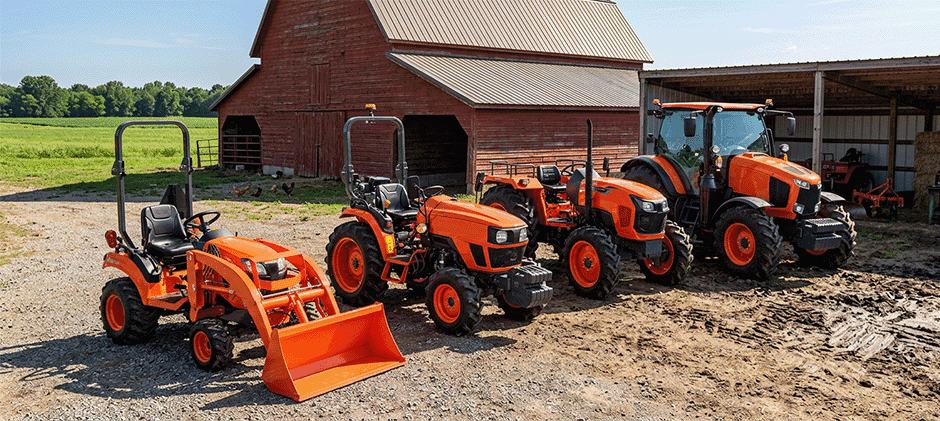
Kubota Tractor Weight By Series
Here is the quick range by series:
- BX Series: 1,404 to 1,520 lb
- B01 Series: 1,433 to 1,632 lb
- LX Series: 2,154 to 2,624 lb
- L Standard Series: 2,601 to 3,428 lb
- MX Series: 3,474 to 3,734 lb
- M Series: 5,005 to 5,027 lb
That gives you the basic weight of kubota tractor by class. Still, the final operating weight can be much higher once you add a loader, rear attachment, loaded tires, or ballast. If you plan to improve traction or front balance, quality tractor weight kits and durable front ballast parts can make setup more predictable.
Kubota Tractor Weight Chart
BX Series
BX tractors are the lightest Kubota tractors in this group. They fit small properties, mowing, light loader work, and snow cleanup.
| Model | Base Weight lb | Base Weight kg |
|---|---|---|
| BX1880 | 1404 | 637 |
| BX2380 | 1454 | 660 |
| BX2680 | 1520 | 689 |
BX Series Weight Notes:
- Best for mowing and light property care
- Easier to trailer than larger compact tractors
- Can still gain a lot of weight with a loader and ballast box
If you are checking Kubota tractor weight for a BX, remember that even a light sub-compact can feel much heavier once you add implements. For owners maintaining these machines, BX series parts are widely available through aftermarket suppliers.
B01 Series
The B01 series gives you a compact size with more capability than BX models. These tractors are common for landscaping, loader work, and general acreage jobs.
| Model | Base Weight lb | Base Weight kg |
|---|---|---|
| B2301HSD | 1566 | 710 |
| B2601HSD | 1632 | 740 |
| B2601 | 1632 | 740 |
| B2401DT | 1521 | 690 |
| B2401DTN | 1433 | 650 |
B01 Series Weight Notes
- Base weight stays mostly in the mid-1,400 to low-1,600 lb range
- Narrow models can weigh less
- HST models are popular for loader and property work
For service and ballast planning, reliable compact tractor parts and well-matched steering components help support smoother daily use.
LX Series
LX tractors bridge the gap between compact size and heavier utility performance. This is where many owners start looking for more loader stability and stronger rear implement control.
| Model | Base Weight lb | Base Weight kg |
|---|---|---|
| LX3520DTN | 2154 | 977 |
| LX3520HSD | 2154 | 977 |
| LX4020HSD | 2191 | 994 |
| LX3520SUHSDC | 2249 | 1020 |
| LX3520HSDC | 2590 | 1175 |
| LX4020HSDC | 2624 | 1190 |
LX Series Weight Notes
- Open-station models start just above 2,100 lb
- Cab models move much closer to 2,600 lb
- Cab, tires, and loader setup can change handling a lot
This is also the point where tractor front weight options and loader-ready ballast solutions become more important for safe lifting and better rear traction.
Standard L Series
The Standard L line is one of the most searched categories for Kubota tractor weight because it covers a wide span of property and farm tasks. It also shows how much transmission choice can affect the base number.
| Model | Base Weight lb | Base Weight kg |
|---|---|---|
| L2502DT | 2601 | 1180 |
| L2502HST | 2833 | 1285 |
| L3302DT | 2734 | 1240 |
| L3302HST | 2778 | 1260 |
| L3902DT | 2767 | 1255 |
| L3902HST | 2778 | 1260 |
| L4802DT | 3296 | 1495 |
| L4802HST | 3428 | 1555 |
| L4701F 2WD | 3219 | 1460 |
| L4701DT 4WD | 3296 | 1495 |
| L4701HST 4WD | 3307 | 1500 |
Standard L Series Weight Notes
- L2502 models begin at 2601 lb
- L4802HST reaches 3428 lb
- HST versions are usually heavier than DT versions
- These tractors often gain substantial working weight with a loader and filled tires
A quick model view helps if you want a faster comparison:
| Model | Weight |
|---|---|
| L2502DT | 2601 lb |
| L2502HST | 2833 lb |
| L3302DT | 2734 lb |
| L3302HST | 2778 lb |
| L3902DT | 2767 lb |
| L3902HST | 2778 lb |
| L4802DT | 3296 lb |
| L4802HST | 3428 lb |
For tractors in this range, heavy-duty axle parts and dependable front-end components become more important once loader work becomes part of the routine.
MX Series
MX tractors step into a heavier class and are often chosen when compact tractors start to feel too light for regular loader work, field tasks, or larger implements.
| Model | Base Weight lb | Base Weight kg |
|---|---|---|
| MX4900 | 3474 | 1576 |
| MX5400 | 3734 | 1694 |
MX Series Weight Notes
- MX models are close to or above 3,500 lb before attachments
- A loader, filled tires, and rear ballast can raise total weight fast
- This class often offers a better balance for heavier jobs without moving all the way to a larger farm tractor
If you are deciding between a larger L and an MX, tractor weight is one of the most useful points to compare.
M Series
M series tractors move into utility farm territory. These machines start around 5,000 lb in base form and are meant for larger field and transport tasks.
| Model | Base Weight lb | Base Weight kg |
|---|---|---|
| M6060 4WD | 5005 | — |
| M7060 2WD | 5027 | — |
M Series Weight Notes
- Base weight starts above 5,000 lb
- Tire setup, ballast, cab, and implements can increase total operating weight quickly
- Trailer and axle planning matters much more at this level
For this class, M series replacement tractor parts and high-quality weight mounting hardware help support long service life under heavier loads.
What Changes The Final Weight
The published spec is only part of the picture. Your real weight of kubota tractor depends on the full configuration.
The main weight changes come from:
- front loader and bucket
- loaded rear tires
- wheel weights
- front suitcase weights
- rear ballast box
- backhoe
- rotary cutter, tiller, or box blade
- cab versus open station
- 2WD versus 4WD
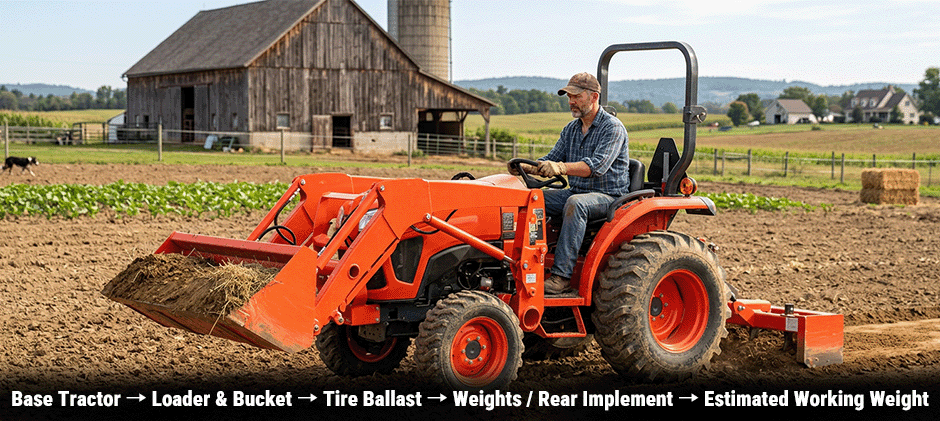
A Kubota tractor’s weight is the base tractor plus the full working setup.
Why Weight Matters?
Tractor weight affects more than transport. It changes daily performance.
Better Traction
More weight can improve grip during pulling, grading, tilling, and loader digging.
Better Stability
Balanced ballast helps keep the rear planted and reduces front-end overload.
Less Or More Ground Impact
Lower weight is easier on lawns and softer soil. Higher weight usually improves grip, but it can leave deeper tracks.
Trailer And Hauling Needs
Base tractor weight is never the full transport number. Fuel, bucket, ballast, and rear implements all count.
Wear On Key Parts
Extra load increases stress on:
- tires
- hubs
- axles
- steering linkage
- front support parts
That is one reason affordable aftermarket tractor parts matter for machines that carry ballast or loader attachments on a regular basis.
How To Estimate Working Weight
You can get much closer to the real number with a simple checklist:
- Start with the base tractor weight
- Add the loader and bucket
- Add loaded tire ballast if installed
- Add front or rear cast weights
- Add the rear implement or ballast box
- Add fuel, chains, and tools
This method is much more useful than relying on the bare tractor spec alone, especially if you are sizing a trailer or checking front axle load.
Final Words
A weight chart earns its keep when it helps with real choices—transport, ballast, and tractor setup. Split clearly by series, this Kubota tractor weight chart lets you compare models faster and see the differences that actually matter. If aftermarket parts or related components are on your list, FridayParts is a practical place to look as you build your setup.
Also Read:
How Much Does a Tractor Tire Weigh? Weight by Size and Type
