

Error codes popping up on your engine? It’s quite serious because these codes affect the drivability of the vehicle and the performance of the engine. Ignoring these DTC codes might lead to further engine malfunction and damage. In this guide, we’ll talk about everything about the P0345 code, including the causes, symptoms, and easy fixes.
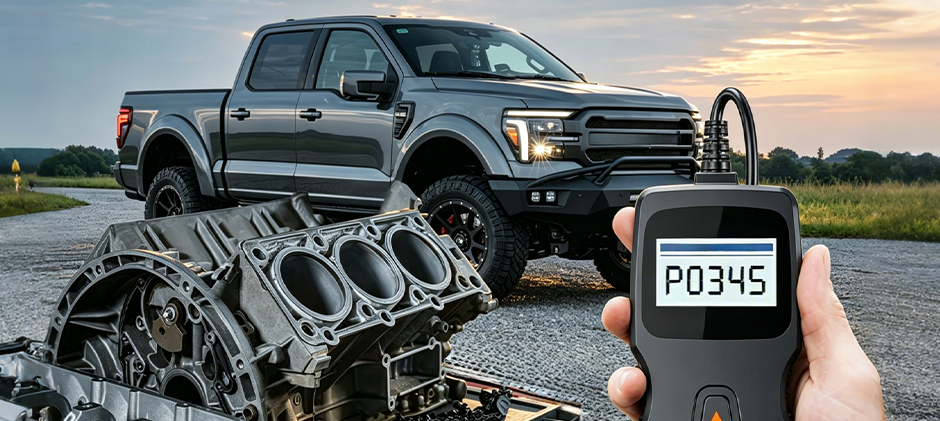
What Does P0345 Mean?
A P0345 code points towards a problem in the camshaft position sensor (CMP) circuit of the engine’s bank 2. Simply put, your vehicle’s computer (PCM) isn’t getting the right signal from the camshaft position sensor on the side of the engine that doesn’t have cylinder #1. The CP, sensor measures the exact rotational position and speed as well as the position of the camshaft to help the ECM to control the ignition spark and the fuel injector timing. When something goes wrong here, the PCM sets the P0345 code to let you know there’s a problem that needs quick attention. If you’re a DIYer planning to fix P0345 yourself, continue reading to learn the common causes of code P0345.
9 Causes of DTC Code P0345
Like all OBD-II codes, there are a handful of usual suspects in terms of P0345. Proper diagnosis and repair can only start once the root cause has been found. The typical causes are as follows:
- A faulty camshaft position sensor bank 2
- Wiring issues like damaged, corroded, or loose connectors or a short/open in the harness
- A faulty crankshaft position sensor (CKP)
- Misaligned or worn-out timing components like a stretched timing chain or damaged timing gears
- Variable Cam Timing (VTC) Solenoid
- Bad battery
- Faulty starter motor or starting system circuit problem
- A malfunctioning powertrain control module (PCM) or outdated engine control software.
- Outdated engine control module (ECM) software (very very rare)
This error code usually happens on brands like Ford, Nissan and Toyota.
7 Common Symptoms with P0345 Code
If your Ford vehicle has a P0345 code active, you may notice these obvious signs when driving:
- Check engine light coming on
- Rough idling, stalling or even engine misfire
- Engine hard to start, or not start at all
- Engine may start just fine one time and not the next
- A loss of power when accelerating
- Sluggish performance
- Increased fuel consumption
Please note that a failed cam position sensor on Bank 2 of an engine with 2 banks will always store this code (or a P0340), but there may be no other noticeable symptoms.
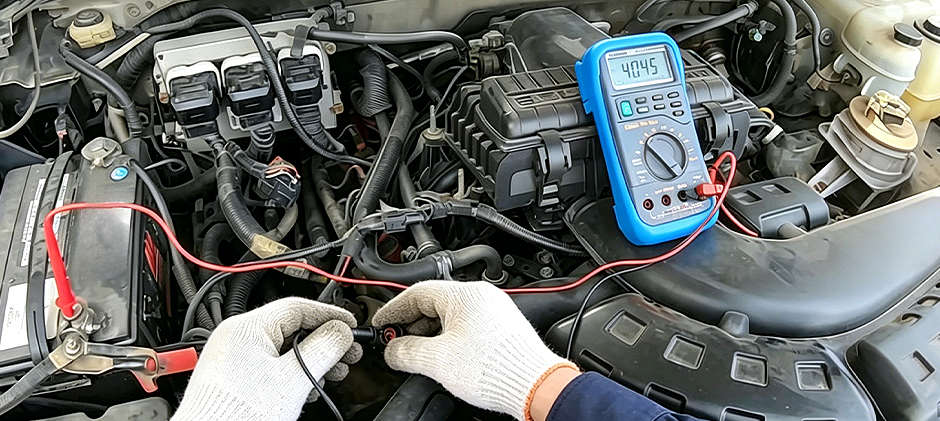
Step-by-Step Diagnosis for OBD-II Code P0345
Diagnosing the P0345 code can be challenging because you’ll have to narrow down the exact cause from the list of all possible causes.
- Pop the hood and zero in on the wiring and connector going to the camshaft position sensor on bank 2
- Look for anything out of the ordinary-frayed wires, green crusty corrosion or loose connectors. Usually, you can solve the problem by unplugging and reseating the connectors.
- Grab your scan tool, confirm the code and see if there are other codes related to the crankshaft sensor or timing
- If the wiring looks solid, pull out your multimeter for a cam sensor test on voltage and resistance.
- Make sure your vehicle’s distributor or synchronizer is set up just right
- Move on to the timing components of the sensor passes the test by checking the timing chain or belt for looseness and gears for chewing up
- Consider the PCM or engine computer if all that checks out
- Have someone help you when poking around under the hood or cranking the engine for certain tests
If you’re unsure of how to go about the process of diagnosis or you’re not that confident with your DIY automotive repair skills, go to your trusted mechanic to have the issue checked.
Want to diagnose the problem yourself? You can watch the video below to refresh your knowledge on the P0345 code: Ford 5.4L 3v Triton Engine P0340 P0344 P0345 PO349: Always Inspect These Items First!
Cost to Diagnose the P0345 Ford code
To diagnose the P0345 code on your Ford, it typically requires one hour of labor. And the rates vary by location, vehicle and shop. Generally, it will charge $100 to $160 per hour. The charge may be higher at dealers. So you can turn to reliable independents for less.
How Do I Fix Code P0345 Ford F150?
Replacing the camshaft position sensor is not a guaranteed fix for the P0345 code. It indicates an issue in any part of the circuit, including the CPS, the wiring or even the PCM. The only way to address it is to review the possible P0345 causes and visually examine the corresponding wiring harness and connectors. Check for damaged components and inspect connector pins for signs of being broken, bent, pushed out, or corroded.
Always refer to the repair manuals and other reliable sources for the right solution. The repair process may also vary depending on your vehicle’s make and model. So, be sure to research confirmed fixes specific to your vehicle. If you have any doubts, don’t hesitate to contact your mechanic.
Code Tech Notes
In some models, low battery voltage or a weak starter can trigger a Camshaft Position Sensor code.
There is a factory service bulletin for the following Ford models:
- 2005-2006 Ford Mustang
- 2004-2005 Ford F-150
- 2005-2006 Ford Expedition
- 2005-2006 Ford F-Super Duty
- 2006 Ford Explorer
- 2007 Ford Explorer Sport Trac
Avoid Common Mistakes When Fixing P0345?
For all folks running into P0345 issues:
- Don’t jump to replacing the camshaft position sensor without checking the wiring or connectors.
- Never overlook the crankshaft position sensor, which can also trigger this code
- Don’t forget to inspect the timing components if your mileage is high
- Always check for alignment and use the right tools during replacement
- Don’t skip any steps
Where Is the Cam Position Sensor Located?
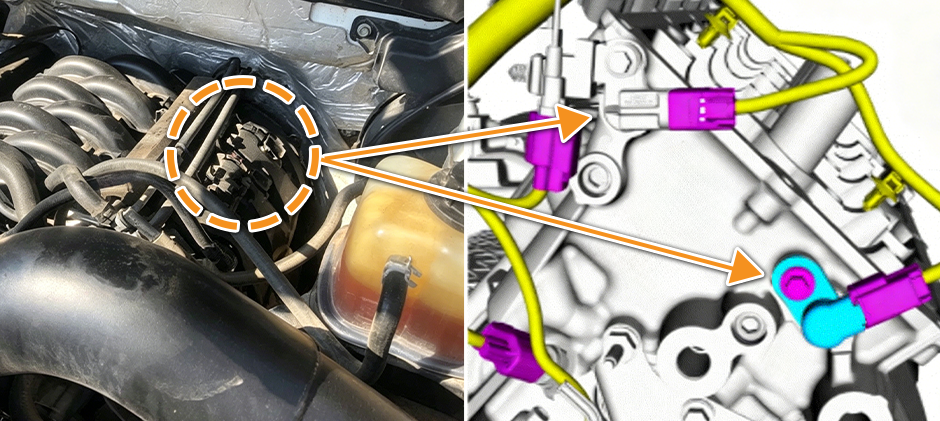
Need the location of cam sensor A Bank 2? The sensor is located on the driver’s side (left side) of the engine, at the very back of the cylinder head. There are 2 sensors on that side. It is not easy to access and you may need to lay across the top of the engine to reach it. See the following picture to find it.
Camshaft Position Sensor Replacement Procedure
Here is a cam sensor replacement procedure of 2014 FORD F-150 for your reference. That’s what Roy said on 2carpros.
Before You Start
- Park your vehicle on level ground
- Ensure engine is off and emergency brake is set
- Allow the engine to cool completely
Tools
- Replacement CMP Sensor
- Socket Set & Ratchet
- Screwdriver Set
- Dielectric Grease
- Engine Oil or WD-40
- Shop Towel
- OBD-II Scanner
- Safety Gloves & Glasses
- High-lift Transmission Jack
Removal
Both RH and LH intake Camshaft Position (CMP) sensors and RH exhaust CMP (Camshaft Position) sensor
1. Disconnect the Camshaft Position (CMP) sensor electrical connector.
2. Remove the bolt and the CMP (Camshaft Position) sensor.
LH exhaust Camshaft Position (CMP) sensor
3. Position the vehicle on a hoist. For additional information, refer to vehicle Jacking and Lifting.
4. If equipped with 4 wheel drive, index-mark the front flange to the pinion flange.
5. If equipped with 4 wheel drive, remove the 6 front flange-to-pinion flange bolts and 2 washers and position the driveshaft aside.
Discard the 6 bolts and 2 washers
6. Remove the 2 bolts and the LH heat shield from the rear of the LH cylinder head.
7. Disconnect the CMP (Camshaft Position) sensor electrical connector.
8. Remove the 2 transmission support insulator nuts.
9. Remove the CMP (Camshaft Position) bolt.
NOTE: Make sure the transmission jack contacts the outer ribs of the transmission fluid pan. Position a suitable high-lift transmission jack under the transmission. Raise the transmission until the CMP (Camshaft Position) sensor can be removed. Remove the CMP (Camshaft Position) sensor.
Installation
LH exhaust Camshaft Position (CMP) sensor
1. NOTE: The bolt must be torqued while the transmission is raised
Position the Camshaft Position (CMP) sensor and install the bolt.
Tighten to 10 Nm (89 lb-in).
2. Using the suitable high-lift transmission jack, lower the transmission and install the 2 transmission support insulator nuts.
Tighten to 103 Nm (75 lb-ft).
3. Connect the CMP (Camshaft Position) sensor electrical connector.
4. Position the LH heat shield onto the rear of the LH cylinder head and install the 2 bolts.
Tighten to 10 Nm (89 lb-in).
5. If equipped with 4 wheel drive, position back the driveshaft, align the index mark and install 2 washers and 6 new bolts.
Tighten to 55 Nm (41 lb-ft).
Both RH and LH intake CMP (Camshaft Position) sensors and RH exhaust CMP (Camshaft Position) sensor
6. Position the CMP (Camshaft Position) sensor and install the bolt.
Tighten to 10 Nm (89 lb-in).
7. Connect the CMP (Camshaft Position) sensor electrical connector.
FAQs about P0345 Code
What does the OBDII code P0345 for Ford indicate?
The code P0345 indicates a problem with the Camshaft Position Sensor ‘A’ Circuit Bank 2 in the vehicle.
How serious is P0345?
A P0345 code can lead to poor engine performance, stalling, or even leave you stranded if the engine won’t start. If left unchecked, it can cause further damage to the engine and costly repairs for things like bent valves and damaged pistons.
Can I drive with P0345 code?
No. It’s not recommended to drive the vehicle with the P0345 code present. It can lead to further engine performance issues and potential damage.
What are the possible causes of the P0345 code in a Ford vehicle?
Possible causes include a faulty camshaft position sensor, wiring issues, sensor connection problems, or a damaged sensor.
Conclusion
The P0345 code means your engine’s computer isn’t getting the right signal from the camshaft position sensor on bank 2. It can seriously mess with how your Ford runs. Diagnosing it should be a top priority, starting with basic wiring checks and sensor testing, and moving on to timing components if needed. If ignored, it can lead to bigger, more expensive problems. The most reliable way to tackle it is to check each possible cause and fix what’s going wrong, rather than just swapping parts at random. At Friday, you can explore a vast selection of quality camshaft position sensors, crankshaft position sensors as well as other sensing components. Don’t wait-address this code as soon as possible to keep your vehicle running safely and reliably.
Articles You Might Also Like
How to Replace the Camshaft Sensor Right?
6 Signs of a Bad Camshaft Position Sensor and How to Test It?
