

Buying the skid steer loader is just the first check you write. The harder part is figuring out which skid steer attachment to buy first, which one pays for itself fastest, and how to keep from frying an expensive hydraulic motor on day one. That is exactly what this guide covers. No fluff, no product catalog, just a practical buying order that makes sense for real work.
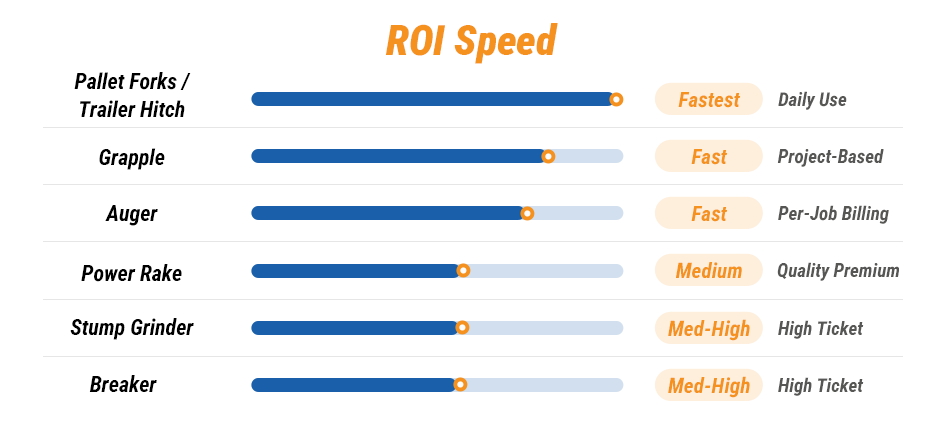
Which Attachment Pays Off Fastest?
Pallet forks and a trailer hitch usually deliver the fastest ROI. For many owners, this is the first skid steer attachment setup that starts paying back right away. The reason is simple. It gets used almost every day.
A basic pallet fork set plus a trailer hitch is also relatively affordable compared with many hydraulic tools. Yet the use cases are constant:
- unloading pallets
- moving materials around the yard
- lifting bundles, seed, pipe, and fencing
- loading trucks
- repositioning trailers without using a pickup
That mix of low cost and high use is hard to beat. A brush cutter may feel more powerful. A mulcher may look more impressive. But most machines make money faster with a fork frame and a hitch because those tools solve daily problems.
Grapple Attachment
A grapple attachment is often next in ROI, especially for land clearing, storm cleanup, and brush work. A bucket moves dirt well. A grapple handles limbs, roots, broken fencing, logs, and loose debris much faster. If the work includes cleanup more than finish grading, a grapple often earns its keep sooner than a second bucket.
Auger Attachment
An auger attachment also has clear payback. Fence crews, landscapers, and acreage owners can bill auger work by the hole or by the project. Post holes, tree planting, footings, and sign installation create direct revenue. That makes augers one of the easiest tools to justify after the first daily-use attachments are covered.
Breaker Attachment and Stump Grinder Attachment
Then there are the higher-ticket specialty tools. A breaker attachment can be very profitable in demolition and concrete removal. A stump grinder attachment can bring strong project revenue in tree work and land clearing. Still, both tend to be used less often than forks, buckets, or grapples. They can make good money, but not always fast money.
Power Rake Attachment
A power rake attachment sits in the middle. It may not run every day on every crew, but it can improve finish quality and help win higher-margin grading or seedbed prep jobs. That means ROI often comes from better job quality and faster completion rather than simple frequency.
ROI Comparison Table
| Attachment | Typical ROI Speed | Best Use Case | Flow Required |
|---|---|---|---|
| Pallet Forks (with optional hitch) | Fastest, daily use | Material handling, loading, moving trailers | None (Mechanical) |
| Grapple | Fast, project-based | Land clearing, debris cleanup | Standard |
| Auger | Fast, per-job billing | Fencing, planting, footings | Standard |
| Power Rake | Medium, quality premium | Final grading, seedbed prep | Standard |
| Stump Grinder | Medium-High, high ticket | Tree removal, land clearing | Standard or High Flow |
| Breaker | Medium-High, high ticket | Demolition, concrete work | Standard or High |
A simple rule helps here.
- Buy the tool that solves the most frequent task.
- Buy the tool that can be billed often.
- Buy the specialty tool only after the daily-use setup is covered.
That is why pallet forks and a trailer hitch stay at the top of the list. They are not the most exciting skid-steer attachment option. They are often the smartest first investment.
For upkeep, routine checks on hydraulic hoses, cutting edges, and fork frames help protect ROI over time. Small service items matter because downtime eats profit fast.
Best First Attachments by Business Type
The best buying order depends on the work being billed. That is where many new owners go wrong. They buy the attachment they like most, not the one the business needs first.
A landscaping crew usually needs grading and finish work before specialty clearing tools. A land clearing crew needs to grab and cut first. A farm may use forks more than anything else. The first three purchases should match the work that happens every week.
Buying Priority by Business Type
| Business Type | 1st Buy | 2nd Buy | 3rd Buy |
|---|---|---|---|
| Landscaping | Bucket | Power Rake | Grapple |
| Land Clearing | Grapple | Brush Cutter | Stump Grinder |
| General Construction | Bucket | Pallet Forks | Breaker |
| Farm or Acreage | Pallet Forks | Bucket | Auger |
| Snow Removal | Snow Pusher | Bucket | Broom |
Landscaping
- Bucket first. It is still the core skid-steer attachment for loading, light grading, soil moving, and cleanup.
- Power rake second. This adds finishing capability for seedbed prep and final surface work.
- Grapple third. This helps with brush, roots, and debris when cleanup work starts to grow.
Land Clearing
- Grapple first. It handles brush and debris faster than a standard bucket.
- Brush cutter second. This turns the machine into a productive cutting tool for overgrowth and small trees.
- Stump grinder third. This adds a higher-value service once clearing volume is steady.
General Construction
- Bucket first. Dirt work still comes first on many sites.
- Pallet forks second. These help with unloading, moving materials, and site logistics.
- Breaker or auger third. Choose based on job type. Concrete removal points to a breaker. Footings and signs point to an auger.
Farm Or Acreage
- Pallet forks first. They are often the most useful attachment on the property.
- Bucket second. This covers mulch, gravel, feed, snow, and general loading.
- Auger third. Fence building, tree planting, and post-work make this an easy next step.
Snow Removal
- Snow pusher first. It moves volume fast and keeps winter work efficient.
- Bucket second. It still helps with piles and mixed material.
- Broom third. This cleans up hard surfaces and helps finish commercial sites.
A practical note belongs here. Buying order matters more than brand count. Three high-use tools with reliable replacement parts beat six specialty tools that sit idle.
The Most Expensive Mistake: Standard Flow vs. High Flow
Flow mismatch is one of the fastest ways to waste money on a skid steer attachment. It also causes some of the most avoidable—and expensive—hydraulic damage.
Start with the basic classification:
No Auxiliary Flow (Mechanical Attachments – 0 GPM)
These tools connect to the loader arm and quick-tach but do not plug into the machine’s auxiliary hydraulic lines:
- standard dirt buckets
- pallet forks
- non-hydraulic snow pushers and bale spears
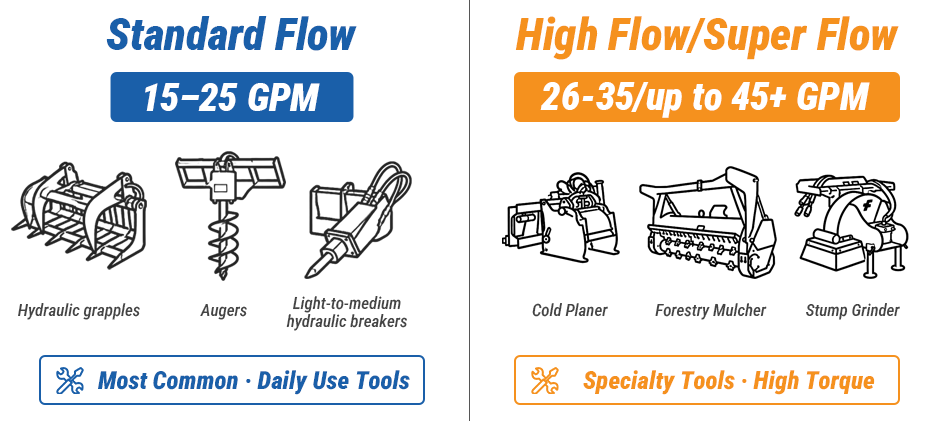
Standard Flow (approx. 15 to 25 GPM)
This is the factory baseline on virtually every standard skid steer and compact track loader (CTL). It operates at standard system pressures (around 3,000–3,300 PSI) and is designed for cylinder-driven or moderate-torque tools:
- hydraulic grapples
- augers
- light-to-medium hydraulic breakers
- hydraulic power rakes and angle brooms
- light-duty rotary brush cutters
High Flow (approx. 26 to 35+ GPM / Super Flow up to 45+ GPM)
High flow is an optional hydraulic package that provides the extra volume and hydraulic horsepower required by continuous-duty, high-rpm rotary attachments:
- forestry mulchers
- high-output stump grinders
- cold planers (asphalt milling)
- heavy-duty dual-stage snow blowers
- rock saws and high-production wheel trenchers
Why Flow Matching Matters
Underpowering (High-Flow Tool on Standard-Flow Machine):
If you connect a high-flow attachment to a standard-flow machine, it will suffer from severe performance loss or stall out under the slightest load. Owners often assume the attachment is defective when, in reality, the machine simply cannot deliver the required GPM.
Overpowering (Standard-Flow Tool on High-Flow Mode):
The opposite mistake is far more catastrophic. Forcing high-flow auxiliary output into a motor rated only for standard flow will drastically overspeed the motor, generate extreme heat, blow internal seals, or crack the motor housing within minutes.
The Crucial Third Line (Case Drain):
Many continuous-rotation high-flow attachments (like mulchers and cutters) require a dedicated case drain line to relieve internal backpressure from high-inertia spinning components. If this third small hose is disconnected or improperly routed, the motor’s shaft seal can blow almost instantly on shutdown.
Before buying, always verify:
- Machine auxiliary output (GPM) and operating pressure (PSI)
- Attachment hydraulic motor minimum/maximum GPM rating
- Case drain requirement
- Auxiliary coupler sizes (standard 1/2″ vs. high-flow 3/4″ or 5/8″ flat-face couplers) and pin-mount dimensions
This is also where hydraulic motors, seal kits, and drive components matter. The right fit protects performance. The wrong fit creates repair bills.
Buy vs. Rent: A Simple Rule
Buy attachments that support weekly work. Rent tools that only fit rare projects. This rule keeps capital focused on tools that stay productive.
Buy It If
- It gets used every week
- It is easy to maintain
- It supports a core service line
- It helps complete jobs faster with your current crew
Rent It First If
- It will be used fewer than five times a year
- It is tied to seasonal or one-off jobs
- Repair costs are high if something goes wrong
- Demand is not proven yet
This is why many owners should buy forks, buckets, grapples, and augers early. Those tools support repeated work. A mulcher or large breaker may be the better long-term move later, but often not as the first specialty purchase.
For ownership costs, plan for wear parts, teeth, cutting tools, and hydraulic hose assemblies before making the decision.
5 Mistakes That Cost New Owners Money
Most early attachment mistakes are simple and preventable. These five show up again and again.
- Buying on price, not duty rating – A low-cost tool can fail fast if the work is too heavy.
- Choosing the wrong width – Too wide reduces efficiency. Too narrow adds extra passes.
- Forgetting wear-part costs – Teeth, edges, hoses, and pins should be part of the budget.
- Assuming every quick-attach mount is the same, always verify mount style and machine fit.
- Buying a specialty tool before daily-use tools — Forks, buckets, and grapples — often creates value sooner.
A final check before purchase helps avoid regret:
- What job will this attachment do next week
- How often will it be billed
- What service items will it need
- Does the machine have the right flow and capacity
Final Words
The best skid steer attachment is usually the one used most often, not the one with the biggest specs. Start with daily-use tools that keep the machine earning every week, then add higher-margin specialty tools as work grows. For ongoing uptime, FridayParts can help with affordable aftermarket parts, broad brand compatibility, and a large inventory that supports many heavy equipment owners.
