

The correct Toyota forklift oil type depends entirely on the system: engines typically use SAE 30 or 5W-30 motor oil, hydraulic systems require ISO VG 32, and transmissions need a Dexron II equivalent. In this guide, we break down the precise fluid specifications for every system. Keep reading to find exactly what your machine needs to stay on the job.
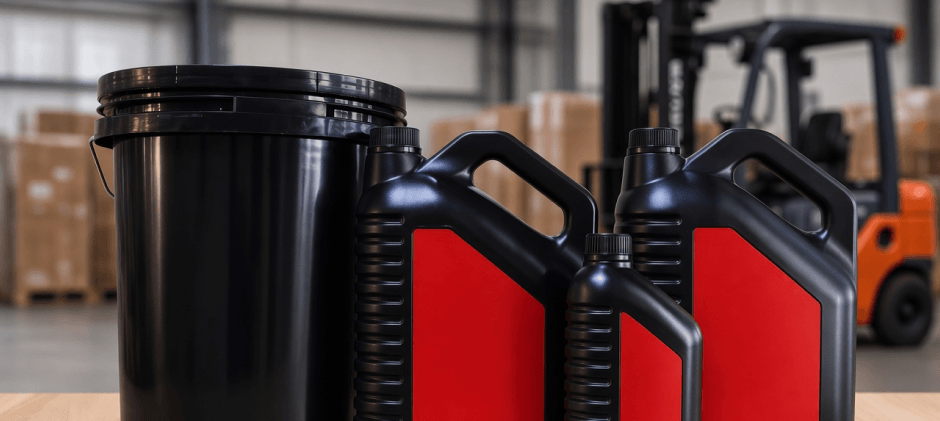
Toyota Forklift Oil and Fluid Specifications
To keep your equipment operating at its best, you must use the right lubricants for each specific part of the machine. Before we look at the exact fluids, let us define a few technical terms you will see on the labels:
- API (American Petroleum Institute): This group classifies lubricants based on their performance level. It tells you if the oil meets the standards for specific engine designs.
- SAE (Society of Automotive Engineers): This rating measures the viscosity, or thickness, of the oil.
- ISO VG (International Standardization Organization Viscosity Grade): This is another way to measure how thick a lubricant is, mostly used for hydraulic fluids.
To make finding your exact Toyota forklift oil type easier, we have compiled the standard fluid requirements for 7-series and 8-series models into a quick-reference table below:
| Forklift System / Part | Recommended Fluid Type | Required Specification / Rating |
|---|---|---|
| Gasoline Engine | Standard Motor Oil | SAE 30 or SAE 5W-30 (API: SH, SJ, SL, SM) |
| Diesel Engine | Diesel Engine Oil | SAE 30 or SAE 5W-30 (API: CE, CF, CF-4) |
| Transmission | Transmission Fluid | Dexron II equivalent |
| Differential Gear | Hypoid Gear Oil | SAE 85W-90 (API: GL-4) |
| Hydraulic System | Hydraulic Oil | ISO VG 32 |
| Brake Lines | Brake Fluid | SAE J-1703 or DOT-3 |
| Brake Cooling | Tractor Transmission Fluid | Shell DONAX TD equivalent |
| Chassis Parts | Multi-Purpose (MP) Grease | Molybdenum disulfide grease |
| Cooling System | Engine Coolant | 30-50% mixture for winter; rust inhibitor for other seasons |
“Using the exact fluid specifications recommended by the manufacturer is the single best way to extend the lifespan of your heavy equipment.”
How Often Should You Change Oil in a Toyota Forklift?
Knowing the right oil type for your Toyota forklift is only half the battle — you also need to know when to swap it out. For typical everyday work, we suggest changing the engine oil every 250 operating hours.
That 250‑hour interval is just a general guideline, though. You’ll want to change your fluids more frequently if you run the forklift in tough conditions. If your warehouse is really dusty, or you work outside in sweltering heat or freezing cold, the oil will wear out much faster. Hauling heavy loads also puts extra strain on the engine, so the oil loses its protective properties sooner.
It’s a good idea to keep up with a maintenance log. Write down the hour‑meter reading each day. Once you get near the 250‑hour mark, book in your service. If you wait too long, the oil turns into sludge. This clogs up filters and can damage internal engine components.
What Fluid Levels to Check Before Operating a Forklift?
When you do your pre‑operation walk‑around inspection, check all these fluid levels to make sure the forklift is good to go for heavy‑duty work:
- Fuel level: Make sure you’ve got enough fuel to get through your whole shift without stopping mid‑job.
- Engine oil and engine coolant: If either one runs too low, your engine will overheat really fast and end up with serious internal damage.
- Brake fluid: Low brake fluid could leave you unable to stop the loaded, heavy forklift. That’s a big safety risk for you and everyone else working in the warehouse.
- Hydraulic fluid: When hydraulic fluid is low, the lifting mast will feel jerky, sluggish, or stop working entirely. You could end up dropping your load.
How to Check Oil Levels on a Toyota Forklift?
Checking the oil is easy, but you need to do it right to get an accurate reading.
- Park your forklift on flat ground. If it’s sitting on a slope, the oil shifts inside the oil pan and you’ll get a wrong reading. Lower the forks all the way down to the floor, shut off the engine, and set the parking brake.
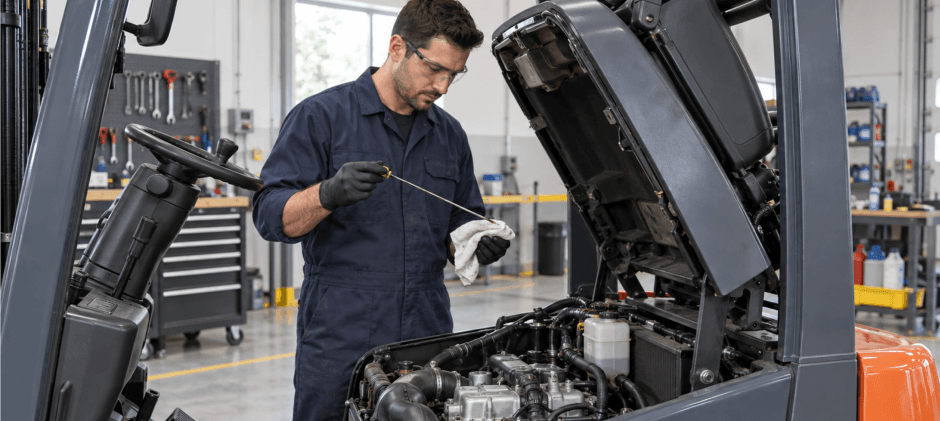
- Open the engine hood and find the engine oil dipstick. Pull it out and wipe it all the way clean with a lint‑free rag. Push the dipstick fully back down into the tube, then pull it out again.
- Check the marks at the end of the dipstick. The oil level should land between the “Low” and “Full” lines. If the oil sits below the “Low” mark, add the right Toyota forklift oil until you hit the correct level. Don’t overfill it. Too much oil creates foam and cuts down on lubrication.
What Happens If You Use the Wrong Oil in a Toyota Forklift?
Putting the wrong fluid into your equipment starts a whole string of mechanical problems. Every system in your machine needs fluid with the right thickness and chemical formula to work properly.
- If you go with oil that’s too thin, it won’t coat all the moving metal parts well enough. Metal components will rub and grind against one another, building up lots of heat and friction. This will wreck your engine bearings and cylinders pretty quickly. On the flip side, oil that is too thick won’t get pumped through the system fast enough. The engine won’t get enough lubrication right when you start it up, which causes lots of extra wear.
- Using the wrong hydraulic fluid is just as harmful. Hydraulic systems depend on precise pressure. If you use anything other than ISO VG 32, the seals inside your hydraulic cylinders may swell up, crack, or start leaking. You’ll lose lifting strength, and your load could drop unexpectedly, which is dangerous.
- Mixing different kinds of fluids can also trigger bad chemical reactions. The additives from two different oils may fight against each other, turning the mix into a thick, useless gel. Always follow the exact fluid specs to keep your machine running safely.
Toyota Forklift Oil Type FAQs
Can I use standard car motor oil in my forklift?
You’re able to run regular car motor oil in a gas‑powered forklift engine, as long as it meets the exact SAE viscosity (such as 5W‑30) and API rating listed in your owner’s manual. That said, diesel forklift engines need dedicated heavy‑duty diesel engine oil.
What does ISO VG 32 mean for my hydraulics?
ISO VG is short for International Standardization Organization Viscosity Grade. The number 32 tells you how thick the fluid is. This is a highly‑refined oil built to hold up under high‑pressure conditions without foaming, so it works great for lifting heavy loads.
Can I mix synthetic and conventional oil?
You can blend them in a pinch for an emergency, but we don’t advise doing it. Mixing the two waters down the advantages of synthetic oil and can change the overall viscosity. Your best bet is to drain out all the old fluid first, then refill with one consistent Toyota forklift oil.
Conclusion
Maintaining your equipment with the correct fluids ensures a long, productive life for your machinery. When you need replacement components to keep up that maintenance, FridayParts carries quality aftermarket replacement parts for your Toyota forklift. We stock a wide selection of reliable parts to help you keep your lift truck running smoothly.
