

If you’re a devoted fanboy of John Deere machines, you’ve probably relied on the green Cool-Gard to keep your engine running smooth and cool. But for years, you’ve likely noticed it’s nowhere to get this green fluid. That’s because it was replaced with upgraded John Deere Cool Gard 2. In this guide, we’ll break down the key differences between Cool-Gard and Cool-Gard II, explain why the upgrade was necessary and discuss other things related to cool gard 2.
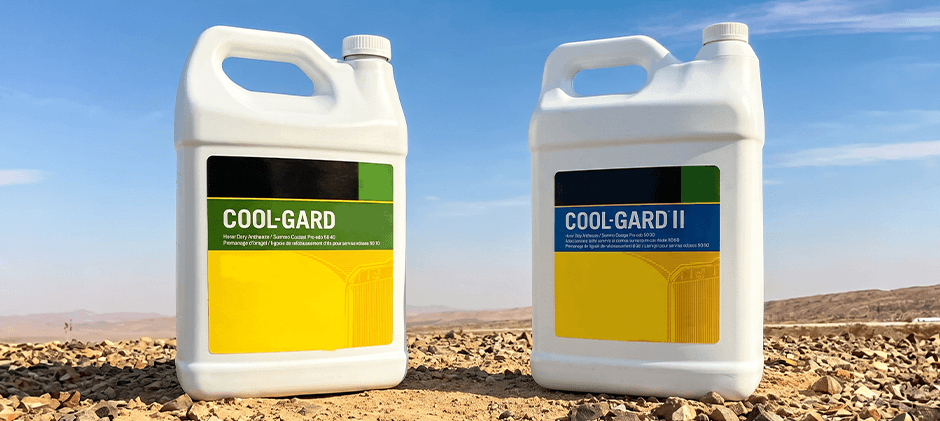
Cool-Gard vs Cool-Gard II: What’s the Difference?
Cool-Gard and Cool-Gard II represent two generations of coolants developed by John Deere for their heavy-duty agricultural machinery, construction equipment and turf care equipment. The transition from Cool-Gard to Cool-Gard II is not merely a change of color. There are key differences in their chemical formulations, service intervals and protective performance. Let’s take a closer look at the table below.
| Dimensions | John Deere Cool Gard | John Deere Cool Gard 2 |
|---|---|---|
| Fluid Color | Green | Amber/ Yellow |
| Chemical Formula | Inorganic additive technology (IAT)Requires regular addition of supplemental coolant additives | Advanced organic acid technology (OAT)Completely nitrite-free |
| Ingredients | Ethylene glycol 107-21-1Diethylene glycol 111-46-6Sodium tetraborate 12179-04-3Pentahydrate inhibitor (No number) | Ethylene glycol 107-21-1Diethylene glycol 111-46-6Sodium tetraborate pentahydrate inhibitor 12179-04-3 |
| Service Life | 5 years/5000 hours | 6 years/6000 hours |
| Cavitation Protection | Good(Requires regular testing and manual addition of cavitation additives/SCAs) | Excellent(Provides permanent wet-sleeve liner cavitation protection with zero SCAs required) |
| Boiling Point(50/50 Pre-Mix) | Approx. 108°C (226°F) | 113°C (235°F) |
| Engine Compatibility | Legacy Engines(Naturally aspirated or lightly turbocharged diesel engines) | Modern Engines(High-emission standard, high-heat, and heavy-duty engines equipped with EGR) |
Why John Deere Cool Gard Upgrades to John Deere Cool Gard 2?
In this part, let’s dive into the details. There are real experiences and views from Cool Gard users on the forum.
Change of Color and Formula
On forums, when many owners see John Deere Cool-Gard II turn amber/yellow, their first reaction is “These two look almost the same on the ingredient list, is it just old wine in a new bottle?” Some even complain about why Deere didn’t keep the original green. But if you dig into their MSDS(material safety data sheets) or consult your chemical engineers, you’ll find there is a great change.
- Cool Gard: It uses a typical low-silicate, nitrite-containing formula. To avoid the situation where high-frequency vibration of the cylinder causes bubbles to form and burst in the outer water jacket, eating away the cylinder block (known as wet cylinder liner cavitation), Cool-Gard relies heavily on nitrites and nitrates. You must use test strips and pour in a small bottle of supplementary coolant additive to prevent cavitation.
- Cool-Gard 2: John Deere removed nitrites in this generation due to environmental regulations in certain countries and regions and turned to organic acid technology(OAT). As revealed by a Deere’s chemical engineer, the second generation uses a “Tri-OAT” formula. The three organic acids complement each other to form an extremely stable microscopic protective film on the metal surface. That means these organic acids can last for up to 6 years with little consumption and you needn’t add any SCA at all for permanent anti-cavitation protection for wet cylinder liners.
Adapting to the High Temperatures
Modern John Deere engines that meet Tier 4 or Stage V emission standards are widely equipped with an EGR system to reduce pollution. The system routes extremely hot exhaust gases into the cooling system, making the local operating temperatures of the engine much higher than in the past.
- Cool Gard: The first-generation Cool-Gard was prone to oxidation and degradation under these extremely high temperatures and could even form scale and sludge inside the water passages.
- Cool-Gard 2: The second generation is specifically optimized for thermal stability under high temperatures. It offers higher heat transfer efficiency and stronger shear resistance, and will not produce deposits that clog the radiator even under extreme heat.
Service Life and Maintenance Costs
The transition to Cool-Gard 2 can help extend service life and save on maintenance costs.
- Cool Gard: Previously, when using the first generation, you had to completely drain the coolant every two years and refill the system. You also had to buy test strips to monitor the additive concentration in between.
- Cool Gard 2: Now, with Cool-Gard II, it is a single fill for 6 years or 6,000 hours of worry-free operation, which can drastically save you both the time and money on maintenance.
John Deere Cool Gard II Equivalent
John Deere Cool Gard II is a nitrite-free coolant with extended service life. Below are equivalents for Cool Gard II.
- Shell Rotella Ultra ELC (Gold Standard)
- Valvoline Zerex Extended Life
- Final Charge NOAT
- Cummins FleetGuard ES Compleat OAT
- Peak Fleet Charge
See What Coolant Is Compatible with John Deere Cool-Gard?
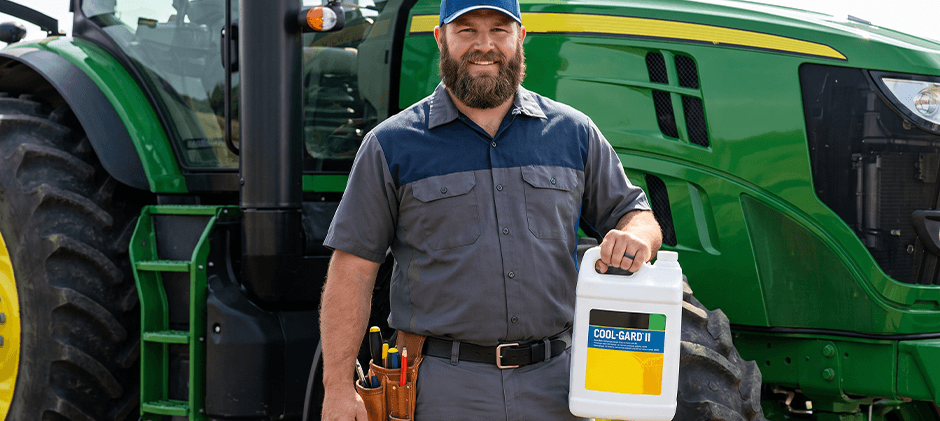
How to Choose the Right Coolant for Your Tractor?
The best way to determine the correct coolant for your John Deere tractor is to consult your owner’s manual, where it will specify the type of coolant recommended by the manufacturer. You can also find this information online or by contacting your local dealers. Here are some general guidelines for you:
- Choose conventional green (IAT) coolant for older tractors produced before the 1990s
- Opt for OAT or HOAT coolant for newer tractors built in the 1990s and later
- Consider NOAT coolant for added cylinder protection if your tractor runs on a diesel engine
Can I Mix Coolant Colors?
Never mix different types of coolants/antifreezes unless the manufacturer explicitly states it’s safe to do so. Mixing incompatible coolants can lead to undesirable issues, like corrosion, sludge formation and reduced cooling performance. If you are not sure what type is currently in your tractor, it’s best to flush the system and refill it with the correct type.
See Related
How to Do A Coolant Flush on My Tractor?
Is Coolant the Same as Antifreeze?
Coolant and antifreeze are not exactly the same kind of fluid. Coolant is a diluted form of antifreeze. They have the same base ingredient – usually monoethylene glycol (MEG) or mono propylene glycol (MPG). But there is the addition of de-ionised water and other additives like corrosion inhibitors in the coolant.
Coolant with a higher concentration of antifreeze is designed to give your engine some added protection in the winter. It does this by lowering the freezing temperature of the coolant, preventing freezing when the engine is off. As standard, coolant is 50% antifreeze, but you can buy coolant with a higher concentration for extreme temperatures. See a complete guide here.
How to Mix Antifreeze?
From above, we know coolant and antifreeze aren’t the same thing. Antifreeze must be mixed with water to create a coolant solution. Generally, the ideal ratio is 50/50 antifreeze and water, which provides protection down to -34°F (-36°C). In colder climates, you can use a 60/40 antifreeze-to-water ratio for increased freeze protection, but never exceed 70% antifreeze, as this can reduce heat transfer efficiency. You must use distilled or deionized water for mixing antifreeze, because tap water contains minerals that can lead to scale buildup and corrosion. You can also search for premixed 50/50 antifreeze, eliminating the need for mixing. Keep this in mind: Always wear gloves and eye protection during this procedure, as antifreeze is toxic and can be harmful if absorbed through the skin. So, keep antifreeze out of reach of children and pets.
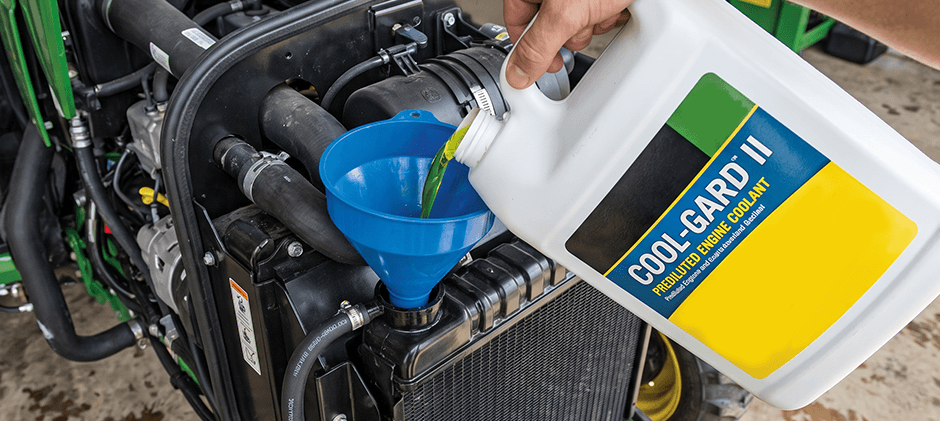
Maintaining Your John Deere Tractor’s Cooling System
Regular cooling system maintenance is essential for preventing overheating and extending the life of your engine. Here are some tips for you to follow:
- Regularly check coolant level in the radiator and overflow tank, especially before and after heavy use
- Inspect hoses and belts for cracks, leaks, and swelling and replace them when necessary
- Flush the cooling system every two to five years, depending on the type of antifreeze used and the operating conditions
- Do a pressure test for your cooling system periodically to check for leaks in the radiator, hoses, water pump, or engine block
- Check radiator cap for damage and replace it with quality tractor radiator caps if necessary
Final Words
Understanding engine coolant is essential for keeping your John Deere tractor running smoothly and preventing costly repairs. It’s recommended to check and refill the coolant regularly. Always refer to your owner’s manual when it comes to changing your coolant and avoid mixing coolant colors and mixing coolant without protective gear. FridayParts does not provide coolant for John Deere, but we offer a vast selection of cooling system parts and aftermarket John Deere tractor parts to keep your Deere back to its optimal performance.
